Event submissions
Published
This submission belongs to the session A. Food Technology and Engineering of the event The 6th International Electronic Conference on Foods
Published date
27 Oct, 2025
Academic Editor
'%3e%3cpath%20d='M12.6657%2010.9104C12.4185%2010.325%2012.0599%209.79327%2011.6097%209.34482C11.1609%208.89508%2010.6293%208.5365%2010.0442%208.28888C10.0389%208.28626%2010.0337%208.28495%2010.0285%208.28233C10.8446%207.69279%2011.3752%206.73249%2011.3752%205.64904C11.3752%203.8542%209.92103%202.39999%208.1262%202.39999C6.33136%202.39999%204.87715%203.8542%204.87715%205.64904C4.87715%206.73249%205.40774%207.69279%206.22393%208.28364C6.21869%208.28626%206.21345%208.28757%206.20821%208.29019C5.62129%208.5378%205.09463%208.89284%204.64265%209.34613C4.1929%209.79493%203.83432%2010.3266%203.58671%2010.9117C3.34345%2011.4845%203.21226%2012.0987%203.20023%2012.7209C3.19988%2012.7349%203.20233%2012.7488%203.20744%2012.7619C3.21255%2012.7749%203.22022%2012.7867%203.22998%2012.7968C3.23975%2012.8068%203.25142%2012.8147%203.26431%2012.8202C3.2772%2012.8256%203.29105%2012.8284%203.30504%2012.8284H4.09109C4.14874%2012.8284%204.19459%2012.7825%204.1959%2012.7262C4.2221%2011.7148%204.62823%2010.7676%205.34617%2010.0497C6.08899%209.30683%207.0755%208.89808%208.1262%208.89808C9.17689%208.89808%2010.1634%209.30683%2010.9062%2010.0497C11.6242%2010.7676%2012.0303%2011.7148%2012.0565%2012.7262C12.0578%2012.7838%2012.1037%2012.8284%2012.1613%2012.8284H12.9474C12.9613%2012.8284%2012.9752%2012.8256%2012.9881%2012.8202C13.001%2012.8147%2013.0126%2012.8068%2013.0224%2012.7968C13.0322%2012.7867%2013.0398%2012.7749%2013.0449%2012.7619C13.0501%2012.7488%2013.0525%2012.7349%2013.0522%2012.7209C13.0391%2012.0947%2012.9094%2011.4855%2012.6657%2010.9104ZM8.1262%207.9024C7.52486%207.9024%206.9589%207.6679%206.53312%207.24211C6.10733%206.81633%205.87283%206.25037%205.87283%205.64904C5.87283%205.0477%206.10733%204.48174%206.53312%204.05596C6.9589%203.63018%207.52486%203.39567%208.1262%203.39567C8.72753%203.39567%209.29349%203.63018%209.71927%204.05596C10.1451%204.48174%2010.3796%205.0477%2010.3796%205.64904C10.3796%206.25037%2010.1451%206.81633%209.71927%207.24211C9.29349%207.6679%208.72753%207.9024%208.1262%207.9024Z'%20fill='%235D1EE1'/%3e%3c/g%3e%3c/svg%3e) Cristobal Aguilar
Cristobal AguilarCitation
Silvana Cecilia Ruiz, Yesica Gramajo Dominguez, Sofía A. Villarreal, Abel Emilio Azar, Gabriela S. Corbalan, Veronica A. Medina, Elisa Mariana García, Effect of bioinputs on the crop performance and overall quality of watermelon (Citrullus lanatus) produced in Santiago del Estero, Argentina, in Proceedings of The 6th International Electronic Conference on Foods, 28 October–30 October 2025, MDPI: Basel, Switzerland
Share
Email
Facebook
Twitter
LinkedIn
Effect of bioinputs on the crop performance and overall quality of watermelon (Citrullus lanatus) produced in Santiago del Estero, Argentina

Silvana Cecilia Ruiz 1
'%3e%3cpath%20d='M12.6647%2010.9104C12.4176%2010.325%2012.0589%209.7933%2011.6088%209.34485C11.16%208.89511%2010.6283%208.53653%2010.0432%208.28891C10.038%208.28629%2010.0327%208.28498%2010.0275%208.28236C10.8437%207.69282%2011.3743%206.73252%2011.3743%205.64907C11.3743%203.85423%209.92005%202.40002%208.12522%202.40002C6.33038%202.40002%204.87618%203.85423%204.87618%205.64907C4.87618%206.73252%205.40677%207.69282%206.22296%208.28367C6.21772%208.28629%206.21248%208.2876%206.20724%208.29022C5.62031%208.53783%205.09365%208.89287%204.64167%209.34616C4.19192%209.79496%203.83334%2010.3266%203.58573%2010.9117C3.34247%2011.4846%203.21128%2012.0987%203.19925%2012.721C3.1989%2012.735%203.20135%2012.7489%203.20646%2012.7619C3.21157%2012.7749%203.21924%2012.7868%203.22901%2012.7968C3.23877%2012.8068%203.25045%2012.8148%203.26334%2012.8202C3.27623%2012.8256%203.29007%2012.8284%203.30406%2012.8284H4.09012C4.14776%2012.8284%204.19362%2012.7825%204.19493%2012.7262C4.22113%2011.7148%204.62726%2010.7676%205.34519%2010.0497C6.08802%209.30686%207.07452%208.89811%208.12522%208.89811C9.17592%208.89811%2010.1624%209.30686%2010.9052%2010.0497C11.6232%2010.7676%2012.0293%2011.7148%2012.0555%2012.7262C12.0568%2012.7839%2012.1027%2012.8284%2012.1603%2012.8284H12.9464C12.9604%2012.8284%2012.9742%2012.8256%2012.9871%2012.8202C13%2012.8148%2013.0117%2012.8068%2013.0214%2012.7968C13.0312%2012.7868%2013.0389%2012.7749%2013.044%2012.7619C13.0491%2012.7489%2013.0515%2012.735%2013.0512%2012.721C13.0381%2012.0947%2012.9084%2011.4856%2012.6647%2010.9104ZM8.12522%207.90243C7.52388%207.90243%206.95792%207.66793%206.53214%207.24215C6.10636%206.81636%205.87185%206.2504%205.87185%205.64907C5.87185%205.04773%206.10636%204.48177%206.53214%204.05599C6.95792%203.63021%207.52388%203.3957%208.12522%203.3957C8.72655%203.3957%209.29252%203.63021%209.7183%204.05599C10.1441%204.48177%2010.3786%205.04773%2010.3786%205.64907C10.3786%206.2504%2010.1441%206.81636%209.7183%207.24215C9.29252%207.66793%208.72655%207.90243%208.12522%207.90243Z'%20fill='%235D1EE1'/%3e%3c/g%3e%3c/svg%3e)
Yesica Gramajo Dominguez 1
Sofía A. Villarreal 2
Abel Emilio Azar 1
Gabriela S. Corbalan 2
Veronica A. Medina 2
Elisa Mariana García 2,3
1. Instituto Nacional de Tecnología Agropecuaria, Estación Experimental Agropecuaria Santiago del Estero, Santiago del Estero, G4200, Argentina
2. Instituto de Ciencias Químicas. Facultad de Agronomía y Agroindustrias. Universidad Nacional de Santiago del Estero, Santiago del Estero, G4200, Argentina
3. Consejo Nacional de Investigaciones Científicas y Técnicas (CONICET), Ciudad Autónoma Buenos Aires C1033AAJ, Argentina
Abstract
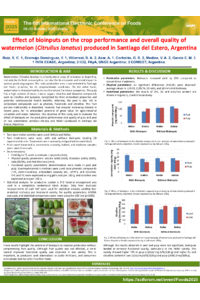
The objective of this study was to evaluate the effect of bioinputs on the productive performance and quality of two watermelon varieties—Delicia and Hollar—produced in Santiago del Estero, Argentina. A 2×2 factorial arrangement was used in a completely randomized block design, with two watermelon varieties and two treatments (with and without bioinputs), totaling 20 experimental units. Treatments were randomly assigned within each block. Fruits were harvested at commercial maturity, halved, and triplicate samples were taken from each. Data from duplicate measurements of each half were used for statistical analysis, yielding four analytical replicates per treatment–variety. Yield (kg ha⁻¹) was used to evaluate crop productivity. Physical quality parameters included soluble solids (%SS), titratable acidity (%TA), SS/TA ratio, and rind thickness (mm). The functional quality of peel and pulp was determined using spectrophotometric methods: total phenolic compounds (TPC, Folin–Ciocalteu), antioxidant capacity (AC, DPPH•), and citrulline. TPC and AC were expressed as mg gallic acid per 100 g, and citrulline was expressed as mg per 100 g. Statistical comparisons were made using the LSD test (p<0.05). Bioinputs increased yield by 23% compared to conventional treatments. No significant differences (P>0.05) were observed in physical parameters, with values around 11% SS, 0.2% TA, an SS/TA ratio of 52, and 18 mm rind thickness. Although not significant, bioinputs tended to enhance functional quality, particularly in the Hollar variety. This variety showed higher TPC in pulp (132±12 mg GAE/100 g) and higher AC and citrulline content in peel (23±2 mg GAE/100 g) and pulp (249±19 mg/100 g). These results highlight the potential of bioinputs to improve production without compromising fruit quality. Although fruit quality was not affected, a trend toward improved functional quality was observed in one variety. This is important, as producers seek alternatives to costly fertilizers, and consumers increasingly look for safer, healthier foods.
Keywords
Citrullus lanatus
bioinputs
yield
physical- functional quality.
Poster
sciforum-131467- Citrillus lanatus.pdf
Enhancing the Foaming Properties of Pea Protein through Enzymatic treatment and High-Pressure Homogenization
Fermented Plant-Based Milks: Effects of pH Value and Storage Conditions on Protein Stability