Event submissions
Published
This submission belongs to the session A. Food Technology and Engineering of the event The 6th International Electronic Conference on Foods
Published date
27 Oct, 2025
Academic Editor
'%3e%3cpath%20d='M12.6657%2010.9104C12.4185%2010.325%2012.0599%209.79327%2011.6097%209.34482C11.1609%208.89508%2010.6293%208.5365%2010.0442%208.28888C10.0389%208.28626%2010.0337%208.28495%2010.0285%208.28233C10.8446%207.69279%2011.3752%206.73249%2011.3752%205.64904C11.3752%203.8542%209.92103%202.39999%208.1262%202.39999C6.33136%202.39999%204.87715%203.8542%204.87715%205.64904C4.87715%206.73249%205.40774%207.69279%206.22393%208.28364C6.21869%208.28626%206.21345%208.28757%206.20821%208.29019C5.62129%208.5378%205.09463%208.89284%204.64265%209.34613C4.1929%209.79493%203.83432%2010.3266%203.58671%2010.9117C3.34345%2011.4845%203.21226%2012.0987%203.20023%2012.7209C3.19988%2012.7349%203.20233%2012.7488%203.20744%2012.7619C3.21255%2012.7749%203.22022%2012.7867%203.22998%2012.7968C3.23975%2012.8068%203.25142%2012.8147%203.26431%2012.8202C3.2772%2012.8256%203.29105%2012.8284%203.30504%2012.8284H4.09109C4.14874%2012.8284%204.19459%2012.7825%204.1959%2012.7262C4.2221%2011.7148%204.62823%2010.7676%205.34617%2010.0497C6.08899%209.30683%207.0755%208.89808%208.1262%208.89808C9.17689%208.89808%2010.1634%209.30683%2010.9062%2010.0497C11.6242%2010.7676%2012.0303%2011.7148%2012.0565%2012.7262C12.0578%2012.7838%2012.1037%2012.8284%2012.1613%2012.8284H12.9474C12.9613%2012.8284%2012.9752%2012.8256%2012.9881%2012.8202C13.001%2012.8147%2013.0126%2012.8068%2013.0224%2012.7968C13.0322%2012.7867%2013.0398%2012.7749%2013.0449%2012.7619C13.0501%2012.7488%2013.0525%2012.7349%2013.0522%2012.7209C13.0391%2012.0947%2012.9094%2011.4855%2012.6657%2010.9104ZM8.1262%207.9024C7.52486%207.9024%206.9589%207.6679%206.53312%207.24211C6.10733%206.81633%205.87283%206.25037%205.87283%205.64904C5.87283%205.0477%206.10733%204.48174%206.53312%204.05596C6.9589%203.63018%207.52486%203.39567%208.1262%203.39567C8.72753%203.39567%209.29349%203.63018%209.71927%204.05596C10.1451%204.48174%2010.3796%205.0477%2010.3796%205.64904C10.3796%206.25037%2010.1451%206.81633%209.71927%207.24211C9.29349%207.6679%208.72753%207.9024%208.1262%207.9024Z'%20fill='%235D1EE1'/%3e%3c/g%3e%3c/svg%3e) Cristobal Aguilar
Cristobal AguilarCitation
Idil Tekin, Fermented Plant-Based Milks: Effects of pH Value and Storage Conditions on Protein Stability, in Proceedings of The 6th International Electronic Conference on Foods, 28 October–30 October 2025, MDPI: Basel, Switzerland
Share
Email
Facebook
Twitter
LinkedIn
Fermented Plant-Based Milks: Effects of pH Value and Storage Conditions on Protein Stability

Idil Tekin 1
1. Science and Technology Application and Research Center, Dokuz Eylül University, 35390, Buca, İzmir, Türkiye
Abstract
Introduction
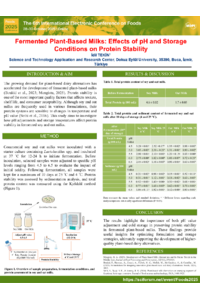
The growing demand for plant-based dairy alternatives has accelerated the development of fermented plant-based milks. Protein stability is one of the most important quality factors that affects texture, shelf life, and consumer acceptability. Although soy and oat milks are frequently used in various formulations, their protein systems are sensitive to changes in temperature and pH value. This study aims to investigate how pH adjustments and storage temperatures affect protein stability in fermented soy and oat milks.
Methods
Commercial soy and oat milks were inoculated with a starter culture containing Lactobacillus spp. and incubated at 37 °C for 12–24 hours to initiate fermentation. Before inoculation, selected samples were adjusted to specific pH levels ranging from 4.5 to 6.5 to evaluate the impact of initial acidity. Following fermentation, all samples were kept for a maximum of 10 days at 25 °C and 4 °C. Protein stability was assessed by sedimentation analysis, and total protein content was measured using the Kjeldahl method.
Results
Preliminary results indicate that samples adjusted to lower pH values (around 4.5–5.0) and stored at 4 °C exhibited significantly improved protein stability, with reduced sedimentation and better protein retention. In contrast, storage at 25 °C led to increased sediment formation and protein destabilization, especially in samples with higher initial pH values.
Conclusions
The results highlight the importance of both pH value adjustment and cold storage in preserving protein stability in fermented plant-based milks. These findings provide useful insights for optimizing formulation and storage strategies, ultimately supporting the development of higher-quality plant-based dairy alternatives.
Keywords
Plant-based
soy milk
oat milk
protein stability
Poster
Poster_134937_Fermented Plant-Based Milks Effects of pH and Storage Conditions on Protein Stability.pdf
Effect of bioinputs on the crop performance and overall quality of watermelon (Citrullus lanatus) produced in Santiago del Estero, Argentina
Techno-Functional and Antioxidant Properties of Plant and Insect-Based Flours