Event submissions
Published
This submission belongs to the session A. Food Technology and Engineering of the event The 6th International Electronic Conference on Foods
Published date
27 Oct, 2025
Academic Editor
'%3e%3cpath%20d='M12.6657%2010.9104C12.4185%2010.325%2012.0599%209.79327%2011.6097%209.34482C11.1609%208.89508%2010.6293%208.5365%2010.0442%208.28888C10.0389%208.28626%2010.0337%208.28495%2010.0285%208.28233C10.8446%207.69279%2011.3752%206.73249%2011.3752%205.64904C11.3752%203.8542%209.92103%202.39999%208.1262%202.39999C6.33136%202.39999%204.87715%203.8542%204.87715%205.64904C4.87715%206.73249%205.40774%207.69279%206.22393%208.28364C6.21869%208.28626%206.21345%208.28757%206.20821%208.29019C5.62129%208.5378%205.09463%208.89284%204.64265%209.34613C4.1929%209.79493%203.83432%2010.3266%203.58671%2010.9117C3.34345%2011.4845%203.21226%2012.0987%203.20023%2012.7209C3.19988%2012.7349%203.20233%2012.7488%203.20744%2012.7619C3.21255%2012.7749%203.22022%2012.7867%203.22998%2012.7968C3.23975%2012.8068%203.25142%2012.8147%203.26431%2012.8202C3.2772%2012.8256%203.29105%2012.8284%203.30504%2012.8284H4.09109C4.14874%2012.8284%204.19459%2012.7825%204.1959%2012.7262C4.2221%2011.7148%204.62823%2010.7676%205.34617%2010.0497C6.08899%209.30683%207.0755%208.89808%208.1262%208.89808C9.17689%208.89808%2010.1634%209.30683%2010.9062%2010.0497C11.6242%2010.7676%2012.0303%2011.7148%2012.0565%2012.7262C12.0578%2012.7838%2012.1037%2012.8284%2012.1613%2012.8284H12.9474C12.9613%2012.8284%2012.9752%2012.8256%2012.9881%2012.8202C13.001%2012.8147%2013.0126%2012.8068%2013.0224%2012.7968C13.0322%2012.7867%2013.0398%2012.7749%2013.0449%2012.7619C13.0501%2012.7488%2013.0525%2012.7349%2013.0522%2012.7209C13.0391%2012.0947%2012.9094%2011.4855%2012.6657%2010.9104ZM8.1262%207.9024C7.52486%207.9024%206.9589%207.6679%206.53312%207.24211C6.10733%206.81633%205.87283%206.25037%205.87283%205.64904C5.87283%205.0477%206.10733%204.48174%206.53312%204.05596C6.9589%203.63018%207.52486%203.39567%208.1262%203.39567C8.72753%203.39567%209.29349%203.63018%209.71927%204.05596C10.1451%204.48174%2010.3796%205.0477%2010.3796%205.64904C10.3796%206.25037%2010.1451%206.81633%209.71927%207.24211C9.29349%207.6679%208.72753%207.9024%208.1262%207.9024Z'%20fill='%235D1EE1'/%3e%3c/g%3e%3c/svg%3e) Elsa Gonçalves
Elsa GonçalvesCitation
Sofia Panzani, Francesca Venturi, Alessandro Bianchi, Pierina Dìaz Guerrero, Ylenia Pieracci, Guido Flamini, Giuseppe Ferroni, Isabella Taglieri, Chiara Sanmartin, What’s inside a “Metato”? The Case Study of Chestnut Flour Obtained by a Traditional Drying Method: Chemical, Aromatic, and Sensory Properties., in Proceedings of The 6th International Electronic Conference on Foods, 28 October–30 October 2025, MDPI: Basel, Switzerland
Share
Email
Facebook
Twitter
LinkedIn
What’s inside a “Metato”? The Case Study of Chestnut Flour Obtained by a Traditional Drying Method: Chemical, Aromatic, and Sensory Properties.
'%3e%3cpath%20d='M12.6647%2010.9104C12.4176%2010.325%2012.0589%209.7933%2011.6088%209.34485C11.16%208.89511%2010.6283%208.53653%2010.0432%208.28891C10.038%208.28629%2010.0327%208.28498%2010.0275%208.28236C10.8437%207.69282%2011.3743%206.73252%2011.3743%205.64907C11.3743%203.85423%209.92005%202.40002%208.12522%202.40002C6.33038%202.40002%204.87618%203.85423%204.87618%205.64907C4.87618%206.73252%205.40677%207.69282%206.22296%208.28367C6.21772%208.28629%206.21248%208.2876%206.20724%208.29022C5.62031%208.53783%205.09365%208.89287%204.64167%209.34616C4.19192%209.79496%203.83334%2010.3266%203.58573%2010.9117C3.34247%2011.4846%203.21128%2012.0987%203.19925%2012.721C3.1989%2012.735%203.20135%2012.7489%203.20646%2012.7619C3.21157%2012.7749%203.21924%2012.7868%203.22901%2012.7968C3.23877%2012.8068%203.25045%2012.8148%203.26334%2012.8202C3.27623%2012.8256%203.29007%2012.8284%203.30406%2012.8284H4.09012C4.14776%2012.8284%204.19362%2012.7825%204.19493%2012.7262C4.22113%2011.7148%204.62726%2010.7676%205.34519%2010.0497C6.08802%209.30686%207.07452%208.89811%208.12522%208.89811C9.17592%208.89811%2010.1624%209.30686%2010.9052%2010.0497C11.6232%2010.7676%2012.0293%2011.7148%2012.0555%2012.7262C12.0568%2012.7839%2012.1027%2012.8284%2012.1603%2012.8284H12.9464C12.9604%2012.8284%2012.9742%2012.8256%2012.9871%2012.8202C13%2012.8148%2013.0117%2012.8068%2013.0214%2012.7968C13.0312%2012.7868%2013.0389%2012.7749%2013.044%2012.7619C13.0491%2012.7489%2013.0515%2012.735%2013.0512%2012.721C13.0381%2012.0947%2012.9084%2011.4856%2012.6647%2010.9104ZM8.12522%207.90243C7.52388%207.90243%206.95792%207.66793%206.53214%207.24215C6.10636%206.81636%205.87185%206.2504%205.87185%205.64907C5.87185%205.04773%206.10636%204.48177%206.53214%204.05599C6.95792%203.63021%207.52388%203.3957%208.12522%203.3957C8.72655%203.3957%209.29252%203.63021%209.7183%204.05599C10.1441%204.48177%2010.3786%205.04773%2010.3786%205.64907C10.3786%206.2504%2010.1441%206.81636%209.7183%207.24215C9.29252%207.66793%208.72655%207.90243%208.12522%207.90243Z'%20fill='%235D1EE1'/%3e%3c/g%3e%3c/svg%3e)
Sofia Panzani 1

Francesca Venturi 1

Alessandro Bianchi 1

Pierina Dìaz Guerrero 1
Ylenia Pieracci 1
Guido Flamini 2
Giuseppe Ferroni 1
Isabella Taglieri 1

Chiara Sanmartin 1
1. Department of Agriculture, Food and Environment, University of Pisa, Via del Borghetto 80, 56124 Pisa, Italy
2. Department of Pharmacy, University of Pisa, Via Bonanno Pisano 12, 56126 Pisa, Italy
Abstract
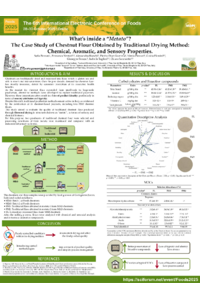
Chestnuts are traditionally dried and processed into flour, which is gluten-free and rich in starch and micronutrients. Over the past decade, demand for chestnut flour has steadily increased, driven by consumer perception of its associated health benefits. As the market for chestnut flour expanded from small-scale to large-scale production, alternative methods were developed to replace traditional processes. However, these innovations often result in a loss of product identity, particularly in terms of sensory attributes and typicity. Despite this shift, traditional production methods remain active in Italy, as evidenced by the certification of 15 chestnut-based products, including two PDO chestnut flours.
This study aimed at evaluating the quality of traditional chestnut flour produced through firewood drying in structures known as “metati”, in terms of sensory and chemical features. For this purpose, two producers of traditional chestnut flour were selected and the processing conditions of their metato were monitored.
The impact on flour was assessed through the analysis of water activity, dry matter, lipid content, starch, glucose, fructose, sucrose, ascorbic acid, total phenolic content, and antioxidant activity. Colorimetry, volatile organic compound (VOC) profiles, and descriptive sensory analysis were also performed.
Although the traditional process typically reduces the content of antioxidant compounds compared to more standardized industrial systems, sensory analysis and VOC profiling revealed that traditional process imparts a distinctive aromatic profile, primarily due to smoke exposure during drying. In contrast, commercially produced chestnut flours generally exhibit a flatter sensory profile, lacking in typicity and recognizable aromatic traits.
However, a weakness of this type of process lies in the poorly controlled conditions within the drying facilities, which can lead to inconsistent drying and affect the final product quality. To address this issue, control methodologies could be developed to improve product quality and simplify process management for producers, in order to reduce the manufacturing costs.
Keywords
Castanea sativa Mill.
gluten-free flour
volatile organic compound
bioactive compounds
sensory analysis
optimizing process
Poster
Panzani_foods 6th PDF.pdf
A Comparative Life Cycle Assessment of Drying Strategies for the Valorization of Pea Byproducts
Effect of addition of amaranth (Amaranthus cruentus l.), quinoa (Chenopodium quinoa w.) and maca (Lepidium meyenii w.) flour on physicochemical and rheological properties of dough