Event submissions
Published
This submission belongs to the session A. Food Technology and Engineering of the event The 6th International Electronic Conference on Foods
Published date
27 Oct, 2025
Academic Editor
'%3e%3cpath%20d='M12.6657%2010.9104C12.4185%2010.325%2012.0599%209.79327%2011.6097%209.34482C11.1609%208.89508%2010.6293%208.5365%2010.0442%208.28888C10.0389%208.28626%2010.0337%208.28495%2010.0285%208.28233C10.8446%207.69279%2011.3752%206.73249%2011.3752%205.64904C11.3752%203.8542%209.92103%202.39999%208.1262%202.39999C6.33136%202.39999%204.87715%203.8542%204.87715%205.64904C4.87715%206.73249%205.40774%207.69279%206.22393%208.28364C6.21869%208.28626%206.21345%208.28757%206.20821%208.29019C5.62129%208.5378%205.09463%208.89284%204.64265%209.34613C4.1929%209.79493%203.83432%2010.3266%203.58671%2010.9117C3.34345%2011.4845%203.21226%2012.0987%203.20023%2012.7209C3.19988%2012.7349%203.20233%2012.7488%203.20744%2012.7619C3.21255%2012.7749%203.22022%2012.7867%203.22998%2012.7968C3.23975%2012.8068%203.25142%2012.8147%203.26431%2012.8202C3.2772%2012.8256%203.29105%2012.8284%203.30504%2012.8284H4.09109C4.14874%2012.8284%204.19459%2012.7825%204.1959%2012.7262C4.2221%2011.7148%204.62823%2010.7676%205.34617%2010.0497C6.08899%209.30683%207.0755%208.89808%208.1262%208.89808C9.17689%208.89808%2010.1634%209.30683%2010.9062%2010.0497C11.6242%2010.7676%2012.0303%2011.7148%2012.0565%2012.7262C12.0578%2012.7838%2012.1037%2012.8284%2012.1613%2012.8284H12.9474C12.9613%2012.8284%2012.9752%2012.8256%2012.9881%2012.8202C13.001%2012.8147%2013.0126%2012.8068%2013.0224%2012.7968C13.0322%2012.7867%2013.0398%2012.7749%2013.0449%2012.7619C13.0501%2012.7488%2013.0525%2012.7349%2013.0522%2012.7209C13.0391%2012.0947%2012.9094%2011.4855%2012.6657%2010.9104ZM8.1262%207.9024C7.52486%207.9024%206.9589%207.6679%206.53312%207.24211C6.10733%206.81633%205.87283%206.25037%205.87283%205.64904C5.87283%205.0477%206.10733%204.48174%206.53312%204.05596C6.9589%203.63018%207.52486%203.39567%208.1262%203.39567C8.72753%203.39567%209.29349%203.63018%209.71927%204.05596C10.1451%204.48174%2010.3796%205.0477%2010.3796%205.64904C10.3796%206.25037%2010.1451%206.81633%209.71927%207.24211C9.29349%207.6679%208.72753%207.9024%208.1262%207.9024Z'%20fill='%235D1EE1'/%3e%3c/g%3e%3c/svg%3e) Mohsen Gavahian
Mohsen GavahianCitation
Maria Victoria Santos, Juliana Orjuela-Palacio, Natalia Ranalli, Noemi Zaritzky, Optimization of the thin-Layer Drying of Brewers’ Spent Grain to obtain a safe and Functional Food Ingredient, in Proceedings of The 6th International Electronic Conference on Foods, 28 October–30 October 2025, MDPI: Basel, Switzerland
Share
Email
Facebook
Twitter
LinkedIn
Optimization of the thin-Layer Drying of Brewers’ Spent Grain to obtain a safe and Functional Food Ingredient
'%3e%3cpath%20d='M12.6647%2010.9104C12.4176%2010.325%2012.0589%209.7933%2011.6088%209.34485C11.16%208.89511%2010.6283%208.53653%2010.0432%208.28891C10.038%208.28629%2010.0327%208.28498%2010.0275%208.28236C10.8437%207.69282%2011.3743%206.73252%2011.3743%205.64907C11.3743%203.85423%209.92005%202.40002%208.12522%202.40002C6.33038%202.40002%204.87618%203.85423%204.87618%205.64907C4.87618%206.73252%205.40677%207.69282%206.22296%208.28367C6.21772%208.28629%206.21248%208.2876%206.20724%208.29022C5.62031%208.53783%205.09365%208.89287%204.64167%209.34616C4.19192%209.79496%203.83334%2010.3266%203.58573%2010.9117C3.34247%2011.4846%203.21128%2012.0987%203.19925%2012.721C3.1989%2012.735%203.20135%2012.7489%203.20646%2012.7619C3.21157%2012.7749%203.21924%2012.7868%203.22901%2012.7968C3.23877%2012.8068%203.25045%2012.8148%203.26334%2012.8202C3.27623%2012.8256%203.29007%2012.8284%203.30406%2012.8284H4.09012C4.14776%2012.8284%204.19362%2012.7825%204.19493%2012.7262C4.22113%2011.7148%204.62726%2010.7676%205.34519%2010.0497C6.08802%209.30686%207.07452%208.89811%208.12522%208.89811C9.17592%208.89811%2010.1624%209.30686%2010.9052%2010.0497C11.6232%2010.7676%2012.0293%2011.7148%2012.0555%2012.7262C12.0568%2012.7839%2012.1027%2012.8284%2012.1603%2012.8284H12.9464C12.9604%2012.8284%2012.9742%2012.8256%2012.9871%2012.8202C13%2012.8148%2013.0117%2012.8068%2013.0214%2012.7968C13.0312%2012.7868%2013.0389%2012.7749%2013.044%2012.7619C13.0491%2012.7489%2013.0515%2012.735%2013.0512%2012.721C13.0381%2012.0947%2012.9084%2011.4856%2012.6647%2010.9104ZM8.12522%207.90243C7.52388%207.90243%206.95792%207.66793%206.53214%207.24215C6.10636%206.81636%205.87185%206.2504%205.87185%205.64907C5.87185%205.04773%206.10636%204.48177%206.53214%204.05599C6.95792%203.63021%207.52388%203.3957%208.12522%203.3957C8.72655%203.3957%209.29252%203.63021%209.7183%204.05599C10.1441%204.48177%2010.3786%205.04773%2010.3786%205.64907C10.3786%206.2504%2010.1441%206.81636%209.7183%207.24215C9.29252%207.66793%208.72655%207.90243%208.12522%207.90243Z'%20fill='%235D1EE1'/%3e%3c/g%3e%3c/svg%3e)
Maria Victoria Santos 1
Juliana Orjuela-Palacio 2
Natalia Ranalli 1
Noemi Zaritzky 2,3
1. Reference Center for Yeasts and Brewing Technology (CRELTEC), IPATEC-CONICET-National University of Comahue, San Carlos de Bariloche (8400), Province of Rio Negro, ARGENTINA.
2. CIDCA- Center of Research and Development in Food Science and Technology (University of La Plata- CONICET - CIC) Faculty of Exact Sciences, UNLP. 47 and 116. La Plata ( 1900) Province of Buenos Aires, ARGENTINA.
3. Chemical Engineering Department - Faculty of Engineering - National University of La Plata. 48 and 115 La Plata ( 1900) Province of Buenos Aires. ARGENTINA.
Abstract
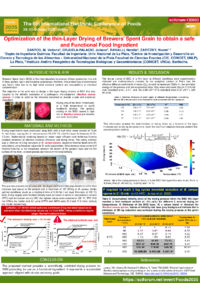
Brewers’ Spent Grain (BSG) is the most abundant by-product of beer production; it is rich in fiber, protein, lignin, and bioactive substances. However, this product has environmental and health risks due to its high initial moisture content and susceptibility to microbial contamination.
The objective of the work was to design a thin-layer drying process of BSG that is coupled to the lethality evaluation of a pathogenic microorganism (Bacillus cereus spores) in order to optimize the industrial treatment.
Drying experiments were conducted using BSG with a high initial water content of 76.46 % (wet basis), varying the air temperatures (75–120 °C) and thin-layer thicknesses (0.75–1.3 cm). Mathematical modeling based on water vapor diffusion and Arrhenius kinetics enabled prediction of effective moisture diffusivity and drying times. The safety criterion was a minimum of a 2-log reduction of B. cereus spores, based on thermal death time (F) calculations using literature values for D- and z-parameters. Simultaneous measurement of thermal histories, at the interphase between the bottom of the product layer and the hot surface of the dryer, allowed precise estimation of microbial lethality.
The process ensured compliance with the Argentine Food Code requirement of ≤13% final moisture (wet basis) in the product and a maximum of 10³ CFU/g of B. cereus. Under optimal conditions (such as a treatment time of 5.9 h for a 1 cm layer thickness at 100 °C), both drying targets and microbial lethality were achieved. In terms of total phenolic content (TPC) and antioxidant activity (AC), the highest values were obtained at 120 °C: the TPC was 19.8 mg GAE/g dry matter, and the ACs using DPPH and ABTS were 20.9 and 17.6 mmol trolox/g dry matter, respectively.
The proposed method provides a scientifically validated drying process for BSG, promoting its use as a functional ingredient. It represents a sustainable approach aligned with circular economy goals.
Keywords
drying process
brewers spent grain
microbial lethality
functional ingredient
Poster
FOODS BSG 24Oct2025.pdf
Effect of addition of amaranth (Amaranthus cruentus l.), quinoa (Chenopodium quinoa w.) and maca (Lepidium meyenii w.) flour on physicochemical and rheological properties of dough
Biosensors for the analysis of bioactive compounds in functional drinks: evolving technologies and long-term potential