Event submissions
Published
This submission belongs to the session A. Food Technology and Engineering of the event The 6th International Electronic Conference on Foods
Published date
27 Oct, 2025
Academic Editor
'%3e%3cpath%20d='M12.6657%2010.9104C12.4185%2010.325%2012.0599%209.79327%2011.6097%209.34482C11.1609%208.89508%2010.6293%208.5365%2010.0442%208.28888C10.0389%208.28626%2010.0337%208.28495%2010.0285%208.28233C10.8446%207.69279%2011.3752%206.73249%2011.3752%205.64904C11.3752%203.8542%209.92103%202.39999%208.1262%202.39999C6.33136%202.39999%204.87715%203.8542%204.87715%205.64904C4.87715%206.73249%205.40774%207.69279%206.22393%208.28364C6.21869%208.28626%206.21345%208.28757%206.20821%208.29019C5.62129%208.5378%205.09463%208.89284%204.64265%209.34613C4.1929%209.79493%203.83432%2010.3266%203.58671%2010.9117C3.34345%2011.4845%203.21226%2012.0987%203.20023%2012.7209C3.19988%2012.7349%203.20233%2012.7488%203.20744%2012.7619C3.21255%2012.7749%203.22022%2012.7867%203.22998%2012.7968C3.23975%2012.8068%203.25142%2012.8147%203.26431%2012.8202C3.2772%2012.8256%203.29105%2012.8284%203.30504%2012.8284H4.09109C4.14874%2012.8284%204.19459%2012.7825%204.1959%2012.7262C4.2221%2011.7148%204.62823%2010.7676%205.34617%2010.0497C6.08899%209.30683%207.0755%208.89808%208.1262%208.89808C9.17689%208.89808%2010.1634%209.30683%2010.9062%2010.0497C11.6242%2010.7676%2012.0303%2011.7148%2012.0565%2012.7262C12.0578%2012.7838%2012.1037%2012.8284%2012.1613%2012.8284H12.9474C12.9613%2012.8284%2012.9752%2012.8256%2012.9881%2012.8202C13.001%2012.8147%2013.0126%2012.8068%2013.0224%2012.7968C13.0322%2012.7867%2013.0398%2012.7749%2013.0449%2012.7619C13.0501%2012.7488%2013.0525%2012.7349%2013.0522%2012.7209C13.0391%2012.0947%2012.9094%2011.4855%2012.6657%2010.9104ZM8.1262%207.9024C7.52486%207.9024%206.9589%207.6679%206.53312%207.24211C6.10733%206.81633%205.87283%206.25037%205.87283%205.64904C5.87283%205.0477%206.10733%204.48174%206.53312%204.05596C6.9589%203.63018%207.52486%203.39567%208.1262%203.39567C8.72753%203.39567%209.29349%203.63018%209.71927%204.05596C10.1451%204.48174%2010.3796%205.0477%2010.3796%205.64904C10.3796%206.25037%2010.1451%206.81633%209.71927%207.24211C9.29349%207.6679%208.72753%207.9024%208.1262%207.9024Z'%20fill='%235D1EE1'/%3e%3c/g%3e%3c/svg%3e) Antonello Santini
Antonello SantiniCitation
Demetrio Javier Aponte Elera, Florencia Sabena, Fernando Bellesi, Ana M.R. Pilosof, High-pressure homogenization enhances the colloidal stability and emulsifying capacity of commercial pea protein, in Proceedings of The 6th International Electronic Conference on Foods, 28 October–30 October 2025, MDPI: Basel, Switzerland
Share
Email
Facebook
Twitter
LinkedIn
High-pressure homogenization enhances the colloidal stability and emulsifying capacity of commercial pea protein
'%3e%3cpath%20d='M12.6647%2010.9104C12.4176%2010.325%2012.0589%209.7933%2011.6088%209.34485C11.16%208.89511%2010.6283%208.53653%2010.0432%208.28891C10.038%208.28629%2010.0327%208.28498%2010.0275%208.28236C10.8437%207.69282%2011.3743%206.73252%2011.3743%205.64907C11.3743%203.85423%209.92005%202.40002%208.12522%202.40002C6.33038%202.40002%204.87618%203.85423%204.87618%205.64907C4.87618%206.73252%205.40677%207.69282%206.22296%208.28367C6.21772%208.28629%206.21248%208.2876%206.20724%208.29022C5.62031%208.53783%205.09365%208.89287%204.64167%209.34616C4.19192%209.79496%203.83334%2010.3266%203.58573%2010.9117C3.34247%2011.4846%203.21128%2012.0987%203.19925%2012.721C3.1989%2012.735%203.20135%2012.7489%203.20646%2012.7619C3.21157%2012.7749%203.21924%2012.7868%203.22901%2012.7968C3.23877%2012.8068%203.25045%2012.8148%203.26334%2012.8202C3.27623%2012.8256%203.29007%2012.8284%203.30406%2012.8284H4.09012C4.14776%2012.8284%204.19362%2012.7825%204.19493%2012.7262C4.22113%2011.7148%204.62726%2010.7676%205.34519%2010.0497C6.08802%209.30686%207.07452%208.89811%208.12522%208.89811C9.17592%208.89811%2010.1624%209.30686%2010.9052%2010.0497C11.6232%2010.7676%2012.0293%2011.7148%2012.0555%2012.7262C12.0568%2012.7839%2012.1027%2012.8284%2012.1603%2012.8284H12.9464C12.9604%2012.8284%2012.9742%2012.8256%2012.9871%2012.8202C13%2012.8148%2013.0117%2012.8068%2013.0214%2012.7968C13.0312%2012.7868%2013.0389%2012.7749%2013.044%2012.7619C13.0491%2012.7489%2013.0515%2012.735%2013.0512%2012.721C13.0381%2012.0947%2012.9084%2011.4856%2012.6647%2010.9104ZM8.12522%207.90243C7.52388%207.90243%206.95792%207.66793%206.53214%207.24215C6.10636%206.81636%205.87185%206.2504%205.87185%205.64907C5.87185%205.04773%206.10636%204.48177%206.53214%204.05599C6.95792%203.63021%207.52388%203.3957%208.12522%203.3957C8.72655%203.3957%209.29252%203.63021%209.7183%204.05599C10.1441%204.48177%2010.3786%205.04773%2010.3786%205.64907C10.3786%206.2504%2010.1441%206.81636%209.7183%207.24215C9.29252%207.66793%208.72655%207.90243%208.12522%207.90243Z'%20fill='%235D1EE1'/%3e%3c/g%3e%3c/svg%3e)
Demetrio Javier Aponte Elera 1
Florencia Sabena 1
Fernando Bellesi 1
Ana M.R. Pilosof 1
1. Instituto de Tecnología de Alimentos y Procesos Químicos (ITAPROQ), Universidad de Buenos Aires, C.P.1428, Buenos Aires, Argentina
Abstract
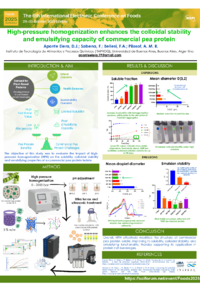
The rising demand for plant-based protein beverages, driven by ethical, health, and sustainability concerns, underscores the need to enhance the functionality of ingredients such as commercial pea protein isolate. Although nutritionally valuable and low in allergens, commercial pea protein’s limited solubility and emulsifying capacity restrict its application in protein beverages. This study aimed to evaluate the effect of high-pressure homogenization (HPH) on the solubility, colloidal stability, and emulsifying properties of a commercial pea protein isolate.
Solutions of commercial pea protein isolate (80%) at 3% w/w were treated at pressures ranging from 0 to 2000 bar (PandaPLUS, GEA, Germany). Solubility, particle size (Mastersizer, Malvern), and colloidal stability were analyzed via the Turbiscan Stability Index (TSI). Oil-in-water emulsions were formulated using 10% olive oil and 90% protein solution, and their droplet size and stability were evaluated after processing with an Ultra-Turrax and ultrasonic treatment.
HPH significantly improved solubility from 17.6% to 94% at 2000 bar, attributed to aggregate disruption. Particle size decreased notably from 48.1 µm to 0.5 µm, while TSI values dropped from 50 (0 bar) to 5 (2000 bar), indicating enhanced colloidal stability. Emulsions prepared with HPH-treated protein showed reduced droplet size, reaching 0.14 µm at 1500 bar compared to 0.59 µm at 0 bar. The most stable emulsions were obtained using protein treated at 1000 bar, exhibiting the lowest TSI values.
At acidic pH (3 and 5), droplet size slightly increased, yet emulsion stability improved significantly, with TSI reductions of up to 85% at pH 3—likely due to enhanced viscoelastic properties.
Overall, HPH effectively modified the structure of the commercial pea protein isolate, improving its solubility, colloidal stability, and emulsifying functionality, thereby supporting its application in protein-rich beverages.
Keywords
pea protein isolate
high-pressure homogenization
colloidal stability
emulsifying properties
Poster
sciforum-134299.pdf
Valorization of palm heart (Chamaerops humilis) and sambo (Cucurbita ficifolia B.) by-products for the development of gluten-free and low-calorie cookies
Tissue-dependent antioxidant response to UV-C irradiation in carrot root slices