Event submissions
Published
This submission belongs to the session A. Food Technology and Engineering of the event The 6th International Electronic Conference on Foods
Published date
27 Oct, 2025
Academic Editor
'%3e%3cpath%20d='M12.6657%2010.9104C12.4185%2010.325%2012.0599%209.79327%2011.6097%209.34482C11.1609%208.89508%2010.6293%208.5365%2010.0442%208.28888C10.0389%208.28626%2010.0337%208.28495%2010.0285%208.28233C10.8446%207.69279%2011.3752%206.73249%2011.3752%205.64904C11.3752%203.8542%209.92103%202.39999%208.1262%202.39999C6.33136%202.39999%204.87715%203.8542%204.87715%205.64904C4.87715%206.73249%205.40774%207.69279%206.22393%208.28364C6.21869%208.28626%206.21345%208.28757%206.20821%208.29019C5.62129%208.5378%205.09463%208.89284%204.64265%209.34613C4.1929%209.79493%203.83432%2010.3266%203.58671%2010.9117C3.34345%2011.4845%203.21226%2012.0987%203.20023%2012.7209C3.19988%2012.7349%203.20233%2012.7488%203.20744%2012.7619C3.21255%2012.7749%203.22022%2012.7867%203.22998%2012.7968C3.23975%2012.8068%203.25142%2012.8147%203.26431%2012.8202C3.2772%2012.8256%203.29105%2012.8284%203.30504%2012.8284H4.09109C4.14874%2012.8284%204.19459%2012.7825%204.1959%2012.7262C4.2221%2011.7148%204.62823%2010.7676%205.34617%2010.0497C6.08899%209.30683%207.0755%208.89808%208.1262%208.89808C9.17689%208.89808%2010.1634%209.30683%2010.9062%2010.0497C11.6242%2010.7676%2012.0303%2011.7148%2012.0565%2012.7262C12.0578%2012.7838%2012.1037%2012.8284%2012.1613%2012.8284H12.9474C12.9613%2012.8284%2012.9752%2012.8256%2012.9881%2012.8202C13.001%2012.8147%2013.0126%2012.8068%2013.0224%2012.7968C13.0322%2012.7867%2013.0398%2012.7749%2013.0449%2012.7619C13.0501%2012.7488%2013.0525%2012.7349%2013.0522%2012.7209C13.0391%2012.0947%2012.9094%2011.4855%2012.6657%2010.9104ZM8.1262%207.9024C7.52486%207.9024%206.9589%207.6679%206.53312%207.24211C6.10733%206.81633%205.87283%206.25037%205.87283%205.64904C5.87283%205.0477%206.10733%204.48174%206.53312%204.05596C6.9589%203.63018%207.52486%203.39567%208.1262%203.39567C8.72753%203.39567%209.29349%203.63018%209.71927%204.05596C10.1451%204.48174%2010.3796%205.0477%2010.3796%205.64904C10.3796%206.25037%2010.1451%206.81633%209.71927%207.24211C9.29349%207.6679%208.72753%207.9024%208.1262%207.9024Z'%20fill='%235D1EE1'/%3e%3c/g%3e%3c/svg%3e) Mohsen Gavahian
Mohsen GavahianCitation
Lucia Valerga, Roxana Elizabeth Gonzales, Mariano Tomás Mauricci, Pablo Federico Cavagnaro, Tissue-dependent antioxidant response to UV-C irradiation in carrot root slices, in Proceedings of The 6th International Electronic Conference on Foods, 28 October–30 October 2025, MDPI: Basel, Switzerland
Share
Email
Facebook
Twitter
LinkedIn
Tissue-dependent antioxidant response to UV-C irradiation in carrot root slices
'%3e%3cpath%20d='M12.6647%2010.9104C12.4176%2010.325%2012.0589%209.7933%2011.6088%209.34485C11.16%208.89511%2010.6283%208.53653%2010.0432%208.28891C10.038%208.28629%2010.0327%208.28498%2010.0275%208.28236C10.8437%207.69282%2011.3743%206.73252%2011.3743%205.64907C11.3743%203.85423%209.92005%202.40002%208.12522%202.40002C6.33038%202.40002%204.87618%203.85423%204.87618%205.64907C4.87618%206.73252%205.40677%207.69282%206.22296%208.28367C6.21772%208.28629%206.21248%208.2876%206.20724%208.29022C5.62031%208.53783%205.09365%208.89287%204.64167%209.34616C4.19192%209.79496%203.83334%2010.3266%203.58573%2010.9117C3.34247%2011.4846%203.21128%2012.0987%203.19925%2012.721C3.1989%2012.735%203.20135%2012.7489%203.20646%2012.7619C3.21157%2012.7749%203.21924%2012.7868%203.22901%2012.7968C3.23877%2012.8068%203.25045%2012.8148%203.26334%2012.8202C3.27623%2012.8256%203.29007%2012.8284%203.30406%2012.8284H4.09012C4.14776%2012.8284%204.19362%2012.7825%204.19493%2012.7262C4.22113%2011.7148%204.62726%2010.7676%205.34519%2010.0497C6.08802%209.30686%207.07452%208.89811%208.12522%208.89811C9.17592%208.89811%2010.1624%209.30686%2010.9052%2010.0497C11.6232%2010.7676%2012.0293%2011.7148%2012.0555%2012.7262C12.0568%2012.7839%2012.1027%2012.8284%2012.1603%2012.8284H12.9464C12.9604%2012.8284%2012.9742%2012.8256%2012.9871%2012.8202C13%2012.8148%2013.0117%2012.8068%2013.0214%2012.7968C13.0312%2012.7868%2013.0389%2012.7749%2013.044%2012.7619C13.0491%2012.7489%2013.0515%2012.735%2013.0512%2012.721C13.0381%2012.0947%2012.9084%2011.4856%2012.6647%2010.9104ZM8.12522%207.90243C7.52388%207.90243%206.95792%207.66793%206.53214%207.24215C6.10636%206.81636%205.87185%206.2504%205.87185%205.64907C5.87185%205.04773%206.10636%204.48177%206.53214%204.05599C6.95792%203.63021%207.52388%203.3957%208.12522%203.3957C8.72655%203.3957%209.29252%203.63021%209.7183%204.05599C10.1441%204.48177%2010.3786%205.04773%2010.3786%205.64907C10.3786%206.2504%2010.1441%206.81636%209.7183%207.24215C9.29252%207.66793%208.72655%207.90243%208.12522%207.90243Z'%20fill='%235D1EE1'/%3e%3c/g%3e%3c/svg%3e)
Lucia Valerga 1,2
Roxana Elizabeth Gonzales 2
Mariano Tomás Mauricci 1,2
Pablo Federico Cavagnaro 1,2,3
1. Consejo Nacional de Investigaciones Científicas y Técnicas (CONICET), Av. Rivadavia 1917, Ciudad Autónoma de Buenos Aires C1425, Argentina
2. Instituto Nacional de Tecnología Agropecuaria (INTA) E.E.A. Mendoza, Luján de Cuyo, Mendoza, La Consulta M5567, Argentina
3. Instituto de Horticultura, Facultad de Ciencias Agrarias, Universidad Nacional de Cuyo, Lujan de Cuyo, Mendoza, M5528AHB, Argentina.
Abstract
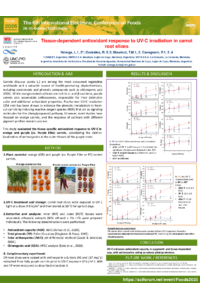
Carrots (Daucus carota L.) contain health-promoting phytochemicals, including carotenoids and phenolic compounds such as chlorogenic acid (CGA). Orange-rooted cultivars are rich in α- and β-carotene, while purple carrots also accumulate anthocyanins, contributing to their distinctive coloration. Among purple carrots, there are cultivars with differing pigment profiles; for example, in the Purple Elite cultivar, anthocyanins are localized primarily in the outer tissues (periderm and phloem), while the inner tissues (phloem and xylem) remain orange. This study focused on orange and purple cv. Purple Elite carrots to investigate tissue-specific responses to UV-C irradiation. Freshly cut carrot slices were UV-C treated (8 kJ m⁻²) and stored at 20 °C for 5 days; no significant color changes were observed. Antioxidant capacity (AOX, via ABTS), total phenolic content (TP, via Folin–Ciocalteu), total anthocyanins (ANT, via the pH differential method ), and CGA (via HPLC) were analyzed in separated tissues. In orange-rooted carrots, AOX increased 2.3- and 2.4-fold; TP increased 3.3- and 3.5-fold; and CGA increased 9.5- and 7.2-fold, in the inner and outer tissues, respectively. In the purple-rooted cultivar, AOX and TP increased only in the inner (orange) tissue by 2.4- and 2.3-fold, respectively, with no significant changes in the outer (purple) tissue. However, CGA increased significantly in both tissues, by 6.1-fold in the inner and 1.99-fold in the outer tissue. In a complementary experiment, orange carrot root slices were coated with anthocyanin solutions (40 and 137 mg L⁻¹) extracted from completely purple carrots prior to UV-C exposure. A concentration-dependent reduction in AOX and TP response was observed, confirming the photoprotective effect of anthocyanins. These results highlight a pigment- and tissue-dependent antioxidant response to UV-C in carrots, with anthocyanins modulating or attenuating phenolic accumulation. These results could be used to develop postharvest strategies, such as the use of UV-C irradiation to increase the nutraceutical value of minimally processed carrots and potentially other vegetables.
Keywords
phenolic compounds
anthocyanins
chlorogenic acid
postharvest treatment
photoprotection
Poster
poster-Valerga Lucia.pdf
High-pressure homogenization enhances the colloidal stability and emulsifying capacity of commercial pea protein
The potential of gamma-decalactone in active edible packaging for strawberry preservation