Event submissions
Published
This submission belongs to the session A. Food Technology and Engineering of the event The 6th International Electronic Conference on Foods
Published date
27 Oct, 2025
Academic Editor
'%3e%3cpath%20d='M12.6657%2010.9104C12.4185%2010.325%2012.0599%209.79327%2011.6097%209.34482C11.1609%208.89508%2010.6293%208.5365%2010.0442%208.28888C10.0389%208.28626%2010.0337%208.28495%2010.0285%208.28233C10.8446%207.69279%2011.3752%206.73249%2011.3752%205.64904C11.3752%203.8542%209.92103%202.39999%208.1262%202.39999C6.33136%202.39999%204.87715%203.8542%204.87715%205.64904C4.87715%206.73249%205.40774%207.69279%206.22393%208.28364C6.21869%208.28626%206.21345%208.28757%206.20821%208.29019C5.62129%208.5378%205.09463%208.89284%204.64265%209.34613C4.1929%209.79493%203.83432%2010.3266%203.58671%2010.9117C3.34345%2011.4845%203.21226%2012.0987%203.20023%2012.7209C3.19988%2012.7349%203.20233%2012.7488%203.20744%2012.7619C3.21255%2012.7749%203.22022%2012.7867%203.22998%2012.7968C3.23975%2012.8068%203.25142%2012.8147%203.26431%2012.8202C3.2772%2012.8256%203.29105%2012.8284%203.30504%2012.8284H4.09109C4.14874%2012.8284%204.19459%2012.7825%204.1959%2012.7262C4.2221%2011.7148%204.62823%2010.7676%205.34617%2010.0497C6.08899%209.30683%207.0755%208.89808%208.1262%208.89808C9.17689%208.89808%2010.1634%209.30683%2010.9062%2010.0497C11.6242%2010.7676%2012.0303%2011.7148%2012.0565%2012.7262C12.0578%2012.7838%2012.1037%2012.8284%2012.1613%2012.8284H12.9474C12.9613%2012.8284%2012.9752%2012.8256%2012.9881%2012.8202C13.001%2012.8147%2013.0126%2012.8068%2013.0224%2012.7968C13.0322%2012.7867%2013.0398%2012.7749%2013.0449%2012.7619C13.0501%2012.7488%2013.0525%2012.7349%2013.0522%2012.7209C13.0391%2012.0947%2012.9094%2011.4855%2012.6657%2010.9104ZM8.1262%207.9024C7.52486%207.9024%206.9589%207.6679%206.53312%207.24211C6.10733%206.81633%205.87283%206.25037%205.87283%205.64904C5.87283%205.0477%206.10733%204.48174%206.53312%204.05596C6.9589%203.63018%207.52486%203.39567%208.1262%203.39567C8.72753%203.39567%209.29349%203.63018%209.71927%204.05596C10.1451%204.48174%2010.3796%205.0477%2010.3796%205.64904C10.3796%206.25037%2010.1451%206.81633%209.71927%207.24211C9.29349%207.6679%208.72753%207.9024%208.1262%207.9024Z'%20fill='%235D1EE1'/%3e%3c/g%3e%3c/svg%3e) Mohsen Gavahian
Mohsen GavahianCitation
Cristina Popovici, Xin Mei Teng, Ravi Jadeja, The effect of walnut skin extract on the physicochemical, antioxidant, textural and sensory properties of plant-based ice cream, in Proceedings of The 6th International Electronic Conference on Foods, 28 October–30 October 2025, MDPI: Basel, Switzerland
Share
Email
Facebook
Twitter
LinkedIn
The effect of walnut skin extract on the physicochemical, antioxidant, textural and sensory properties of plant-based ice cream

Cristina Popovici 1
'%3e%3cpath%20d='M12.6647%2010.9104C12.4176%2010.325%2012.0589%209.7933%2011.6088%209.34485C11.16%208.89511%2010.6283%208.53653%2010.0432%208.28891C10.038%208.28629%2010.0327%208.28498%2010.0275%208.28236C10.8437%207.69282%2011.3743%206.73252%2011.3743%205.64907C11.3743%203.85423%209.92005%202.40002%208.12522%202.40002C6.33038%202.40002%204.87618%203.85423%204.87618%205.64907C4.87618%206.73252%205.40677%207.69282%206.22296%208.28367C6.21772%208.28629%206.21248%208.2876%206.20724%208.29022C5.62031%208.53783%205.09365%208.89287%204.64167%209.34616C4.19192%209.79496%203.83334%2010.3266%203.58573%2010.9117C3.34247%2011.4846%203.21128%2012.0987%203.19925%2012.721C3.1989%2012.735%203.20135%2012.7489%203.20646%2012.7619C3.21157%2012.7749%203.21924%2012.7868%203.22901%2012.7968C3.23877%2012.8068%203.25045%2012.8148%203.26334%2012.8202C3.27623%2012.8256%203.29007%2012.8284%203.30406%2012.8284H4.09012C4.14776%2012.8284%204.19362%2012.7825%204.19493%2012.7262C4.22113%2011.7148%204.62726%2010.7676%205.34519%2010.0497C6.08802%209.30686%207.07452%208.89811%208.12522%208.89811C9.17592%208.89811%2010.1624%209.30686%2010.9052%2010.0497C11.6232%2010.7676%2012.0293%2011.7148%2012.0555%2012.7262C12.0568%2012.7839%2012.1027%2012.8284%2012.1603%2012.8284H12.9464C12.9604%2012.8284%2012.9742%2012.8256%2012.9871%2012.8202C13%2012.8148%2013.0117%2012.8068%2013.0214%2012.7968C13.0312%2012.7868%2013.0389%2012.7749%2013.044%2012.7619C13.0491%2012.7489%2013.0515%2012.735%2013.0512%2012.721C13.0381%2012.0947%2012.9084%2011.4856%2012.6647%2010.9104ZM8.12522%207.90243C7.52388%207.90243%206.95792%207.66793%206.53214%207.24215C6.10636%206.81636%205.87185%206.2504%205.87185%205.64907C5.87185%205.04773%206.10636%204.48177%206.53214%204.05599C6.95792%203.63021%207.52388%203.3957%208.12522%203.3957C8.72655%203.3957%209.29252%203.63021%209.7183%204.05599C10.1441%204.48177%2010.3786%205.04773%2010.3786%205.64907C10.3786%206.2504%2010.1441%206.81636%209.7183%207.24215C9.29252%207.66793%208.72655%207.90243%208.12522%207.90243Z'%20fill='%235D1EE1'/%3e%3c/g%3e%3c/svg%3e)
Xin Mei Teng 2,3
Ravi Jadeja 2,3
1. Department of Food and Nutrition, Faculty of Food Technology, Technical University of Moldova, 168 Stefan cel Mare si Sfant blvd., Chisinau MD 2004, Republic of Moldova
2. Robert M. Kerr Food & Agricultural Products Center, Oklahoma State University, Stillwater, OK 74078, USA
3. Department of Animal & Food Sciences, Oklahoma State University, Stillwater, OK 74078, USA
Abstract
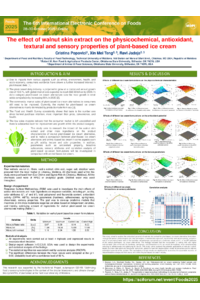
A lactose-free walnut milk substitute was used as the main ingredient to produce a novel plant-based ice cream enriched with water/ethanol walnut skin extract (WSE). Plant-based ice cream formulations were characterized regarding their physicochemical characteristics, total polyphenol (TPC) and flavonoid (TFC) content, antioxidant activity, texture parameters and sensory attributes. The ice cream formulations with WSE had a slightly decreased pH (5.24) and titratable acidity (0.25%). The phenolic profile of the plant-based ice cream involved a TPC of 217 mg GA/100g and a TFC of 83 mg QE/100g. WSE increased the DPPH and ABTS values of the formulation by 46.89% and 89.93% in comparison with the values in the reference sample of 10.21% and 17.56%, respectively. Although the extract had an effect on the color characteristics of the ice cream, the formulation containing WSE recorded the lowest L* index and the highest a* and b* indexes, at 59.23, 14.33 and 0.17, respectively. The reference sample exhibited the highest L* index and the lowest a* and b* indexes, measuring 70.17, 12.76 and 0.03, respectively. The formulation with WSE had high scores for all sensory attributes (≥8.15). Notably, the formulation with WSE demonstrated a hardness value of 651.99 g, similar to that of the reference sample, at 674.46 g (P ˂0.05). The Pearson's correlations revealed the contribution of the phenolic compounds to all of the evaluated parameters. The TPC analysis achieved very strong positive correlations with DPPH (r2 = 0.9792), ABTS (r2 = 0.9897), hardness (r2 = 0.9903) and overall sensory acceptability (r2 = 0.9653), while a positive correlation was attained with pH (r2 =0.7783) and TA (r2 =0.7579). The implications of these results are significant for advancing the sustainable recovery of natural bioactive compounds from walnut skin within the plant-based ice cream industry.
Acknowledgments. This research was supported by Institutional Project subprogram 020405 “Optimizing food processing technologies in the context of the circular bioeconomy and climate change”, Bio-OpTehPAS, implemented at the Technical University of Moldova.
Keywords
Biocative compounds
walnuts
plant-based dairy alternatives
Poster
Poster_ID_sciforum-134512.pdf
Correlation between visual appearance and physicochemical attributes of a chinicuil-based condiment using computer vision for quality monitoring
Proposal of a Digital Maturity Model to Assess the Impact of Agriculture 4.0 Technologies on Small- and Medium-Sized Rural Properties: A Case Study in the Agrotechnological District (DAT) of Caconde (Brazil)