Event submissions
Published
This submission belongs to the session A. Food Technology and Engineering of the event The 6th International Electronic Conference on Foods
Published date
27 Oct, 2025
Academic Editor
'%3e%3cpath%20d='M12.6657%2010.9104C12.4185%2010.325%2012.0599%209.79327%2011.6097%209.34482C11.1609%208.89508%2010.6293%208.5365%2010.0442%208.28888C10.0389%208.28626%2010.0337%208.28495%2010.0285%208.28233C10.8446%207.69279%2011.3752%206.73249%2011.3752%205.64904C11.3752%203.8542%209.92103%202.39999%208.1262%202.39999C6.33136%202.39999%204.87715%203.8542%204.87715%205.64904C4.87715%206.73249%205.40774%207.69279%206.22393%208.28364C6.21869%208.28626%206.21345%208.28757%206.20821%208.29019C5.62129%208.5378%205.09463%208.89284%204.64265%209.34613C4.1929%209.79493%203.83432%2010.3266%203.58671%2010.9117C3.34345%2011.4845%203.21226%2012.0987%203.20023%2012.7209C3.19988%2012.7349%203.20233%2012.7488%203.20744%2012.7619C3.21255%2012.7749%203.22022%2012.7867%203.22998%2012.7968C3.23975%2012.8068%203.25142%2012.8147%203.26431%2012.8202C3.2772%2012.8256%203.29105%2012.8284%203.30504%2012.8284H4.09109C4.14874%2012.8284%204.19459%2012.7825%204.1959%2012.7262C4.2221%2011.7148%204.62823%2010.7676%205.34617%2010.0497C6.08899%209.30683%207.0755%208.89808%208.1262%208.89808C9.17689%208.89808%2010.1634%209.30683%2010.9062%2010.0497C11.6242%2010.7676%2012.0303%2011.7148%2012.0565%2012.7262C12.0578%2012.7838%2012.1037%2012.8284%2012.1613%2012.8284H12.9474C12.9613%2012.8284%2012.9752%2012.8256%2012.9881%2012.8202C13.001%2012.8147%2013.0126%2012.8068%2013.0224%2012.7968C13.0322%2012.7867%2013.0398%2012.7749%2013.0449%2012.7619C13.0501%2012.7488%2013.0525%2012.7349%2013.0522%2012.7209C13.0391%2012.0947%2012.9094%2011.4855%2012.6657%2010.9104ZM8.1262%207.9024C7.52486%207.9024%206.9589%207.6679%206.53312%207.24211C6.10733%206.81633%205.87283%206.25037%205.87283%205.64904C5.87283%205.0477%206.10733%204.48174%206.53312%204.05596C6.9589%203.63018%207.52486%203.39567%208.1262%203.39567C8.72753%203.39567%209.29349%203.63018%209.71927%204.05596C10.1451%204.48174%2010.3796%205.0477%2010.3796%205.64904C10.3796%206.25037%2010.1451%206.81633%209.71927%207.24211C9.29349%207.6679%208.72753%207.9024%208.1262%207.9024Z'%20fill='%235D1EE1'/%3e%3c/g%3e%3c/svg%3e) Cristobal Aguilar
Cristobal AguilarCitation
Estefanía Belén Coronel, Vanesa Yanet Ixtaina, Marianela Ivana Capitani, Study of the quality of a dry gluten-free pasta formulated with pregelatinized flours, in Proceedings of The 6th International Electronic Conference on Foods, 28 October–30 October 2025, MDPI: Basel, Switzerland
Share
Email
Facebook
Twitter
LinkedIn
Study of the quality of a dry gluten-free pasta formulated with pregelatinized flours
'%3e%3cpath%20d='M12.6647%2010.9104C12.4176%2010.325%2012.0589%209.7933%2011.6088%209.34485C11.16%208.89511%2010.6283%208.53653%2010.0432%208.28891C10.038%208.28629%2010.0327%208.28498%2010.0275%208.28236C10.8437%207.69282%2011.3743%206.73252%2011.3743%205.64907C11.3743%203.85423%209.92005%202.40002%208.12522%202.40002C6.33038%202.40002%204.87618%203.85423%204.87618%205.64907C4.87618%206.73252%205.40677%207.69282%206.22296%208.28367C6.21772%208.28629%206.21248%208.2876%206.20724%208.29022C5.62031%208.53783%205.09365%208.89287%204.64167%209.34616C4.19192%209.79496%203.83334%2010.3266%203.58573%2010.9117C3.34247%2011.4846%203.21128%2012.0987%203.19925%2012.721C3.1989%2012.735%203.20135%2012.7489%203.20646%2012.7619C3.21157%2012.7749%203.21924%2012.7868%203.22901%2012.7968C3.23877%2012.8068%203.25045%2012.8148%203.26334%2012.8202C3.27623%2012.8256%203.29007%2012.8284%203.30406%2012.8284H4.09012C4.14776%2012.8284%204.19362%2012.7825%204.19493%2012.7262C4.22113%2011.7148%204.62726%2010.7676%205.34519%2010.0497C6.08802%209.30686%207.07452%208.89811%208.12522%208.89811C9.17592%208.89811%2010.1624%209.30686%2010.9052%2010.0497C11.6232%2010.7676%2012.0293%2011.7148%2012.0555%2012.7262C12.0568%2012.7839%2012.1027%2012.8284%2012.1603%2012.8284H12.9464C12.9604%2012.8284%2012.9742%2012.8256%2012.9871%2012.8202C13%2012.8148%2013.0117%2012.8068%2013.0214%2012.7968C13.0312%2012.7868%2013.0389%2012.7749%2013.044%2012.7619C13.0491%2012.7489%2013.0515%2012.735%2013.0512%2012.721C13.0381%2012.0947%2012.9084%2011.4856%2012.6647%2010.9104ZM8.12522%207.90243C7.52388%207.90243%206.95792%207.66793%206.53214%207.24215C6.10636%206.81636%205.87185%206.2504%205.87185%205.64907C5.87185%205.04773%206.10636%204.48177%206.53214%204.05599C6.95792%203.63021%207.52388%203.3957%208.12522%203.3957C8.72655%203.3957%209.29252%203.63021%209.7183%204.05599C10.1441%204.48177%2010.3786%205.04773%2010.3786%205.64907C10.3786%206.2504%2010.1441%206.81636%209.7183%207.24215C9.29252%207.66793%208.72655%207.90243%208.12522%207.90243Z'%20fill='%235D1EE1'/%3e%3c/g%3e%3c/svg%3e)
Estefanía Belén Coronel 1,2
Vanesa Yanet Ixtaina 3,4
Marianela Ivana Capitani 1,2
1. Departamento de Ingeniería Química y Tecnología de los Alimentos, Facultad de Ingeniería, Universidad Nacional del Centro de la Provincia de Buenos aires, Olavarría (CP7400), Buenos Aires, Argentina
2. CONICET - CCT Tandil, Tandil (CP 7000), Buenos Aires, Argentina
3. Centro de Investigación y Desarrollo en Ciencia y Tecnología de los Alimentos (CIDCA) CONICET La Plata, Facultad de Ciencias Exactas (UNLP), CICPBA, La Plata (CP 1900), Buenos Aires, Argentina
4. Facultad de Ciencias Agrarias y Forestales, Universidad Nacional de La Plata,La Plata (CP 1900), Buenos Aires, Argentina
Abstract
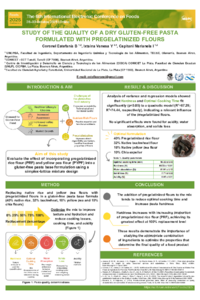
Gluten-free foods are on the rise due to healthier lifestyle choices. Therefore, it is necessary to diversify the development of these types of foods based on alternatives that incorporate nutritious raw materials, such as flours derived from legumes, pseudocereals, and oilseeds. However, given the technological limitations of gluten-free matrices, it is important to improve the functionality of ingredients through processes such as pregelatinization. Therefore, the objective of this research was to evaluate the effect of incorporating pregelatinized rice flours (PRF) and yellow pea flours (PYPF) into a gluten-free pasta base formulation made only with nativerice, buckwheat, yellow pea floura, and chia expeller in a 40:32:18:10 ratio, respectively. To optimize the mix, a simplex-lattice design was used, replacing native rice and pea flours with their respective pregelatinized flours in ranges from 0 to 100%, keeping the proportion of the remaining ingredients fixed. Nine pasta formulations were prepared, and their quality was determined by analyzing hardness, optimal cooking time (TOC), water absorption, solids loss during cooking, and acidity. Analysis of variance (ANOVA) and regression models showed that hardness and TOC fit significantly (p<0.05) to a quadratic model (R2=87.29; R2=74.44, respectively), indicating a relevant influence of the pregelatinized flours. No significant effects were found for acidity, water absorption, and solids loss. These results demonstrate the importance of studying the appropriate combination of ingredients to optimize properties that determine the final quality of a food product.
Keywords
gluten-free
dry pasta
mix design
quality properties
pregelatinization
Poster
Póster Coronel.pdf
Process Optimization of Hybrid Dried Tender Jackfruit-Fortified Pasta by Response Surface Methodology
PHENOLIC CONTENT AND ANTIOXIDANT ACTIVITY OF APPLES DEHYDRATED BY FREEZE-DRYING AND HOT AIR DRYING