Event submissions
Published
This submission belongs to the session A. Food Technology and Engineering of the event The 6th International Electronic Conference on Foods
Published date
27 Oct, 2025
Academic Editor
'%3e%3cpath%20d='M12.6657%2010.9104C12.4185%2010.325%2012.0599%209.79327%2011.6097%209.34482C11.1609%208.89508%2010.6293%208.5365%2010.0442%208.28888C10.0389%208.28626%2010.0337%208.28495%2010.0285%208.28233C10.8446%207.69279%2011.3752%206.73249%2011.3752%205.64904C11.3752%203.8542%209.92103%202.39999%208.1262%202.39999C6.33136%202.39999%204.87715%203.8542%204.87715%205.64904C4.87715%206.73249%205.40774%207.69279%206.22393%208.28364C6.21869%208.28626%206.21345%208.28757%206.20821%208.29019C5.62129%208.5378%205.09463%208.89284%204.64265%209.34613C4.1929%209.79493%203.83432%2010.3266%203.58671%2010.9117C3.34345%2011.4845%203.21226%2012.0987%203.20023%2012.7209C3.19988%2012.7349%203.20233%2012.7488%203.20744%2012.7619C3.21255%2012.7749%203.22022%2012.7867%203.22998%2012.7968C3.23975%2012.8068%203.25142%2012.8147%203.26431%2012.8202C3.2772%2012.8256%203.29105%2012.8284%203.30504%2012.8284H4.09109C4.14874%2012.8284%204.19459%2012.7825%204.1959%2012.7262C4.2221%2011.7148%204.62823%2010.7676%205.34617%2010.0497C6.08899%209.30683%207.0755%208.89808%208.1262%208.89808C9.17689%208.89808%2010.1634%209.30683%2010.9062%2010.0497C11.6242%2010.7676%2012.0303%2011.7148%2012.0565%2012.7262C12.0578%2012.7838%2012.1037%2012.8284%2012.1613%2012.8284H12.9474C12.9613%2012.8284%2012.9752%2012.8256%2012.9881%2012.8202C13.001%2012.8147%2013.0126%2012.8068%2013.0224%2012.7968C13.0322%2012.7867%2013.0398%2012.7749%2013.0449%2012.7619C13.0501%2012.7488%2013.0525%2012.7349%2013.0522%2012.7209C13.0391%2012.0947%2012.9094%2011.4855%2012.6657%2010.9104ZM8.1262%207.9024C7.52486%207.9024%206.9589%207.6679%206.53312%207.24211C6.10733%206.81633%205.87283%206.25037%205.87283%205.64904C5.87283%205.0477%206.10733%204.48174%206.53312%204.05596C6.9589%203.63018%207.52486%203.39567%208.1262%203.39567C8.72753%203.39567%209.29349%203.63018%209.71927%204.05596C10.1451%204.48174%2010.3796%205.0477%2010.3796%205.64904C10.3796%206.25037%2010.1451%206.81633%209.71927%207.24211C9.29349%207.6679%208.72753%207.9024%208.1262%207.9024Z'%20fill='%235D1EE1'/%3e%3c/g%3e%3c/svg%3e) Mohsen Gavahian
Mohsen GavahianCitation
Kristan Diane Canta, Kylene Michele Balbuena, Chynna Mae Marie Bautista, Amie Lawrenz Castillo, Louise Claire Rivera, Ashlyn Reign Sarce, ANTIOXIDANT PROPERTIES OF OLASIMAN (Portulaca oleracea) AGAINST OXIDATIVE RANCIDITY OF ROASTED PEANUTS, in Proceedings of The 6th International Electronic Conference on Foods, 28 October–30 October 2025, MDPI: Basel, Switzerland
Share
Email
Facebook
Twitter
LinkedIn
ANTIOXIDANT PROPERTIES OF OLASIMAN (Portulaca oleracea) AGAINST OXIDATIVE RANCIDITY OF ROASTED PEANUTS
'%3e%3cpath%20d='M12.6647%2010.9104C12.4176%2010.325%2012.0589%209.7933%2011.6088%209.34485C11.16%208.89511%2010.6283%208.53653%2010.0432%208.28891C10.038%208.28629%2010.0327%208.28498%2010.0275%208.28236C10.8437%207.69282%2011.3743%206.73252%2011.3743%205.64907C11.3743%203.85423%209.92005%202.40002%208.12522%202.40002C6.33038%202.40002%204.87618%203.85423%204.87618%205.64907C4.87618%206.73252%205.40677%207.69282%206.22296%208.28367C6.21772%208.28629%206.21248%208.2876%206.20724%208.29022C5.62031%208.53783%205.09365%208.89287%204.64167%209.34616C4.19192%209.79496%203.83334%2010.3266%203.58573%2010.9117C3.34247%2011.4846%203.21128%2012.0987%203.19925%2012.721C3.1989%2012.735%203.20135%2012.7489%203.20646%2012.7619C3.21157%2012.7749%203.21924%2012.7868%203.22901%2012.7968C3.23877%2012.8068%203.25045%2012.8148%203.26334%2012.8202C3.27623%2012.8256%203.29007%2012.8284%203.30406%2012.8284H4.09012C4.14776%2012.8284%204.19362%2012.7825%204.19493%2012.7262C4.22113%2011.7148%204.62726%2010.7676%205.34519%2010.0497C6.08802%209.30686%207.07452%208.89811%208.12522%208.89811C9.17592%208.89811%2010.1624%209.30686%2010.9052%2010.0497C11.6232%2010.7676%2012.0293%2011.7148%2012.0555%2012.7262C12.0568%2012.7839%2012.1027%2012.8284%2012.1603%2012.8284H12.9464C12.9604%2012.8284%2012.9742%2012.8256%2012.9871%2012.8202C13%2012.8148%2013.0117%2012.8068%2013.0214%2012.7968C13.0312%2012.7868%2013.0389%2012.7749%2013.044%2012.7619C13.0491%2012.7489%2013.0515%2012.735%2013.0512%2012.721C13.0381%2012.0947%2012.9084%2011.4856%2012.6647%2010.9104ZM8.12522%207.90243C7.52388%207.90243%206.95792%207.66793%206.53214%207.24215C6.10636%206.81636%205.87185%206.2504%205.87185%205.64907C5.87185%205.04773%206.10636%204.48177%206.53214%204.05599C6.95792%203.63021%207.52388%203.3957%208.12522%203.3957C8.72655%203.3957%209.29252%203.63021%209.7183%204.05599C10.1441%204.48177%2010.3786%205.04773%2010.3786%205.64907C10.3786%206.2504%2010.1441%206.81636%209.7183%207.24215C9.29252%207.66793%208.72655%207.90243%208.12522%207.90243Z'%20fill='%235D1EE1'/%3e%3c/g%3e%3c/svg%3e)
Kristan Diane Canta 1
Kylene Michele Balbuena 1
Chynna Mae Marie Bautista 1
Amie Lawrenz Castillo 1
Louise Claire Rivera 1
Ashlyn Reign Sarce 1
1. College of Science, Bulacan State University, Malolos, Bulacan, 3000, Philippines
Abstract
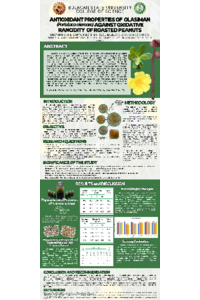
Peanuts, a widely cultivated crop in the Philippines, are susceptible to oxidative rancidity due to its high fat content. Antioxidants are commonly applied to inhibit oxidation in peanuts. This study assessed the effectiveness of adding Portulaca oleracea extract to roasted peanuts to control oxidative rancidity. The Portulaca olerecea extract, known for its antioxidant and omega-3 content, was evaluated for its pH (4.6), total soluble solids (56°Bx), and color (yellow brown). Different concentrations of the extract (10%, 15%, and 20%) were incorporated into roasted peanuts. For a two-week storage period, rancidity indices such as moisture content, peroxide value, and free fatty acid were measured. Roasted peanuts with 10% P. olerecea extract exhibited the lowest moisture content of 1.49-1.53%, while the control group has the highest moisture content of 2.42-3.89% for 2-week storage. In contrast, in terms of peroxide value, the control group had the lowest peroxide value (0.19-0.45 meq/kg) followed by roasted peanuts with 20% P. olerecea extract (0.19-0.54meq/kg). The same was observed for free fatty acid, with the control group exhibiting the lowest %FFA of 1.08-1.35% oleic acid, followed by the sample with 20% P. olerecea extract (1.09-1.35%), all exceeding the CODEX standards of 1.0%. All samples of roasted peanuts with P. oleracea showed a result of 10 cfu/g for the total plate count, less than 10 cfu/g for E.coli, a total coliform count less than 10 cfu/g, and a yeast count and mold count less than 10 cfu/g, and S. aureus showed less than 10 cfu/g, which passed FDA standards. Furthermore, a sensory evaluation with 96 panelists was conducted after thirty-eight days of storage, favoring the roasted peanuts with 10% P. oleracea extract where an off flavor was not detected. Further research is recommended to explore the potential of Portulaca oleracea as a food antioxidant comprehensively in longer storage periods.
Keywords
Portulaca oleracea
antioxidant
roasted peanut
oxidative rancidity
Poster
ANTIOXIDANT PROPERTIES OF OLASIMAN.pdf
PHENOLIC CONTENT AND ANTIOXIDANT ACTIVITY OF APPLES DEHYDRATED BY FREEZE-DRYING AND HOT AIR DRYING
Response surface methodology for natural antioxidants recovery from Pyropia columbina seaweed using pressurized liquid extraction.