Event submissions
Published
This submission belongs to the session A. Food Technology and Engineering of the event The 6th International Electronic Conference on Foods
Published date
27 Oct, 2025
Academic Editor
'%3e%3cpath%20d='M12.6657%2010.9104C12.4185%2010.325%2012.0599%209.79327%2011.6097%209.34482C11.1609%208.89508%2010.6293%208.5365%2010.0442%208.28888C10.0389%208.28626%2010.0337%208.28495%2010.0285%208.28233C10.8446%207.69279%2011.3752%206.73249%2011.3752%205.64904C11.3752%203.8542%209.92103%202.39999%208.1262%202.39999C6.33136%202.39999%204.87715%203.8542%204.87715%205.64904C4.87715%206.73249%205.40774%207.69279%206.22393%208.28364C6.21869%208.28626%206.21345%208.28757%206.20821%208.29019C5.62129%208.5378%205.09463%208.89284%204.64265%209.34613C4.1929%209.79493%203.83432%2010.3266%203.58671%2010.9117C3.34345%2011.4845%203.21226%2012.0987%203.20023%2012.7209C3.19988%2012.7349%203.20233%2012.7488%203.20744%2012.7619C3.21255%2012.7749%203.22022%2012.7867%203.22998%2012.7968C3.23975%2012.8068%203.25142%2012.8147%203.26431%2012.8202C3.2772%2012.8256%203.29105%2012.8284%203.30504%2012.8284H4.09109C4.14874%2012.8284%204.19459%2012.7825%204.1959%2012.7262C4.2221%2011.7148%204.62823%2010.7676%205.34617%2010.0497C6.08899%209.30683%207.0755%208.89808%208.1262%208.89808C9.17689%208.89808%2010.1634%209.30683%2010.9062%2010.0497C11.6242%2010.7676%2012.0303%2011.7148%2012.0565%2012.7262C12.0578%2012.7838%2012.1037%2012.8284%2012.1613%2012.8284H12.9474C12.9613%2012.8284%2012.9752%2012.8256%2012.9881%2012.8202C13.001%2012.8147%2013.0126%2012.8068%2013.0224%2012.7968C13.0322%2012.7867%2013.0398%2012.7749%2013.0449%2012.7619C13.0501%2012.7488%2013.0525%2012.7349%2013.0522%2012.7209C13.0391%2012.0947%2012.9094%2011.4855%2012.6657%2010.9104ZM8.1262%207.9024C7.52486%207.9024%206.9589%207.6679%206.53312%207.24211C6.10733%206.81633%205.87283%206.25037%205.87283%205.64904C5.87283%205.0477%206.10733%204.48174%206.53312%204.05596C6.9589%203.63018%207.52486%203.39567%208.1262%203.39567C8.72753%203.39567%209.29349%203.63018%209.71927%204.05596C10.1451%204.48174%2010.3796%205.0477%2010.3796%205.64904C10.3796%206.25037%2010.1451%206.81633%209.71927%207.24211C9.29349%207.6679%208.72753%207.9024%208.1262%207.9024Z'%20fill='%235D1EE1'/%3e%3c/g%3e%3c/svg%3e) Mohsen Gavahian
Mohsen GavahianCitation
Melisa Fushimi, Cecilia Dauber, Patricia Raquel Quiroga, Valeria Nepote, Ignacio Vieitez, Response surface methodology for natural antioxidants recovery from Pyropia columbina seaweed using pressurized liquid extraction., in Proceedings of The 6th International Electronic Conference on Foods, 28 October–30 October 2025, MDPI: Basel, Switzerland
Share
Email
Facebook
Twitter
LinkedIn
Response surface methodology for natural antioxidants recovery from Pyropia columbina seaweed using pressurized liquid extraction.

Melisa Fushimi 1,2,3
'%3e%3cpath%20d='M12.6647%2010.9104C12.4176%2010.325%2012.0589%209.7933%2011.6088%209.34485C11.16%208.89511%2010.6283%208.53653%2010.0432%208.28891C10.038%208.28629%2010.0327%208.28498%2010.0275%208.28236C10.8437%207.69282%2011.3743%206.73252%2011.3743%205.64907C11.3743%203.85423%209.92005%202.40002%208.12522%202.40002C6.33038%202.40002%204.87618%203.85423%204.87618%205.64907C4.87618%206.73252%205.40677%207.69282%206.22296%208.28367C6.21772%208.28629%206.21248%208.2876%206.20724%208.29022C5.62031%208.53783%205.09365%208.89287%204.64167%209.34616C4.19192%209.79496%203.83334%2010.3266%203.58573%2010.9117C3.34247%2011.4846%203.21128%2012.0987%203.19925%2012.721C3.1989%2012.735%203.20135%2012.7489%203.20646%2012.7619C3.21157%2012.7749%203.21924%2012.7868%203.22901%2012.7968C3.23877%2012.8068%203.25045%2012.8148%203.26334%2012.8202C3.27623%2012.8256%203.29007%2012.8284%203.30406%2012.8284H4.09012C4.14776%2012.8284%204.19362%2012.7825%204.19493%2012.7262C4.22113%2011.7148%204.62726%2010.7676%205.34519%2010.0497C6.08802%209.30686%207.07452%208.89811%208.12522%208.89811C9.17592%208.89811%2010.1624%209.30686%2010.9052%2010.0497C11.6232%2010.7676%2012.0293%2011.7148%2012.0555%2012.7262C12.0568%2012.7839%2012.1027%2012.8284%2012.1603%2012.8284H12.9464C12.9604%2012.8284%2012.9742%2012.8256%2012.9871%2012.8202C13%2012.8148%2013.0117%2012.8068%2013.0214%2012.7968C13.0312%2012.7868%2013.0389%2012.7749%2013.044%2012.7619C13.0491%2012.7489%2013.0515%2012.735%2013.0512%2012.721C13.0381%2012.0947%2012.9084%2011.4856%2012.6647%2010.9104ZM8.12522%207.90243C7.52388%207.90243%206.95792%207.66793%206.53214%207.24215C6.10636%206.81636%205.87185%206.2504%205.87185%205.64907C5.87185%205.04773%206.10636%204.48177%206.53214%204.05599C6.95792%203.63021%207.52388%203.3957%208.12522%203.3957C8.72655%203.3957%209.29252%203.63021%209.7183%204.05599C10.1441%204.48177%2010.3786%205.04773%2010.3786%205.64907C10.3786%206.2504%2010.1441%206.81636%209.7183%207.24215C9.29252%207.66793%208.72655%207.90243%208.12522%207.90243Z'%20fill='%235D1EE1'/%3e%3c/g%3e%3c/svg%3e)
Cecilia Dauber 4

Patricia Raquel Quiroga 1,5
Valeria Nepote 1,6

Ignacio Vieitez 4
1. Multidisciplinary Institute of Plant Biology, National Council for Scientific and Technical Research, Córdoba, 5000, Argentina
2. Department of Agrofoods, Faculty of Agricultural Sciences, National University of Córdoba, Córdoba, 5000, Argentina
3. Faculty of Medical Sciences, National University of Córdoba, Córdoba, 5000, Argentina
4. Department of Food Science and Technology, Faculty of Chemistry, University of the Republic, Montevideo, Uruguay.
5. Faculty of Agricultural Sciences, National University of Córdoba, Córdoba, 5000, Argentina
6. Faculty of Exact, Physical and Natural Sciences, National University of Córdoba, Córdoba, 5000, Argentina
Abstract
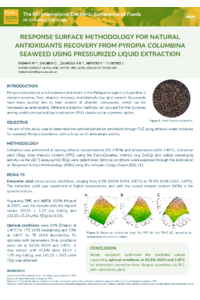
Argentina’s extensive coastline harbors diverse macroalgae, with the red seaweed (Rhodophyceae) Pyropia columbina being particularly prominent in Patagonia. Seaweed composition varies with environmental and processing conditions. It is known to contain proteins, fiber, vitamins, minerals, and relatively low lipid content. In recent years, seaweed has also been studied due to its content of phenolic compounds, which can be harnessed as antioxidants for potential nutraceutical applications and the prevention of chronic diseases. Different extraction methods can be used for this purpose, among which pressurized liquid extraction (PLE) stands out as a greener option. The aim of this study was to determine the optimal extraction conditions through PLE using ethanol–water mixtures for seaweed Pyropia columbina, with a focus on its antioxidant activity. Extraction was performed at varying ethanol concentrations (50–100%) and temperatures (100–140°C). Extraction yield (%/g), total phenolic content (TPC) using the Folin–Ciocalteu method (mg GAE/g), and radical scavenging activity via the ABTS assay (mg TEAC/g) were determined. Optimal conditions were assessed through the application of Expert Design (ED) methodology. Extraction yield varied across conditions, ranging from 4.3% (100% EtOH, 100°C) to 70.9% (50% EtOH, 140°C). Regarding TPC and ABTS, 100% Ethanol at 140°C was the sample with the highest values (20.25±1.33 mg GAE/g and 151.55±5.24 mg TEAC/g) (∝<0.05). Using ED, optimal conditions were 94% Ethanol at 140°C for TPC (0.98 desirability) and 73% at 140°C for TEAC (0.94 desirability). To optimize both parameters, final conditions were set at 83.5% EtOH and 140°C. A new extract with 41.8% yield, 18.24±1.79 mg GAE/g, and 141.21 ± 6.97 mg TEAC/g was obtained. Model validation confirmed the predicted values, supporting optimal conditions for antioxidant extraction from Pyropia columbina via PLE with satisfactory yield.
Keywords
seaweed
pressurized liquid extraction
natural antioxidants
Poster
Conference food and sustainability - FUSHIMI poster -.pdf
ANTIOXIDANT PROPERTIES OF OLASIMAN (Portulaca oleracea) AGAINST OXIDATIVE RANCIDITY OF ROASTED PEANUTS
Identifying distinct markers in non-volatile compounds for baijiu based on non-targeted metabolomics analysis and machine learning