Event submissions
EventsThe 1st International Electronic Conference on Medicinal Chemistry and Pharmaceutics
Published
This submission belongs to the session S11. Formulation, Drug Delivery and Controlled Release of the event The 1st International Electronic Conference on Medicinal Chemistry and Pharmaceutics
Published date
29 Oct, 2025
Academic Editor
'%3e%3cpath%20d='M12.6657%2010.9104C12.4185%2010.325%2012.0599%209.79327%2011.6097%209.34482C11.1609%208.89508%2010.6293%208.5365%2010.0442%208.28888C10.0389%208.28626%2010.0337%208.28495%2010.0285%208.28233C10.8446%207.69279%2011.3752%206.73249%2011.3752%205.64904C11.3752%203.8542%209.92103%202.39999%208.1262%202.39999C6.33136%202.39999%204.87715%203.8542%204.87715%205.64904C4.87715%206.73249%205.40774%207.69279%206.22393%208.28364C6.21869%208.28626%206.21345%208.28757%206.20821%208.29019C5.62129%208.5378%205.09463%208.89284%204.64265%209.34613C4.1929%209.79493%203.83432%2010.3266%203.58671%2010.9117C3.34345%2011.4845%203.21226%2012.0987%203.20023%2012.7209C3.19988%2012.7349%203.20233%2012.7488%203.20744%2012.7619C3.21255%2012.7749%203.22022%2012.7867%203.22998%2012.7968C3.23975%2012.8068%203.25142%2012.8147%203.26431%2012.8202C3.2772%2012.8256%203.29105%2012.8284%203.30504%2012.8284H4.09109C4.14874%2012.8284%204.19459%2012.7825%204.1959%2012.7262C4.2221%2011.7148%204.62823%2010.7676%205.34617%2010.0497C6.08899%209.30683%207.0755%208.89808%208.1262%208.89808C9.17689%208.89808%2010.1634%209.30683%2010.9062%2010.0497C11.6242%2010.7676%2012.0303%2011.7148%2012.0565%2012.7262C12.0578%2012.7838%2012.1037%2012.8284%2012.1613%2012.8284H12.9474C12.9613%2012.8284%2012.9752%2012.8256%2012.9881%2012.8202C13.001%2012.8147%2013.0126%2012.8068%2013.0224%2012.7968C13.0322%2012.7867%2013.0398%2012.7749%2013.0449%2012.7619C13.0501%2012.7488%2013.0525%2012.7349%2013.0522%2012.7209C13.0391%2012.0947%2012.9094%2011.4855%2012.6657%2010.9104ZM8.1262%207.9024C7.52486%207.9024%206.9589%207.6679%206.53312%207.24211C6.10733%206.81633%205.87283%206.25037%205.87283%205.64904C5.87283%205.0477%206.10733%204.48174%206.53312%204.05596C6.9589%203.63018%207.52486%203.39567%208.1262%203.39567C8.72753%203.39567%209.29349%203.63018%209.71927%204.05596C10.1451%204.48174%2010.3796%205.0477%2010.3796%205.64904C10.3796%206.25037%2010.1451%206.81633%209.71927%207.24211C9.29349%207.6679%208.72753%207.9024%208.1262%207.9024Z'%20fill='%235D1EE1'/%3e%3c/g%3e%3c/svg%3e) Gareth R. Williams
Gareth R. WilliamsCitation
Sosina Dires Sewunet, Evaluation of Alginate-Based Gels as Drug Carrier for Controlled Release of Spiramycin., in Proceedings of The 1st International Electronic Conference on Medicinal Chemistry and Pharmaceutics, 1 November–30 November 2025, MDPI: Basel, Switzerland
Share
Email
Facebook
Twitter
LinkedIn
Evaluation of Alginate-Based Gels as Drug Carrier for Controlled Release of Spiramycin.

Sosina Dires Sewunet 1,2
1. Faculty of Fundamental Problems of Technology, Wroclaw University of Science and Technology, Wrocław, Poland.
2. College of Veterinary Medicine and Animal Sciences, University of Gondar, Ethiopia.
Abstract
Abstract
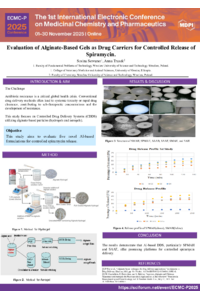
Introduction: Controlled drug delivery systems (DDS) are vital for enhancing therapeutic efficacy while minimizing side effects. Alginate (Al)-based materials have emerged as promising candidates due to their biocompatibility, gel-forming capacity, and ease of modification. This study aims to evaluate the performance of five novel Al-based formulations for the controlled rate of spiramycin release.
Methods: Five DDS were developed: spiramycin-Al hydrogel (SAH), spiramycin-acid activated montmorillonite-Al hydrogel (SMAH), spiramycin-polylactide-acid activated MMT-Al hydrogel (SPMAH), and spiramycin-Al aerogel beads and films (SAAB and SAAF). Preparation involved drug encapsulation, incorporation of MMT as a sorbent, calcium chloride-induced crosslinking, coating with polylactide, solvent exchange, supercritical drying, and drug impregnation. In vitro drug release was assessed via dissolution tests, and antimicrobial efficacy was evaluated against E. coli, S. aureus, and E. faecalis.
Results: Among the hydrogel formulations, SPMAH demonstrated the slowest release profile (20%), indicating effective sustained release, while SMAH and SAH showed higher release rates (>21% and >42%, respectively). SAAB and SAAF exhibited faster release in water compared to 50% Glycerol Ringer’s solution. In antimicrobial assays, SAAB showed the most potent inhibition against all tested bacteria, highlighting its potential for effective antimicrobial action.
Conclusion: The results demonstrate that Al-based DDS, particularly SPMAH and SAAF, offer promising platforms for controlled spiramycin delivery. These systems may contribute to combating antimicrobial resistance by enabling sustained and targeted drug release. This study provides new insights into the development of advanced biomaterial-based DDS for antibiotics.
Keywords
Aerogel
Alginate
Controlled Drug delivery
Hydrogel
Montmorillonite
Spiramycin
Poster
The 1st International Electronic Conference on Medicinal Chemistry and Pharmaceutics_Updated.pdf
Microfluidics-based synthesized ZIF-8 nanoparticles embedded inside a natural scaffold for sustained-release of cargo in drug delivery purposes
Paeonia lactiflora root extract as a promising phytochemical for LPS-induced skin inflammation management