Event submissions
EventsThe 1st International Electronic Conference on Medicinal Chemistry and Pharmaceutics
Published
This submission belongs to the session S12. Biopharmaceutics, Pharmacokinetics and Pharmacodynamics of the event The 1st International Electronic Conference on Medicinal Chemistry and Pharmaceutics
Published date
29 Oct, 2025
Academic Editor
'%3e%3cpath%20d='M12.6657%2010.9104C12.4185%2010.325%2012.0599%209.79327%2011.6097%209.34482C11.1609%208.89508%2010.6293%208.5365%2010.0442%208.28888C10.0389%208.28626%2010.0337%208.28495%2010.0285%208.28233C10.8446%207.69279%2011.3752%206.73249%2011.3752%205.64904C11.3752%203.8542%209.92103%202.39999%208.1262%202.39999C6.33136%202.39999%204.87715%203.8542%204.87715%205.64904C4.87715%206.73249%205.40774%207.69279%206.22393%208.28364C6.21869%208.28626%206.21345%208.28757%206.20821%208.29019C5.62129%208.5378%205.09463%208.89284%204.64265%209.34613C4.1929%209.79493%203.83432%2010.3266%203.58671%2010.9117C3.34345%2011.4845%203.21226%2012.0987%203.20023%2012.7209C3.19988%2012.7349%203.20233%2012.7488%203.20744%2012.7619C3.21255%2012.7749%203.22022%2012.7867%203.22998%2012.7968C3.23975%2012.8068%203.25142%2012.8147%203.26431%2012.8202C3.2772%2012.8256%203.29105%2012.8284%203.30504%2012.8284H4.09109C4.14874%2012.8284%204.19459%2012.7825%204.1959%2012.7262C4.2221%2011.7148%204.62823%2010.7676%205.34617%2010.0497C6.08899%209.30683%207.0755%208.89808%208.1262%208.89808C9.17689%208.89808%2010.1634%209.30683%2010.9062%2010.0497C11.6242%2010.7676%2012.0303%2011.7148%2012.0565%2012.7262C12.0578%2012.7838%2012.1037%2012.8284%2012.1613%2012.8284H12.9474C12.9613%2012.8284%2012.9752%2012.8256%2012.9881%2012.8202C13.001%2012.8147%2013.0126%2012.8068%2013.0224%2012.7968C13.0322%2012.7867%2013.0398%2012.7749%2013.0449%2012.7619C13.0501%2012.7488%2013.0525%2012.7349%2013.0522%2012.7209C13.0391%2012.0947%2012.9094%2011.4855%2012.6657%2010.9104ZM8.1262%207.9024C7.52486%207.9024%206.9589%207.6679%206.53312%207.24211C6.10733%206.81633%205.87283%206.25037%205.87283%205.64904C5.87283%205.0477%206.10733%204.48174%206.53312%204.05596C6.9589%203.63018%207.52486%203.39567%208.1262%203.39567C8.72753%203.39567%209.29349%203.63018%209.71927%204.05596C10.1451%204.48174%2010.3796%205.0477%2010.3796%205.64904C10.3796%206.25037%2010.1451%206.81633%209.71927%207.24211C9.29349%207.6679%208.72753%207.9024%208.1262%207.9024Z'%20fill='%235D1EE1'/%3e%3c/g%3e%3c/svg%3e) Raimar Löbenberg
Raimar LöbenbergCitation
Pegi Pavletić, In silico evaluation of EGFR PROTACs’ ADMET properties based on linker structure, in Proceedings of The 1st International Electronic Conference on Medicinal Chemistry and Pharmaceutics, 1 November–30 November 2025, MDPI: Basel, Switzerland
Share
Email
Facebook
Twitter
LinkedIn
In silico evaluation of EGFR PROTACs’ ADMET properties based on linker structure
'%3e%3cpath%20d='M12.6647%2010.9104C12.4176%2010.325%2012.0589%209.7933%2011.6088%209.34485C11.16%208.89511%2010.6283%208.53653%2010.0432%208.28891C10.038%208.28629%2010.0327%208.28498%2010.0275%208.28236C10.8437%207.69282%2011.3743%206.73252%2011.3743%205.64907C11.3743%203.85423%209.92005%202.40002%208.12522%202.40002C6.33038%202.40002%204.87618%203.85423%204.87618%205.64907C4.87618%206.73252%205.40677%207.69282%206.22296%208.28367C6.21772%208.28629%206.21248%208.2876%206.20724%208.29022C5.62031%208.53783%205.09365%208.89287%204.64167%209.34616C4.19192%209.79496%203.83334%2010.3266%203.58573%2010.9117C3.34247%2011.4846%203.21128%2012.0987%203.19925%2012.721C3.1989%2012.735%203.20135%2012.7489%203.20646%2012.7619C3.21157%2012.7749%203.21924%2012.7868%203.22901%2012.7968C3.23877%2012.8068%203.25045%2012.8148%203.26334%2012.8202C3.27623%2012.8256%203.29007%2012.8284%203.30406%2012.8284H4.09012C4.14776%2012.8284%204.19362%2012.7825%204.19493%2012.7262C4.22113%2011.7148%204.62726%2010.7676%205.34519%2010.0497C6.08802%209.30686%207.07452%208.89811%208.12522%208.89811C9.17592%208.89811%2010.1624%209.30686%2010.9052%2010.0497C11.6232%2010.7676%2012.0293%2011.7148%2012.0555%2012.7262C12.0568%2012.7839%2012.1027%2012.8284%2012.1603%2012.8284H12.9464C12.9604%2012.8284%2012.9742%2012.8256%2012.9871%2012.8202C13%2012.8148%2013.0117%2012.8068%2013.0214%2012.7968C13.0312%2012.7868%2013.0389%2012.7749%2013.044%2012.7619C13.0491%2012.7489%2013.0515%2012.735%2013.0512%2012.721C13.0381%2012.0947%2012.9084%2011.4856%2012.6647%2010.9104ZM8.12522%207.90243C7.52388%207.90243%206.95792%207.66793%206.53214%207.24215C6.10636%206.81636%205.87185%206.2504%205.87185%205.64907C5.87185%205.04773%206.10636%204.48177%206.53214%204.05599C6.95792%203.63021%207.52388%203.3957%208.12522%203.3957C8.72655%203.3957%209.29252%203.63021%209.7183%204.05599C10.1441%204.48177%2010.3786%205.04773%2010.3786%205.64907C10.3786%206.2504%2010.1441%206.81636%209.7183%207.24215C9.29252%207.66793%208.72655%207.90243%208.12522%207.90243Z'%20fill='%235D1EE1'/%3e%3c/g%3e%3c/svg%3e)
Pegi Pavletić 1
1. Faculty of Biotechnology and Drug Development, University of Rijeka, Rijeka, 51000, Croatia
Abstract
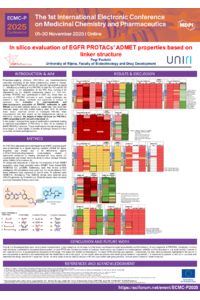
Proteolysis-targeting chimeras (PROTACs) are heterobifunctional molecules consisting of two linked substructures: protein-of-interest-binding ligand (POI ligand) and the E3 ubiquitin ligase-binding ligand. In this case, POI is the epidermal growth factor receptor (EGFR). EGFR is a transmembrane protein involved in cellular proliferation, angiogenesis, apoptosis and cancer metastasis in case of overexpression (particularly in lung cancer). Simultaneous binding of the PROTAC to both the EGFR and the E3 ligase leads to the ubiquitylation of the EGFR, thus marking it for degradation via the ubiquitin proteosome system. First EGFR PROTACs were developed in 2001, but all early synthetic PROTACs exhibited similar issues- high molecular weight and hooking effect, leading to poor ADMET properties of ligands.
To address those issues on a broad scale, scientists investigated whether PROTAC linker structure impacts biodegradation efficacy and PROTAC pharmacokinetics. However, the impact of linker structure on PROTACs’ DMPK properties is still not well understood. In this research we employed literature research to understand the current practices in EGFR PROTAC synthesis with improved ADMET properties. Based on theoretical findings, we have designed EGFR PROTAC structures employing one of the following linker modifications: i) linker length; ii) linker rigidity; iii) number of hydrogen donors in linker; iv) number of introduced heteroatoms. All compounds were tested in silico for the evaluation of their ADMET properties, using freely available online ADMET Tools: SwissADME, ADMETlab 2.0, pkCSM6, ADMET-AI, Simulations Plus ADMET Predictor.
Obtained results show that the AI tools have a higher precision in predicting ADMET properties of drugs not conforming to the rule of 5. The increase in linker length for EGFR PROTACs leads to improved bioavailability and decreased carcinogenicity, and higher linker rigidity causes increased plasma protein binding. Higher number of HBD leads to decreased oral acute toxicity, and the higher number of heteroatoms causes a decrease in hERG blocking.
Keywords
EGFR
PROTAC
ADMET
AI
Poster
ECMC-P-Pavletic-Pegi.pdf
Aloe-emodin-Loaded Microemulsion Based Herbal Gel: Design, Optimization, and Therapeutic Evaluation for Diabetic Wound Healing
Impact of Ferrocene and Ferrocenium on Cell Death Pathways in MCF-7 Cells