Event submissions
EventsThe 1st International Electronic Conference on Medicinal Chemistry and Pharmaceutics
Published
This submission belongs to the session S11. Formulation, Drug Delivery and Controlled Release of the event The 1st International Electronic Conference on Medicinal Chemistry and Pharmaceutics
Published date
29 Oct, 2025
Academic Editor
'%3e%3cpath%20d='M12.6657%2010.9104C12.4185%2010.325%2012.0599%209.79327%2011.6097%209.34482C11.1609%208.89508%2010.6293%208.5365%2010.0442%208.28888C10.0389%208.28626%2010.0337%208.28495%2010.0285%208.28233C10.8446%207.69279%2011.3752%206.73249%2011.3752%205.64904C11.3752%203.8542%209.92103%202.39999%208.1262%202.39999C6.33136%202.39999%204.87715%203.8542%204.87715%205.64904C4.87715%206.73249%205.40774%207.69279%206.22393%208.28364C6.21869%208.28626%206.21345%208.28757%206.20821%208.29019C5.62129%208.5378%205.09463%208.89284%204.64265%209.34613C4.1929%209.79493%203.83432%2010.3266%203.58671%2010.9117C3.34345%2011.4845%203.21226%2012.0987%203.20023%2012.7209C3.19988%2012.7349%203.20233%2012.7488%203.20744%2012.7619C3.21255%2012.7749%203.22022%2012.7867%203.22998%2012.7968C3.23975%2012.8068%203.25142%2012.8147%203.26431%2012.8202C3.2772%2012.8256%203.29105%2012.8284%203.30504%2012.8284H4.09109C4.14874%2012.8284%204.19459%2012.7825%204.1959%2012.7262C4.2221%2011.7148%204.62823%2010.7676%205.34617%2010.0497C6.08899%209.30683%207.0755%208.89808%208.1262%208.89808C9.17689%208.89808%2010.1634%209.30683%2010.9062%2010.0497C11.6242%2010.7676%2012.0303%2011.7148%2012.0565%2012.7262C12.0578%2012.7838%2012.1037%2012.8284%2012.1613%2012.8284H12.9474C12.9613%2012.8284%2012.9752%2012.8256%2012.9881%2012.8202C13.001%2012.8147%2013.0126%2012.8068%2013.0224%2012.7968C13.0322%2012.7867%2013.0398%2012.7749%2013.0449%2012.7619C13.0501%2012.7488%2013.0525%2012.7349%2013.0522%2012.7209C13.0391%2012.0947%2012.9094%2011.4855%2012.6657%2010.9104ZM8.1262%207.9024C7.52486%207.9024%206.9589%207.6679%206.53312%207.24211C6.10733%206.81633%205.87283%206.25037%205.87283%205.64904C5.87283%205.0477%206.10733%204.48174%206.53312%204.05596C6.9589%203.63018%207.52486%203.39567%208.1262%203.39567C8.72753%203.39567%209.29349%203.63018%209.71927%204.05596C10.1451%204.48174%2010.3796%205.0477%2010.3796%205.64904C10.3796%206.25037%2010.1451%206.81633%209.71927%207.24211C9.29349%207.6679%208.72753%207.9024%208.1262%207.9024Z'%20fill='%235D1EE1'/%3e%3c/g%3e%3c/svg%3e) Donato Cosco
Donato CoscoCitation
Ankit Chowdhury, Bapi Gorain, Papiya Mitra Mazumder, Citrus flavanone (naringenin)-infused transferosome based gel: Development, optimization, characterization with an exploration of diabetic wound healing potential through an integration of network pharmacology, in vitro and in vivo studies, in Proceedings of The 1st International Electronic Conference on Medicinal Chemistry and Pharmaceutics, 1 November–30 November 2025, MDPI: Basel, Switzerland
Share
Email
Facebook
Twitter
LinkedIn
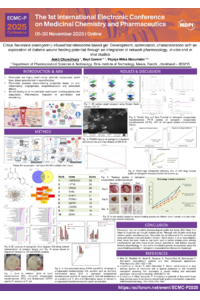
Citrus flavanone (naringenin)-infused transferosome based gel: Development, optimization, characterization with an exploration of diabetic wound healing potential through an integration of network pharmacology, in vitro and in vivo studies
'%3e%3cpath%20d='M12.6647%2010.9104C12.4176%2010.325%2012.0589%209.7933%2011.6088%209.34485C11.16%208.89511%2010.6283%208.53653%2010.0432%208.28891C10.038%208.28629%2010.0327%208.28498%2010.0275%208.28236C10.8437%207.69282%2011.3743%206.73252%2011.3743%205.64907C11.3743%203.85423%209.92005%202.40002%208.12522%202.40002C6.33038%202.40002%204.87618%203.85423%204.87618%205.64907C4.87618%206.73252%205.40677%207.69282%206.22296%208.28367C6.21772%208.28629%206.21248%208.2876%206.20724%208.29022C5.62031%208.53783%205.09365%208.89287%204.64167%209.34616C4.19192%209.79496%203.83334%2010.3266%203.58573%2010.9117C3.34247%2011.4846%203.21128%2012.0987%203.19925%2012.721C3.1989%2012.735%203.20135%2012.7489%203.20646%2012.7619C3.21157%2012.7749%203.21924%2012.7868%203.22901%2012.7968C3.23877%2012.8068%203.25045%2012.8148%203.26334%2012.8202C3.27623%2012.8256%203.29007%2012.8284%203.30406%2012.8284H4.09012C4.14776%2012.8284%204.19362%2012.7825%204.19493%2012.7262C4.22113%2011.7148%204.62726%2010.7676%205.34519%2010.0497C6.08802%209.30686%207.07452%208.89811%208.12522%208.89811C9.17592%208.89811%2010.1624%209.30686%2010.9052%2010.0497C11.6232%2010.7676%2012.0293%2011.7148%2012.0555%2012.7262C12.0568%2012.7839%2012.1027%2012.8284%2012.1603%2012.8284H12.9464C12.9604%2012.8284%2012.9742%2012.8256%2012.9871%2012.8202C13%2012.8148%2013.0117%2012.8068%2013.0214%2012.7968C13.0312%2012.7868%2013.0389%2012.7749%2013.044%2012.7619C13.0491%2012.7489%2013.0515%2012.735%2013.0512%2012.721C13.0381%2012.0947%2012.9084%2011.4856%2012.6647%2010.9104ZM8.12522%207.90243C7.52388%207.90243%206.95792%207.66793%206.53214%207.24215C6.10636%206.81636%205.87185%206.2504%205.87185%205.64907C5.87185%205.04773%206.10636%204.48177%206.53214%204.05599C6.95792%203.63021%207.52388%203.3957%208.12522%203.3957C8.72655%203.3957%209.29252%203.63021%209.7183%204.05599C10.1441%204.48177%2010.3786%205.04773%2010.3786%205.64907C10.3786%206.2504%2010.1441%206.81636%209.7183%207.24215C9.29252%207.66793%208.72655%207.90243%208.12522%207.90243Z'%20fill='%235D1EE1'/%3e%3c/g%3e%3c/svg%3e)
Ankit Chowdhury 1
Bapi Gorain 1
Papiya Mitra Mazumder 1
1. Department of Pharmaceutical Sciences & Technology, Birla Institute of Technology, Mesra, Ranchi, Jharkhand, 835215, India
Abstract
Flavonoids are widely used natural phenolic compounds, which have shown potential role in wound healing. Many pre-clinical studies have indicated that flavonoids are one of the most promising and important group of natural compounds which can be used to treat acute as well as chronic wounds. Flavonoids can be classified as flavones, isoflavones, flavonols, flavanols, flavanones and anthocyanins respectively. Naringin, the glycone part and naringenin the aglycone part falls under the broad umbrella of flavonoid class (flavanones) which are majorly obtained from various citrus fruits like lemon, orange, grapefruit. Several therapeutic roles have been documented for naringenin, such as anti-inflammatory, antioxidant, antiulcer, anticancer, wound healing activities. Due to challenges in solubility, it is crucial to encapsulate these compounds using nanotechnological platform to deliver and make them bioavailable for the treatment of several diseases. Nanocarriers like transferosomes act as self-adaptable ultra-deformable flexible bilayer vesicles composed of phospholipid and edge activators along with hydration media. The present study has focused on the beneficial role of the flavonoid naringenin with a special emphasis on naringenin encapsulated transferosomal gel towards healing of different diabetic wound conditions and exploring their underlying mechanisms. Quality by design (QbD) employing design expert software to optimize transferosomes and further Dynamic light scattering (DLS) studies, Field emission scanning electron microscopy (FESEM), Fourier-transformed infrared spectroscopy (FT-IR) analysis, X-ray diffraction (XRD) studies, Rheology studies, Percentage entrapment efficiency followed by In vitro drug release studies for naringenin encapsulated transferosomal gel has been evaluated. Development of naringenin embedded transferosomal gel has been carried out along with its in vitro antioxidant, antimicrobial activity evaluation followed by in vivo wound healing studies.
Keywords
Flavonoids
nanotechnology
nanocarriers
drug delivery systems
diabetic wound healing.
Poster
Ankit Chowdhury_ECMC-P 2025_MDPI.pdf
Impact of Ferrocene and Ferrocenium on Cell Death Pathways in MCF-7 Cells
Development of Folate Receptor (FR-α) Mediated Nano Carrier Sustained Release Formulation for Ameliorating Colorectal Cancer