Event submissions
EventsThe 1st International Electronic Conference on Medicinal Chemistry and Pharmaceutics
Published
This submission belongs to the session S11. Formulation, Drug Delivery and Controlled Release of the event The 1st International Electronic Conference on Medicinal Chemistry and Pharmaceutics
Published date
29 Oct, 2025
Academic Editor
'%3e%3cpath%20d='M12.6657%2010.9104C12.4185%2010.325%2012.0599%209.79327%2011.6097%209.34482C11.1609%208.89508%2010.6293%208.5365%2010.0442%208.28888C10.0389%208.28626%2010.0337%208.28495%2010.0285%208.28233C10.8446%207.69279%2011.3752%206.73249%2011.3752%205.64904C11.3752%203.8542%209.92103%202.39999%208.1262%202.39999C6.33136%202.39999%204.87715%203.8542%204.87715%205.64904C4.87715%206.73249%205.40774%207.69279%206.22393%208.28364C6.21869%208.28626%206.21345%208.28757%206.20821%208.29019C5.62129%208.5378%205.09463%208.89284%204.64265%209.34613C4.1929%209.79493%203.83432%2010.3266%203.58671%2010.9117C3.34345%2011.4845%203.21226%2012.0987%203.20023%2012.7209C3.19988%2012.7349%203.20233%2012.7488%203.20744%2012.7619C3.21255%2012.7749%203.22022%2012.7867%203.22998%2012.7968C3.23975%2012.8068%203.25142%2012.8147%203.26431%2012.8202C3.2772%2012.8256%203.29105%2012.8284%203.30504%2012.8284H4.09109C4.14874%2012.8284%204.19459%2012.7825%204.1959%2012.7262C4.2221%2011.7148%204.62823%2010.7676%205.34617%2010.0497C6.08899%209.30683%207.0755%208.89808%208.1262%208.89808C9.17689%208.89808%2010.1634%209.30683%2010.9062%2010.0497C11.6242%2010.7676%2012.0303%2011.7148%2012.0565%2012.7262C12.0578%2012.7838%2012.1037%2012.8284%2012.1613%2012.8284H12.9474C12.9613%2012.8284%2012.9752%2012.8256%2012.9881%2012.8202C13.001%2012.8147%2013.0126%2012.8068%2013.0224%2012.7968C13.0322%2012.7867%2013.0398%2012.7749%2013.0449%2012.7619C13.0501%2012.7488%2013.0525%2012.7349%2013.0522%2012.7209C13.0391%2012.0947%2012.9094%2011.4855%2012.6657%2010.9104ZM8.1262%207.9024C7.52486%207.9024%206.9589%207.6679%206.53312%207.24211C6.10733%206.81633%205.87283%206.25037%205.87283%205.64904C5.87283%205.0477%206.10733%204.48174%206.53312%204.05596C6.9589%203.63018%207.52486%203.39567%208.1262%203.39567C8.72753%203.39567%209.29349%203.63018%209.71927%204.05596C10.1451%204.48174%2010.3796%205.0477%2010.3796%205.64904C10.3796%206.25037%2010.1451%206.81633%209.71927%207.24211C9.29349%207.6679%208.72753%207.9024%208.1262%207.9024Z'%20fill='%235D1EE1'/%3e%3c/g%3e%3c/svg%3e) Antonio Vassallo
Antonio VassalloCitation
Rebecca Castellacci, Anna Rita Bilia, Maria Camilla Bergonzi, Conventional and Galactosylated Liposomal Formulations of Ellagic Acid for the Modulation of Cellular Senescence, in Proceedings of The 1st International Electronic Conference on Medicinal Chemistry and Pharmaceutics, 1 November–30 November 2025, MDPI: Basel, Switzerland
Share
Email
Facebook
Twitter
LinkedIn
Conventional and Galactosylated Liposomal Formulations of Ellagic Acid for the Modulation of Cellular Senescence
'%3e%3cpath%20d='M12.6647%2010.9104C12.4176%2010.325%2012.0589%209.7933%2011.6088%209.34485C11.16%208.89511%2010.6283%208.53653%2010.0432%208.28891C10.038%208.28629%2010.0327%208.28498%2010.0275%208.28236C10.8437%207.69282%2011.3743%206.73252%2011.3743%205.64907C11.3743%203.85423%209.92005%202.40002%208.12522%202.40002C6.33038%202.40002%204.87618%203.85423%204.87618%205.64907C4.87618%206.73252%205.40677%207.69282%206.22296%208.28367C6.21772%208.28629%206.21248%208.2876%206.20724%208.29022C5.62031%208.53783%205.09365%208.89287%204.64167%209.34616C4.19192%209.79496%203.83334%2010.3266%203.58573%2010.9117C3.34247%2011.4846%203.21128%2012.0987%203.19925%2012.721C3.1989%2012.735%203.20135%2012.7489%203.20646%2012.7619C3.21157%2012.7749%203.21924%2012.7868%203.22901%2012.7968C3.23877%2012.8068%203.25045%2012.8148%203.26334%2012.8202C3.27623%2012.8256%203.29007%2012.8284%203.30406%2012.8284H4.09012C4.14776%2012.8284%204.19362%2012.7825%204.19493%2012.7262C4.22113%2011.7148%204.62726%2010.7676%205.34519%2010.0497C6.08802%209.30686%207.07452%208.89811%208.12522%208.89811C9.17592%208.89811%2010.1624%209.30686%2010.9052%2010.0497C11.6232%2010.7676%2012.0293%2011.7148%2012.0555%2012.7262C12.0568%2012.7839%2012.1027%2012.8284%2012.1603%2012.8284H12.9464C12.9604%2012.8284%2012.9742%2012.8256%2012.9871%2012.8202C13%2012.8148%2013.0117%2012.8068%2013.0214%2012.7968C13.0312%2012.7868%2013.0389%2012.7749%2013.044%2012.7619C13.0491%2012.7489%2013.0515%2012.735%2013.0512%2012.721C13.0381%2012.0947%2012.9084%2011.4856%2012.6647%2010.9104ZM8.12522%207.90243C7.52388%207.90243%206.95792%207.66793%206.53214%207.24215C6.10636%206.81636%205.87185%206.2504%205.87185%205.64907C5.87185%205.04773%206.10636%204.48177%206.53214%204.05599C6.95792%203.63021%207.52388%203.3957%208.12522%203.3957C8.72655%203.3957%209.29252%203.63021%209.7183%204.05599C10.1441%204.48177%2010.3786%205.04773%2010.3786%205.64907C10.3786%206.2504%2010.1441%206.81636%209.7183%207.24215C9.29252%207.66793%208.72655%207.90243%208.12522%207.90243Z'%20fill='%235D1EE1'/%3e%3c/g%3e%3c/svg%3e)
Rebecca Castellacci 1
Anna Rita Bilia 1

Maria Camilla Bergonzi 1
1. Department of Chemistry, University of Florence, via Ugo Schiff 6, Sesto Fiorentino, 50019, Italy.
Abstract
Ellagic acid (EA) is a natural polyphenolic compound mainly present in Punica granatum L. It has gained increasing interest for its antioxidant and anti-senescence properties, with documented benefits in models of cardiovascular, renal, and neurodegenerative aging. However, its clinical application is hindered by very low aqueous solubility (9.7 µg/mL), poor bioavailability, and limited stability.
This study aimed to overcome these limitations by developing a liposomal formulation (LP-EA), further functionalized with a galactose derivative (Gal-LP-EA) for selective delivery to senescent cells. This targeting strategy exploits the overexpression of β-galactosidase, which cleaves the galactose–liposome bond, enabling the intracellular release of EA specifically in pathological cells.
LP-EA and Gal-LP-EA were prepared by thin-film hydration method and physicochemically characterized for particle size, polydispersity index (PdI), zeta potential, morphology, and encapsulation efficiency (EE%). Stability was assessed over 30 days at controlled temperatures, and in vitro release profile was investigated using the dialysis bag method. Passive permeability across the blood–brain barrier (BBB) was evaluated by PAMPA test.
Encapsulation of EA into LP increased its solubility by approximately 56-fold. LP-EA and GAL-LP-EA showed size, PdI and Zeta potential of 113.2±0.91 nm, 0.21±0.00 and -24.57±0.43 mV and 110.8±0.17 nm, 0.21±0.02 and -24.04±0.04 mV, respectively. EE% was around 80% for both formulations. The physicochemical properties were stable through the study period. Moreover, LP provided a sustained and gradual release over 24 h (~30%), avoiding the burst effect observed for EA solution (52% at 2h), following the Fickian diffusion mechanism. Liposomal formulations significantly enhanced EA BBB permeation, as evidenced by an approximately one order of magnitude increase in the permeability coefficient.
These results indicate that LP improved EA solubility, stability and controlled release, facilitating its transport across the BBB. Thus, GAL-LP-EA could represent a promising nanomedicine-based strategy for age-related diseases.
Keywords
Ellagic acid
liposomes
galactose-functionalization
controlled release
PAMPA assay
senescence
Poster
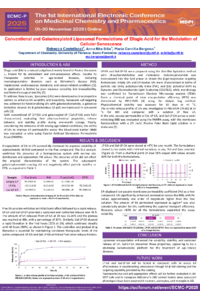
Rebecca Castellacci Poster The 1st Int Elect Conf on Med Chem and Pharm.pdf
Development of a method for obtaining and quality control of composites nanostructured with AgNPs particles for promising medical applications
IVERMECTIN LOADED SOLID LIPID NANOPARTICLES FOR OVARIAN CANCER TREATMENT: DEVELOPMENT, CHARACTERIZATION AND ENHANCED CYTOTOXIC ACTIVITY