Event submissions
EventsThe 1st International Electronic Conference on Medicinal Chemistry and Pharmaceutics
Published
This submission belongs to the session S7. Emerging technologies in drug discovery of the event The 1st International Electronic Conference on Medicinal Chemistry and Pharmaceutics
Published date
29 Oct, 2025
Academic Editor
'%3e%3cpath%20d='M12.6657%2010.9104C12.4185%2010.325%2012.0599%209.79327%2011.6097%209.34482C11.1609%208.89508%2010.6293%208.5365%2010.0442%208.28888C10.0389%208.28626%2010.0337%208.28495%2010.0285%208.28233C10.8446%207.69279%2011.3752%206.73249%2011.3752%205.64904C11.3752%203.8542%209.92103%202.39999%208.1262%202.39999C6.33136%202.39999%204.87715%203.8542%204.87715%205.64904C4.87715%206.73249%205.40774%207.69279%206.22393%208.28364C6.21869%208.28626%206.21345%208.28757%206.20821%208.29019C5.62129%208.5378%205.09463%208.89284%204.64265%209.34613C4.1929%209.79493%203.83432%2010.3266%203.58671%2010.9117C3.34345%2011.4845%203.21226%2012.0987%203.20023%2012.7209C3.19988%2012.7349%203.20233%2012.7488%203.20744%2012.7619C3.21255%2012.7749%203.22022%2012.7867%203.22998%2012.7968C3.23975%2012.8068%203.25142%2012.8147%203.26431%2012.8202C3.2772%2012.8256%203.29105%2012.8284%203.30504%2012.8284H4.09109C4.14874%2012.8284%204.19459%2012.7825%204.1959%2012.7262C4.2221%2011.7148%204.62823%2010.7676%205.34617%2010.0497C6.08899%209.30683%207.0755%208.89808%208.1262%208.89808C9.17689%208.89808%2010.1634%209.30683%2010.9062%2010.0497C11.6242%2010.7676%2012.0303%2011.7148%2012.0565%2012.7262C12.0578%2012.7838%2012.1037%2012.8284%2012.1613%2012.8284H12.9474C12.9613%2012.8284%2012.9752%2012.8256%2012.9881%2012.8202C13.001%2012.8147%2013.0126%2012.8068%2013.0224%2012.7968C13.0322%2012.7867%2013.0398%2012.7749%2013.0449%2012.7619C13.0501%2012.7488%2013.0525%2012.7349%2013.0522%2012.7209C13.0391%2012.0947%2012.9094%2011.4855%2012.6657%2010.9104ZM8.1262%207.9024C7.52486%207.9024%206.9589%207.6679%206.53312%207.24211C6.10733%206.81633%205.87283%206.25037%205.87283%205.64904C5.87283%205.0477%206.10733%204.48174%206.53312%204.05596C6.9589%203.63018%207.52486%203.39567%208.1262%203.39567C8.72753%203.39567%209.29349%203.63018%209.71927%204.05596C10.1451%204.48174%2010.3796%205.0477%2010.3796%205.64904C10.3796%206.25037%2010.1451%206.81633%209.71927%207.24211C9.29349%207.6679%208.72753%207.9024%208.1262%207.9024Z'%20fill='%235D1EE1'/%3e%3c/g%3e%3c/svg%3e) Mary Jane Meegan
Mary Jane MeeganCitation
Ns Hari Narayana Moorthy, Sushmita Verma, C Karthikeyn, Machine Learning Based classification Analysis of hERG Blockers for Prevention of Cardiac Toxicity, in Proceedings of The 1st International Electronic Conference on Medicinal Chemistry and Pharmaceutics, 1 November–30 November 2025, MDPI: Basel, Switzerland
Share
Email
Facebook
Twitter
LinkedIn
Machine Learning Based classification Analysis of hERG Blockers for Prevention of Cardiac Toxicity
'%3e%3cpath%20d='M12.6647%2010.9104C12.4176%2010.325%2012.0589%209.7933%2011.6088%209.34485C11.16%208.89511%2010.6283%208.53653%2010.0432%208.28891C10.038%208.28629%2010.0327%208.28498%2010.0275%208.28236C10.8437%207.69282%2011.3743%206.73252%2011.3743%205.64907C11.3743%203.85423%209.92005%202.40002%208.12522%202.40002C6.33038%202.40002%204.87618%203.85423%204.87618%205.64907C4.87618%206.73252%205.40677%207.69282%206.22296%208.28367C6.21772%208.28629%206.21248%208.2876%206.20724%208.29022C5.62031%208.53783%205.09365%208.89287%204.64167%209.34616C4.19192%209.79496%203.83334%2010.3266%203.58573%2010.9117C3.34247%2011.4846%203.21128%2012.0987%203.19925%2012.721C3.1989%2012.735%203.20135%2012.7489%203.20646%2012.7619C3.21157%2012.7749%203.21924%2012.7868%203.22901%2012.7968C3.23877%2012.8068%203.25045%2012.8148%203.26334%2012.8202C3.27623%2012.8256%203.29007%2012.8284%203.30406%2012.8284H4.09012C4.14776%2012.8284%204.19362%2012.7825%204.19493%2012.7262C4.22113%2011.7148%204.62726%2010.7676%205.34519%2010.0497C6.08802%209.30686%207.07452%208.89811%208.12522%208.89811C9.17592%208.89811%2010.1624%209.30686%2010.9052%2010.0497C11.6232%2010.7676%2012.0293%2011.7148%2012.0555%2012.7262C12.0568%2012.7839%2012.1027%2012.8284%2012.1603%2012.8284H12.9464C12.9604%2012.8284%2012.9742%2012.8256%2012.9871%2012.8202C13%2012.8148%2013.0117%2012.8068%2013.0214%2012.7968C13.0312%2012.7868%2013.0389%2012.7749%2013.044%2012.7619C13.0491%2012.7489%2013.0515%2012.735%2013.0512%2012.721C13.0381%2012.0947%2012.9084%2011.4856%2012.6647%2010.9104ZM8.12522%207.90243C7.52388%207.90243%206.95792%207.66793%206.53214%207.24215C6.10636%206.81636%205.87185%206.2504%205.87185%205.64907C5.87185%205.04773%206.10636%204.48177%206.53214%204.05599C6.95792%203.63021%207.52388%203.3957%208.12522%203.3957C8.72655%203.3957%209.29252%203.63021%209.7183%204.05599C10.1441%204.48177%2010.3786%205.04773%2010.3786%205.64907C10.3786%206.2504%2010.1441%206.81636%209.7183%207.24215C9.29252%207.66793%208.72655%207.90243%208.12522%207.90243Z'%20fill='%235D1EE1'/%3e%3c/g%3e%3c/svg%3e)
Ns Hari Narayana Moorthy 1
Sushmita Verma 1
C Karthikeyn 1
1. Department of Pharmacy, Indira Gandhi National Tribal University, Amarkantak-484887, Madhya Pradesh, India
Abstract
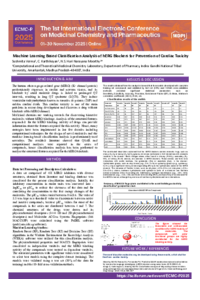
The human ether-a-go-go-related gene (hERG) predominantly expresses in cardiac tissues causes long QT syndrome and blockade of this gene leads to cardiotoxicity. Medicinal chemists are working towards for discovering bioactive molecules without hERG blockage. Hence, many strategies have been implemented in last few decades including computational techniques for the design of novel molecules and the machine learning based classification analysis is predominantly used nowadays. In this investigation, 451 compounds with hERG blocking activity (experimental -LogIC50), obtained from literature were considered in the study. For this analysis, the Decision Tree, Random Forest and Random Tree algorithms of WEKA software were applied. The results obtained from the analysis showed that the models developed with complete training set and validated by test set (30%) and 10-fold cross-validation methods provided significant statistical parameters. The contributed descriptors explained that the hERG blockers contain aromatic rings, such as phenyl (C6H5) or benzyl (C6H5CH2) groups, which can participate in π-π interactions with aromatic residues in the channel. Basic nitrogen atoms, often found in primary (R-NH2), secondary (R2-NH), or tertiary (R3-N) amines, are common in hERG blockers. Hydrophobic groups, such as alkyl chains (e.g., CH3, C2H5) or cycloalkyl groups (e.g., cyclohexyl, C6H11), play a significant role by enhancing binding affinity to the hydrophobic pocket of the hERG channel. The presence of flexible linkers, such as ethylene (–CH2–CH2–) or propylene (–CH2–CH2–CH2–) chains, between hydrophobic and hydrophilic parts of a molecule can facilitate optimal orientation within the binding site. Additionally, hydrogen bond donors (–OH, –NH2) and acceptors (e.g., –CO, –CN) contribute to the binding affinity and specificity of a compound for the hERG channel, although they are less critical than hydrophobic and ionic interactions. This analysis provides information on the physicochemical properties required for the avoiding hERG blockade.
Keywords
Machine learning
hERG
drug discovery
decision tree
descriptors
Poster
Poster-Sushmita.pdf
A Novel Hierarchical Support Vector Regression Approach for Predicting BBB Penetration
Dopexamine as a Multitargeted Drug Candidate for E. coli caused Urinary Tract and Bloodstream Infections and Outperforms FDA-approved Drugs Nitrofurantoin and Ceftriaxone