Event submissions
EventsThe 1st International Electronic Conference on Medicinal Chemistry and Pharmaceutics
Published
This submission belongs to the session S11. Formulation, Drug Delivery and Controlled Release of the event The 1st International Electronic Conference on Medicinal Chemistry and Pharmaceutics
Published date
29 Oct, 2025
Academic Editor
'%3e%3cpath%20d='M12.6657%2010.9104C12.4185%2010.325%2012.0599%209.79327%2011.6097%209.34482C11.1609%208.89508%2010.6293%208.5365%2010.0442%208.28888C10.0389%208.28626%2010.0337%208.28495%2010.0285%208.28233C10.8446%207.69279%2011.3752%206.73249%2011.3752%205.64904C11.3752%203.8542%209.92103%202.39999%208.1262%202.39999C6.33136%202.39999%204.87715%203.8542%204.87715%205.64904C4.87715%206.73249%205.40774%207.69279%206.22393%208.28364C6.21869%208.28626%206.21345%208.28757%206.20821%208.29019C5.62129%208.5378%205.09463%208.89284%204.64265%209.34613C4.1929%209.79493%203.83432%2010.3266%203.58671%2010.9117C3.34345%2011.4845%203.21226%2012.0987%203.20023%2012.7209C3.19988%2012.7349%203.20233%2012.7488%203.20744%2012.7619C3.21255%2012.7749%203.22022%2012.7867%203.22998%2012.7968C3.23975%2012.8068%203.25142%2012.8147%203.26431%2012.8202C3.2772%2012.8256%203.29105%2012.8284%203.30504%2012.8284H4.09109C4.14874%2012.8284%204.19459%2012.7825%204.1959%2012.7262C4.2221%2011.7148%204.62823%2010.7676%205.34617%2010.0497C6.08899%209.30683%207.0755%208.89808%208.1262%208.89808C9.17689%208.89808%2010.1634%209.30683%2010.9062%2010.0497C11.6242%2010.7676%2012.0303%2011.7148%2012.0565%2012.7262C12.0578%2012.7838%2012.1037%2012.8284%2012.1613%2012.8284H12.9474C12.9613%2012.8284%2012.9752%2012.8256%2012.9881%2012.8202C13.001%2012.8147%2013.0126%2012.8068%2013.0224%2012.7968C13.0322%2012.7867%2013.0398%2012.7749%2013.0449%2012.7619C13.0501%2012.7488%2013.0525%2012.7349%2013.0522%2012.7209C13.0391%2012.0947%2012.9094%2011.4855%2012.6657%2010.9104ZM8.1262%207.9024C7.52486%207.9024%206.9589%207.6679%206.53312%207.24211C6.10733%206.81633%205.87283%206.25037%205.87283%205.64904C5.87283%205.0477%206.10733%204.48174%206.53312%204.05596C6.9589%203.63018%207.52486%203.39567%208.1262%203.39567C8.72753%203.39567%209.29349%203.63018%209.71927%204.05596C10.1451%204.48174%2010.3796%205.0477%2010.3796%205.64904C10.3796%206.25037%2010.1451%206.81633%209.71927%207.24211C9.29349%207.6679%208.72753%207.9024%208.1262%207.9024Z'%20fill='%235D1EE1'/%3e%3c/g%3e%3c/svg%3e) Antonio Vassallo
Antonio VassalloCitation
Varnita Karmakar, Bapi Gorain, Targeting Neuroinflammation and Tau/APP Pathology via Intranasal Delivery of Azilsartan Medoxomil Nanoemulgel in AlCl₃-induced Alzheimer’s Dementia Model, in Proceedings of The 1st International Electronic Conference on Medicinal Chemistry and Pharmaceutics, 1 November–30 November 2025, MDPI: Basel, Switzerland
Share
Email
Facebook
Twitter
LinkedIn
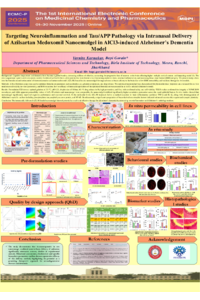
Targeting Neuroinflammation and Tau/APP Pathology via Intranasal Delivery of Azilsartan Medoxomil Nanoemulgel in AlCl3-induced Alzheimer’s Dementia Model
'%3e%3cpath%20d='M12.6647%2010.9104C12.4176%2010.325%2012.0589%209.7933%2011.6088%209.34485C11.16%208.89511%2010.6283%208.53653%2010.0432%208.28891C10.038%208.28629%2010.0327%208.28498%2010.0275%208.28236C10.8437%207.69282%2011.3743%206.73252%2011.3743%205.64907C11.3743%203.85423%209.92005%202.40002%208.12522%202.40002C6.33038%202.40002%204.87618%203.85423%204.87618%205.64907C4.87618%206.73252%205.40677%207.69282%206.22296%208.28367C6.21772%208.28629%206.21248%208.2876%206.20724%208.29022C5.62031%208.53783%205.09365%208.89287%204.64167%209.34616C4.19192%209.79496%203.83334%2010.3266%203.58573%2010.9117C3.34247%2011.4846%203.21128%2012.0987%203.19925%2012.721C3.1989%2012.735%203.20135%2012.7489%203.20646%2012.7619C3.21157%2012.7749%203.21924%2012.7868%203.22901%2012.7968C3.23877%2012.8068%203.25045%2012.8148%203.26334%2012.8202C3.27623%2012.8256%203.29007%2012.8284%203.30406%2012.8284H4.09012C4.14776%2012.8284%204.19362%2012.7825%204.19493%2012.7262C4.22113%2011.7148%204.62726%2010.7676%205.34519%2010.0497C6.08802%209.30686%207.07452%208.89811%208.12522%208.89811C9.17592%208.89811%2010.1624%209.30686%2010.9052%2010.0497C11.6232%2010.7676%2012.0293%2011.7148%2012.0555%2012.7262C12.0568%2012.7839%2012.1027%2012.8284%2012.1603%2012.8284H12.9464C12.9604%2012.8284%2012.9742%2012.8256%2012.9871%2012.8202C13%2012.8148%2013.0117%2012.8068%2013.0214%2012.7968C13.0312%2012.7868%2013.0389%2012.7749%2013.044%2012.7619C13.0491%2012.7489%2013.0515%2012.735%2013.0512%2012.721C13.0381%2012.0947%2012.9084%2011.4856%2012.6647%2010.9104ZM8.12522%207.90243C7.52388%207.90243%206.95792%207.66793%206.53214%207.24215C6.10636%206.81636%205.87185%206.2504%205.87185%205.64907C5.87185%205.04773%206.10636%204.48177%206.53214%204.05599C6.95792%203.63021%207.52388%203.3957%208.12522%203.3957C8.72655%203.3957%209.29252%203.63021%209.7183%204.05599C10.1441%204.48177%2010.3786%205.04773%2010.3786%205.64907C10.3786%206.2504%2010.1441%206.81636%209.7183%207.24215C9.29252%207.66793%208.72655%207.90243%208.12522%207.90243Z'%20fill='%235D1EE1'/%3e%3c/g%3e%3c/svg%3e)
Varnita Karmakar 1
Bapi Gorain 2
1. Research Scholar (CSIR-SRF), Department of Pharmaceutical Sciences and Technology, Birla Institute of Technology, Mesra, India
2. Department of Pharmaceutical Sciences & Technology, Birla Institute of Technology, Mera, Ranchi, India
Abstract
Background: Cognitive impairment and dementia have become a global burden, distressing millions of elderlies, accounting for progressive loss of neurons in the brain affecting higher multiple cortical centers, and impacting social life. The renin-angiotensin system and its receptors, widely distributed within the brain, offer potential to treat dementia via diminishing oxidative stress, neuronal inflammation, and increasing blood-brain barrier (BBB) integrity. The present study delves into the formulation and optimization of thermoresponsive azilsartan medoxomil (AZL-M) loaded in situ nanoemulgel for targeted nose-to-brain delivery to the brain due to low BBB permeability and validated through in vivo models.
Methods: A Box-Behnken design was used to optimize formulation parameters such as droplet size, gelation temperature, and drug release. The optimized nanoemulgel was characterized for physicochemical properties and evaluated for ex-vivo nasal mucosal toxicity, in-vitro cytotoxicity, and ROS reduction. In-vivo efficacy of intranasal application of the optimized formulation was assessed in an AlCl₃-induced Alzheimer's model.
Results: Formulation-F20 showed optimal gelation at 33.4°C, pH-6.21, droplet size of 160nm, 60.4% drug release in 8h, high permeation, and flux, with confirmed safety and cell viability. TEER studies confirmed the integrity of RPMI-2650 monolayers, and while apparent permeability values of AZL-M solution and nanoemulgel were comparable, the nanoemulgel exhibited significantly higher cumulative permeation across the nasal epithelial barrier. In-vivo studies showed that nanoemulgel significantly improved cognitive performance and neuronal survival. At the molecular level, AZL-M treatment led to a marked reduction in brain inflammatory cytokines TNF-α and IL-1β, along with downregulation of Alzheimer’s-specific markers including phosphorylated tau, amyloid precursor protein, and NF-κB. Simultaneously, a significant upregulation of brain-derived neurotrophic factors indicated enhanced neurotrophic support and synaptic plasticity.
Conclusion: The intranasally delivered AZL-M-loaded nanoemulgel showed potential as a safe and effective therapy for Alzheimer’s dementia by attenuating neuroinflammation and Alzheimer’s pathology markers.
Keywords
Keywords: azilsartan medoxomil
nanoemulgel
Alzheimer’s dementia
neuroprotection
biomarker study
Poster
VK MDPI.pdf
Dopexamine as a Multitargeted Drug Candidate for E. coli caused Urinary Tract and Bloodstream Infections and Outperforms FDA-approved Drugs Nitrofurantoin and Ceftriaxone
Preventing Sepsis by Preemptive Restoration of “Leaky Gut” with an Advanced Probiotic Platform