Event submissions
EventsThe 1st International Electronic Conference on Medicinal Chemistry and Pharmaceutics
Published
This submission belongs to the session S10. Nanomedicine and Nanotechnology of the event The 1st International Electronic Conference on Medicinal Chemistry and Pharmaceutics
Published date
29 Oct, 2025
Academic Editor
'%3e%3cpath%20d='M12.6657%2010.9104C12.4185%2010.325%2012.0599%209.79327%2011.6097%209.34482C11.1609%208.89508%2010.6293%208.5365%2010.0442%208.28888C10.0389%208.28626%2010.0337%208.28495%2010.0285%208.28233C10.8446%207.69279%2011.3752%206.73249%2011.3752%205.64904C11.3752%203.8542%209.92103%202.39999%208.1262%202.39999C6.33136%202.39999%204.87715%203.8542%204.87715%205.64904C4.87715%206.73249%205.40774%207.69279%206.22393%208.28364C6.21869%208.28626%206.21345%208.28757%206.20821%208.29019C5.62129%208.5378%205.09463%208.89284%204.64265%209.34613C4.1929%209.79493%203.83432%2010.3266%203.58671%2010.9117C3.34345%2011.4845%203.21226%2012.0987%203.20023%2012.7209C3.19988%2012.7349%203.20233%2012.7488%203.20744%2012.7619C3.21255%2012.7749%203.22022%2012.7867%203.22998%2012.7968C3.23975%2012.8068%203.25142%2012.8147%203.26431%2012.8202C3.2772%2012.8256%203.29105%2012.8284%203.30504%2012.8284H4.09109C4.14874%2012.8284%204.19459%2012.7825%204.1959%2012.7262C4.2221%2011.7148%204.62823%2010.7676%205.34617%2010.0497C6.08899%209.30683%207.0755%208.89808%208.1262%208.89808C9.17689%208.89808%2010.1634%209.30683%2010.9062%2010.0497C11.6242%2010.7676%2012.0303%2011.7148%2012.0565%2012.7262C12.0578%2012.7838%2012.1037%2012.8284%2012.1613%2012.8284H12.9474C12.9613%2012.8284%2012.9752%2012.8256%2012.9881%2012.8202C13.001%2012.8147%2013.0126%2012.8068%2013.0224%2012.7968C13.0322%2012.7867%2013.0398%2012.7749%2013.0449%2012.7619C13.0501%2012.7488%2013.0525%2012.7349%2013.0522%2012.7209C13.0391%2012.0947%2012.9094%2011.4855%2012.6657%2010.9104ZM8.1262%207.9024C7.52486%207.9024%206.9589%207.6679%206.53312%207.24211C6.10733%206.81633%205.87283%206.25037%205.87283%205.64904C5.87283%205.0477%206.10733%204.48174%206.53312%204.05596C6.9589%203.63018%207.52486%203.39567%208.1262%203.39567C8.72753%203.39567%209.29349%203.63018%209.71927%204.05596C10.1451%204.48174%2010.3796%205.0477%2010.3796%205.64904C10.3796%206.25037%2010.1451%206.81633%209.71927%207.24211C9.29349%207.6679%208.72753%207.9024%208.1262%207.9024Z'%20fill='%235D1EE1'/%3e%3c/g%3e%3c/svg%3e) Gareth R. Williams
Gareth R. WilliamsCitation
Shuang Zhao, Huilan Fan, Shuxiang Yang, Chengyan Xu, Yanli Liu, Yixuan Guo, Yangyi Yu, Yafei Sun, Haijing Li, Yong Wang, Jincheng Guo, Chun Li, Jingyu Wang, Artificial Cell-Derived Vesicles from Ginsenoside Rg1-Primed Mesenchymal Stromal Cells Mitigate Oxidative Stress and DNA Damage in Myocardial Ischemic/Reperfusion Injury, in Proceedings of The 1st International Electronic Conference on Medicinal Chemistry and Pharmaceutics, 1 November–30 November 2025, MDPI: Basel, Switzerland
Share
Email
Facebook
Twitter
LinkedIn
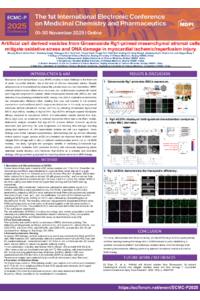
Artificial Cell-Derived Vesicles from Ginsenoside Rg1-Primed Mesenchymal Stromal Cells Mitigate Oxidative Stress and DNA Damage in Myocardial Ischemic/Reperfusion Injury
'%3e%3cpath%20d='M12.6647%2010.9104C12.4176%2010.325%2012.0589%209.7933%2011.6088%209.34485C11.16%208.89511%2010.6283%208.53653%2010.0432%208.28891C10.038%208.28629%2010.0327%208.28498%2010.0275%208.28236C10.8437%207.69282%2011.3743%206.73252%2011.3743%205.64907C11.3743%203.85423%209.92005%202.40002%208.12522%202.40002C6.33038%202.40002%204.87618%203.85423%204.87618%205.64907C4.87618%206.73252%205.40677%207.69282%206.22296%208.28367C6.21772%208.28629%206.21248%208.2876%206.20724%208.29022C5.62031%208.53783%205.09365%208.89287%204.64167%209.34616C4.19192%209.79496%203.83334%2010.3266%203.58573%2010.9117C3.34247%2011.4846%203.21128%2012.0987%203.19925%2012.721C3.1989%2012.735%203.20135%2012.7489%203.20646%2012.7619C3.21157%2012.7749%203.21924%2012.7868%203.22901%2012.7968C3.23877%2012.8068%203.25045%2012.8148%203.26334%2012.8202C3.27623%2012.8256%203.29007%2012.8284%203.30406%2012.8284H4.09012C4.14776%2012.8284%204.19362%2012.7825%204.19493%2012.7262C4.22113%2011.7148%204.62726%2010.7676%205.34519%2010.0497C6.08802%209.30686%207.07452%208.89811%208.12522%208.89811C9.17592%208.89811%2010.1624%209.30686%2010.9052%2010.0497C11.6232%2010.7676%2012.0293%2011.7148%2012.0555%2012.7262C12.0568%2012.7839%2012.1027%2012.8284%2012.1603%2012.8284H12.9464C12.9604%2012.8284%2012.9742%2012.8256%2012.9871%2012.8202C13%2012.8148%2013.0117%2012.8068%2013.0214%2012.7968C13.0312%2012.7868%2013.0389%2012.7749%2013.044%2012.7619C13.0491%2012.7489%2013.0515%2012.735%2013.0512%2012.721C13.0381%2012.0947%2012.9084%2011.4856%2012.6647%2010.9104ZM8.12522%207.90243C7.52388%207.90243%206.95792%207.66793%206.53214%207.24215C6.10636%206.81636%205.87185%206.2504%205.87185%205.64907C5.87185%205.04773%206.10636%204.48177%206.53214%204.05599C6.95792%203.63021%207.52388%203.3957%208.12522%203.3957C8.72655%203.3957%209.29252%203.63021%209.7183%204.05599C10.1441%204.48177%2010.3786%205.04773%2010.3786%205.64907C10.3786%206.2504%2010.1441%206.81636%209.7183%207.24215C9.29252%207.66793%208.72655%207.90243%208.12522%207.90243Z'%20fill='%235D1EE1'/%3e%3c/g%3e%3c/svg%3e)
Shuang Zhao 1
Huilan Fan 1
Shuxiang Yang 2
Chengyan Xu 1
Yanli Liu 1
Yixuan Guo 2
Yangyi Yu 1
Yafei Sun 1
Haijing Li 1
Yong Wang 3
Jincheng Guo 1
Chun Li 1,4,5
Jingyu Wang 1
1. College of Traditional Chinese Medicine, Beijing University of Chinese Medicine, Beijing 100029, China
2. School of Management, Beijing University of Chinese Medicine, Beijing 100029, China
3. Dongzhimen Hospital, Beijing University of Chinese Medicine, Beijing 100007, China
4. State Key Laboratory of Traditional Chinese Medicine Syndrome, Guangzhou University of Chinese Medicine, Guangzhou 510006, China
5. Modern Research Center for Traditional Chinese Medicine, Beijing University of Chinese Medicine, Beijing 100029, China
Abstract
Myocardial ischemia/reperfusion injury (MI/RI) remains a major challenge in the treatment of acute myocardial infarction due to the lack of effective therapeutic options. Despite advancements in interventional techniques like percutaneous coronary intervention, MI/RI-induced oxidative stress, inflammatory responses, and cardiomyocyte apoptosis still lead to poor long-term prognosis for patients. While mesenchymal stromal cells (MSCs) and their derivates show promising potential for MI/RI therapy, their clinical application is hindered by low transplantation efficiency—often resulting from poor cell retention in the ischemic myocardium—and insufficient yield for large-scale clinical use. In this study, we engineered nanoscale artificial cell-derived vesicles (ACDVs) by extruding Ginsenoside Rg1-primed MSCs (Rg1-MSCs), resulting in Rg1-ACDVs. Rg1-ACDVs displayed superior therapeutic efficacy compared to non-primed ACDVs and extracellular vesicles derived from Rg1-MSCs (Rg1-EVs), as evidenced by reduced myocardial infarct size in rat MI/RI models. Multi-omics analysis revealed that Rg1-ACDVs possess distinct molecular signatures associated with promoting cell cycle progression and reducing DNA damage, including upregulated expression of DNA repair-related proteins and cell cycle regulators. These findings were further validated experimentally, demonstrating that Rg1-ACDVs effectively reduce reactive oxygen species (ROS) accumulation—an important driver of MI/RI—and mitigate DNA damage both in vitro (in cultured cardiomyocytes) and in vivo (in rat MI/RI models). This study highlights the synergistic benefits of combining Ginsenoside Rg1 priming (which modulates MSC paracrine function) with nanoscale engineering (which optimizes vesicle delivery), and introduces Rg1-ACDVs as a scalable and innovative strategy, offering a promising approach for improving clinical outcomes in MI/RI therapy.
Keywords
myocardial ischemia-reperfusion injury;mesenchymal stromal cells; artificial cell derived vesicles; extracellular vesicles,;Ginsenoside Rg1;oxidative stress
Poster
poster Shuang.pdf
Intranasal administration of recombinant chaperone GRP78 is a promising disease-modifying treatment approach for Parkinson’s disease and sleep restriction-associated neurodegeneration
Innovative nanoplatforms with simultaneous triple drug co-delivery for improved synergistic therapeutic effects