Event submissions
EventsThe 1st International Electronic Conference on Medicinal Chemistry and Pharmaceutics
Published
This submission belongs to the session S11. Formulation, Drug Delivery and Controlled Release of the event The 1st International Electronic Conference on Medicinal Chemistry and Pharmaceutics
Published date
29 Oct, 2025
Academic Editor
'%3e%3cpath%20d='M12.6657%2010.9104C12.4185%2010.325%2012.0599%209.79327%2011.6097%209.34482C11.1609%208.89508%2010.6293%208.5365%2010.0442%208.28888C10.0389%208.28626%2010.0337%208.28495%2010.0285%208.28233C10.8446%207.69279%2011.3752%206.73249%2011.3752%205.64904C11.3752%203.8542%209.92103%202.39999%208.1262%202.39999C6.33136%202.39999%204.87715%203.8542%204.87715%205.64904C4.87715%206.73249%205.40774%207.69279%206.22393%208.28364C6.21869%208.28626%206.21345%208.28757%206.20821%208.29019C5.62129%208.5378%205.09463%208.89284%204.64265%209.34613C4.1929%209.79493%203.83432%2010.3266%203.58671%2010.9117C3.34345%2011.4845%203.21226%2012.0987%203.20023%2012.7209C3.19988%2012.7349%203.20233%2012.7488%203.20744%2012.7619C3.21255%2012.7749%203.22022%2012.7867%203.22998%2012.7968C3.23975%2012.8068%203.25142%2012.8147%203.26431%2012.8202C3.2772%2012.8256%203.29105%2012.8284%203.30504%2012.8284H4.09109C4.14874%2012.8284%204.19459%2012.7825%204.1959%2012.7262C4.2221%2011.7148%204.62823%2010.7676%205.34617%2010.0497C6.08899%209.30683%207.0755%208.89808%208.1262%208.89808C9.17689%208.89808%2010.1634%209.30683%2010.9062%2010.0497C11.6242%2010.7676%2012.0303%2011.7148%2012.0565%2012.7262C12.0578%2012.7838%2012.1037%2012.8284%2012.1613%2012.8284H12.9474C12.9613%2012.8284%2012.9752%2012.8256%2012.9881%2012.8202C13.001%2012.8147%2013.0126%2012.8068%2013.0224%2012.7968C13.0322%2012.7867%2013.0398%2012.7749%2013.0449%2012.7619C13.0501%2012.7488%2013.0525%2012.7349%2013.0522%2012.7209C13.0391%2012.0947%2012.9094%2011.4855%2012.6657%2010.9104ZM8.1262%207.9024C7.52486%207.9024%206.9589%207.6679%206.53312%207.24211C6.10733%206.81633%205.87283%206.25037%205.87283%205.64904C5.87283%205.0477%206.10733%204.48174%206.53312%204.05596C6.9589%203.63018%207.52486%203.39567%208.1262%203.39567C8.72753%203.39567%209.29349%203.63018%209.71927%204.05596C10.1451%204.48174%2010.3796%205.0477%2010.3796%205.64904C10.3796%206.25037%2010.1451%206.81633%209.71927%207.24211C9.29349%207.6679%208.72753%207.9024%208.1262%207.9024Z'%20fill='%235D1EE1'/%3e%3c/g%3e%3c/svg%3e) Isabel Almeida
Isabel AlmeidaCitation
Salman Ashfaq Ahmad, Syed Muhammad Farid Hasan, FROM CCD TO ANN: A HYBRID STATISTICAL-COMPUTATIONAL FRAMEWORK FOR OPTIMIZATION OF DOXYLAMINE SUCCINATE ORALLY DISINTEGRATING TABLETS, in Proceedings of The 1st International Electronic Conference on Medicinal Chemistry and Pharmaceutics, 1 November–30 November 2025, MDPI: Basel, Switzerland
Share
Email
Facebook
Twitter
LinkedIn
FROM CCD TO ANN: A HYBRID STATISTICAL-COMPUTATIONAL FRAMEWORK FOR OPTIMIZATION OF DOXYLAMINE SUCCINATE ORALLY DISINTEGRATING TABLETS

Salman Ashfaq Ahmad 1,2
'%3e%3cpath%20d='M12.6647%2010.9104C12.4176%2010.325%2012.0589%209.7933%2011.6088%209.34485C11.16%208.89511%2010.6283%208.53653%2010.0432%208.28891C10.038%208.28629%2010.0327%208.28498%2010.0275%208.28236C10.8437%207.69282%2011.3743%206.73252%2011.3743%205.64907C11.3743%203.85423%209.92005%202.40002%208.12522%202.40002C6.33038%202.40002%204.87618%203.85423%204.87618%205.64907C4.87618%206.73252%205.40677%207.69282%206.22296%208.28367C6.21772%208.28629%206.21248%208.2876%206.20724%208.29022C5.62031%208.53783%205.09365%208.89287%204.64167%209.34616C4.19192%209.79496%203.83334%2010.3266%203.58573%2010.9117C3.34247%2011.4846%203.21128%2012.0987%203.19925%2012.721C3.1989%2012.735%203.20135%2012.7489%203.20646%2012.7619C3.21157%2012.7749%203.21924%2012.7868%203.22901%2012.7968C3.23877%2012.8068%203.25045%2012.8148%203.26334%2012.8202C3.27623%2012.8256%203.29007%2012.8284%203.30406%2012.8284H4.09012C4.14776%2012.8284%204.19362%2012.7825%204.19493%2012.7262C4.22113%2011.7148%204.62726%2010.7676%205.34519%2010.0497C6.08802%209.30686%207.07452%208.89811%208.12522%208.89811C9.17592%208.89811%2010.1624%209.30686%2010.9052%2010.0497C11.6232%2010.7676%2012.0293%2011.7148%2012.0555%2012.7262C12.0568%2012.7839%2012.1027%2012.8284%2012.1603%2012.8284H12.9464C12.9604%2012.8284%2012.9742%2012.8256%2012.9871%2012.8202C13%2012.8148%2013.0117%2012.8068%2013.0214%2012.7968C13.0312%2012.7868%2013.0389%2012.7749%2013.044%2012.7619C13.0491%2012.7489%2013.0515%2012.735%2013.0512%2012.721C13.0381%2012.0947%2012.9084%2011.4856%2012.6647%2010.9104ZM8.12522%207.90243C7.52388%207.90243%206.95792%207.66793%206.53214%207.24215C6.10636%206.81636%205.87185%206.2504%205.87185%205.64907C5.87185%205.04773%206.10636%204.48177%206.53214%204.05599C6.95792%203.63021%207.52388%203.3957%208.12522%203.3957C8.72655%203.3957%209.29252%203.63021%209.7183%204.05599C10.1441%204.48177%2010.3786%205.04773%2010.3786%205.64907C10.3786%206.2504%2010.1441%206.81636%209.7183%207.24215C9.29252%207.66793%208.72655%207.90243%208.12522%207.90243Z'%20fill='%235D1EE1'/%3e%3c/g%3e%3c/svg%3e)
Syed Muhammad Farid Hasan 2
1. Faculty of Pharmacy, Iqra University, Karachi, Pakistan
2. Department of Pharmaceutics, Faculty of Pharmacy & Pharmaceutical Sciences, University of Karachi, Karachi, Pakistan
Abstract
INTRODUCTION
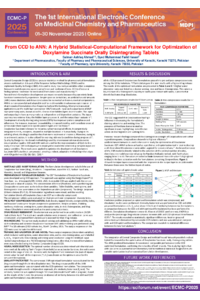
Orally disintegrating tablets (ODTs) are popular due to their rapid disintegration, improved patient compliance, and enhanced therapeutic efficacy. Designing ODTs requires careful optimization of formulation variables to achieve desired quality attributes. This study integrates Central Composite Design (CCD) and Artificial Neural Networks (ANN) to optimize Doxylamine Succinate ODTs using binder and superdisintegrant variables.
METHODS
CCD was used to design and develop directly compressed Doxylamine Succinate ODTs. Binder concentration (Povidone) and superdisintegrant (Crospovidone) were the independent variables, with tablet friability, wetting time, and disintegration time as the dependent variables (responses). The compressed tablets were evaluated for all the responses. The dissolution studies were also performed in Hydrochloric Acid (0.01N). Response data were used to train the ANN-based model to optimize the formulation. ANN-based optimized formulation was assessed for drug release, and the release profiles of CCD and ANN-based optimized formulations were compared, using the f2 test (similarity factor test).
RESULTS
All the CCD proposed formulations showed appropriate wetting time (10-12 seconds) with disintegration time ranging from 27-29 seconds and friability lower than 1%. All the formulations showed drug release above 80%. The highest drug release was observed with F7, which was considered the optimized formulation based on CCD results.
The selection of the optimal number of nodes influences the performance of the ANN model. The model for the current study was trained using the TanH values ranging from 3 to 10. The SSE and r2 values were recorded at each node value. Node value 5 was the best activation node. The release profile of the ANN-optimized formulation was also assessed. The f2 test demonstrated similarity between the two formulations.
CONCLUSION
The integration of ANN with CCD provides a robust, reliable, and multi-objective optimization platform for ODT development.
Keywords
Artificial neural network (ANN)
Central composite design
Doxylamine Succinate
Optimization
Poster
Poster (Salman Ashfaq Ahmad).pdf
In Silico Assessment of Diketopiperazines as Potential Therapeutic Scaffolds for NTSR1
Synthesis of new quinoline analogs of selected neuroleptics