Event submissions
EventsThe 1st International Electronic Conference on Medicinal Chemistry and Pharmaceutics
Published
This submission belongs to the session S4. New Small molecules as drug candidates of the event The 1st International Electronic Conference on Medicinal Chemistry and Pharmaceutics
Published date
29 Oct, 2025
Academic Editor
'%3e%3cpath%20d='M12.6657%2010.9104C12.4185%2010.325%2012.0599%209.79327%2011.6097%209.34482C11.1609%208.89508%2010.6293%208.5365%2010.0442%208.28888C10.0389%208.28626%2010.0337%208.28495%2010.0285%208.28233C10.8446%207.69279%2011.3752%206.73249%2011.3752%205.64904C11.3752%203.8542%209.92103%202.39999%208.1262%202.39999C6.33136%202.39999%204.87715%203.8542%204.87715%205.64904C4.87715%206.73249%205.40774%207.69279%206.22393%208.28364C6.21869%208.28626%206.21345%208.28757%206.20821%208.29019C5.62129%208.5378%205.09463%208.89284%204.64265%209.34613C4.1929%209.79493%203.83432%2010.3266%203.58671%2010.9117C3.34345%2011.4845%203.21226%2012.0987%203.20023%2012.7209C3.19988%2012.7349%203.20233%2012.7488%203.20744%2012.7619C3.21255%2012.7749%203.22022%2012.7867%203.22998%2012.7968C3.23975%2012.8068%203.25142%2012.8147%203.26431%2012.8202C3.2772%2012.8256%203.29105%2012.8284%203.30504%2012.8284H4.09109C4.14874%2012.8284%204.19459%2012.7825%204.1959%2012.7262C4.2221%2011.7148%204.62823%2010.7676%205.34617%2010.0497C6.08899%209.30683%207.0755%208.89808%208.1262%208.89808C9.17689%208.89808%2010.1634%209.30683%2010.9062%2010.0497C11.6242%2010.7676%2012.0303%2011.7148%2012.0565%2012.7262C12.0578%2012.7838%2012.1037%2012.8284%2012.1613%2012.8284H12.9474C12.9613%2012.8284%2012.9752%2012.8256%2012.9881%2012.8202C13.001%2012.8147%2013.0126%2012.8068%2013.0224%2012.7968C13.0322%2012.7867%2013.0398%2012.7749%2013.0449%2012.7619C13.0501%2012.7488%2013.0525%2012.7349%2013.0522%2012.7209C13.0391%2012.0947%2012.9094%2011.4855%2012.6657%2010.9104ZM8.1262%207.9024C7.52486%207.9024%206.9589%207.6679%206.53312%207.24211C6.10733%206.81633%205.87283%206.25037%205.87283%205.64904C5.87283%205.0477%206.10733%204.48174%206.53312%204.05596C6.9589%203.63018%207.52486%203.39567%208.1262%203.39567C8.72753%203.39567%209.29349%203.63018%209.71927%204.05596C10.1451%204.48174%2010.3796%205.0477%2010.3796%205.64904C10.3796%206.25037%2010.1451%206.81633%209.71927%207.24211C9.29349%207.6679%208.72753%207.9024%208.1262%207.9024Z'%20fill='%235D1EE1'/%3e%3c/g%3e%3c/svg%3e) Thierry Besson
Thierry BessonCitation
Daria Klimoszek, Paulina Strzyga-Łach, Małgorzata Jeleń, Marta Struga, Beata Morak-Młodawska, Małgorzata Dołowy, Synthesis of new quinoline analogs of selected neuroleptics, in Proceedings of The 1st International Electronic Conference on Medicinal Chemistry and Pharmaceutics, 1 November–30 November 2025, MDPI: Basel, Switzerland
Share
Email
Facebook
Twitter
LinkedIn
Synthesis of new quinoline analogs of selected neuroleptics
'%3e%3cpath%20d='M12.6647%2010.9104C12.4176%2010.325%2012.0589%209.7933%2011.6088%209.34485C11.16%208.89511%2010.6283%208.53653%2010.0432%208.28891C10.038%208.28629%2010.0327%208.28498%2010.0275%208.28236C10.8437%207.69282%2011.3743%206.73252%2011.3743%205.64907C11.3743%203.85423%209.92005%202.40002%208.12522%202.40002C6.33038%202.40002%204.87618%203.85423%204.87618%205.64907C4.87618%206.73252%205.40677%207.69282%206.22296%208.28367C6.21772%208.28629%206.21248%208.2876%206.20724%208.29022C5.62031%208.53783%205.09365%208.89287%204.64167%209.34616C4.19192%209.79496%203.83334%2010.3266%203.58573%2010.9117C3.34247%2011.4846%203.21128%2012.0987%203.19925%2012.721C3.1989%2012.735%203.20135%2012.7489%203.20646%2012.7619C3.21157%2012.7749%203.21924%2012.7868%203.22901%2012.7968C3.23877%2012.8068%203.25045%2012.8148%203.26334%2012.8202C3.27623%2012.8256%203.29007%2012.8284%203.30406%2012.8284H4.09012C4.14776%2012.8284%204.19362%2012.7825%204.19493%2012.7262C4.22113%2011.7148%204.62726%2010.7676%205.34519%2010.0497C6.08802%209.30686%207.07452%208.89811%208.12522%208.89811C9.17592%208.89811%2010.1624%209.30686%2010.9052%2010.0497C11.6232%2010.7676%2012.0293%2011.7148%2012.0555%2012.7262C12.0568%2012.7839%2012.1027%2012.8284%2012.1603%2012.8284H12.9464C12.9604%2012.8284%2012.9742%2012.8256%2012.9871%2012.8202C13%2012.8148%2013.0117%2012.8068%2013.0214%2012.7968C13.0312%2012.7868%2013.0389%2012.7749%2013.044%2012.7619C13.0491%2012.7489%2013.0515%2012.735%2013.0512%2012.721C13.0381%2012.0947%2012.9084%2011.4856%2012.6647%2010.9104ZM8.12522%207.90243C7.52388%207.90243%206.95792%207.66793%206.53214%207.24215C6.10636%206.81636%205.87185%206.2504%205.87185%205.64907C5.87185%205.04773%206.10636%204.48177%206.53214%204.05599C6.95792%203.63021%207.52388%203.3957%208.12522%203.3957C8.72655%203.3957%209.29252%203.63021%209.7183%204.05599C10.1441%204.48177%2010.3786%205.04773%2010.3786%205.64907C10.3786%206.2504%2010.1441%206.81636%209.7183%207.24215C9.29252%207.66793%208.72655%207.90243%208.12522%207.90243Z'%20fill='%235D1EE1'/%3e%3c/g%3e%3c/svg%3e)
Daria Klimoszek 1
Paulina Strzyga-Łach 2
Małgorzata Jeleń 3
Marta Struga 2

Beata Morak-Młodawska 3

Małgorzata Dołowy 4
1. Faculty of Pharmaceutical Sciences in Sosnowiec, Doctoral School, Medical University of Silesia, 40-055 Katowice, Poland
2. Chair and Department of Biochemistry, Medical University of Warsaw, 02-097 Warsaw, Poland
3. Department of Organic Chemistry, Faculty of Pharmaceutical Sciences in Sosnowiec, Medical University of Silesia in Katowice, 41-200 Sosnowiec, Poland
4. Department of Analytical Chemistry, Faculty of Pharmaceutical Sciences in Sosnowiec, Medical University of Silesia in Katowice, 41-200 Sosnowiec, Poland
Abstract
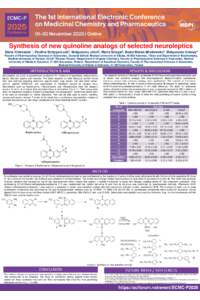
Introduction Neuroleptics are used as psychotropic medication for treatment of psychosis, schizophrenia, bipolar disorder, apathy and neurosis. The latest research on their biological activity shows their new activities including anticancer against brain, lung, breast, liver and colon cancer, antiviral against SARS-CoV and suppression of infections caused by dengue virus. Neuroleptics such as fluphenazine, triflupromazine and trifluoperazine were the research subject. The aim of the study was to synthesize new quinoline analogs of selected neuroleptics as new drugs’ candidates with more beneficial ADMET profiles.
Methods To synthesize new quinoline analogs, 6H-8-trifluoromethylquinobenzothiazine was synthesized by the reaction of 2-amino-4-trifluoromethylthiphenol with 3-bromo-2-chloroquinoline. After synthesizing 6H-8-trifluoromethylquinobenzothiazine its structure was confirmed by spectroscopic methods. Afterwards 6H-8-trifluoromethylquinobenzothiazine was used as a substrate to obtain new quinoline analogs with pharmacophore dialkylaminoalkyl substituents. The structure of each one of newly synthesized compounds was confirmed by the use of spectroscopic methods such as 1H NMR, 13C NMR and ESI HR MS. All synthesized compounds were studied for anticancer activity against three human cancer cell lines: breast (MDA-MB-231), pancreatic (Mia-PaCa-2) and lung (A-549). Doxorubicin and cisplatin were used as reference drug. Human keratinocyte cell line (HaCaT) was used as healthy cells.
Results The research carried out allowed to synthesize 6H-8-trifluoromethylquinobenzothiazine and to obtain new quinoline analogs with pharmacophore dialkylaminoalkyl substituents. Currently, eleven new quinoline analogs were synthesized. The study for anticancer activity allowed to determine concentration of new compounds required for 50% inhibition of three human cancer cell lines.
Conclusions The method chosen to synthesize new quinoline analogs was effective and allowed eleven new compounds to be obtained. The study for anticancer activity against three human cancer cell lines concludes that there are three compounds that show the most promising anticancer activity (IC50 < 5.5 μM).
Keywords
phenothiazine
quinobenzothiazine
Poster
Synthesis of new quinoline analogs of selected neuroleptics - D. Klimoszek and the others.pdf
FROM CCD TO ANN: A HYBRID STATISTICAL-COMPUTATIONAL FRAMEWORK FOR OPTIMIZATION OF DOXYLAMINE SUCCINATE ORALLY DISINTEGRATING TABLETS
Formulation of Lavender oil loaded Self-Microemulsifying Drug Delivery System for Psoriasis management.