Event submissions
EventsThe 1st International Electronic Conference on Medicinal Chemistry and Pharmaceutics
Published
This submission belongs to the session S11. Formulation, Drug Delivery and Controlled Release of the event The 1st International Electronic Conference on Medicinal Chemistry and Pharmaceutics
Published date
29 Oct, 2025
Academic Editor
'%3e%3cpath%20d='M12.6657%2010.9104C12.4185%2010.325%2012.0599%209.79327%2011.6097%209.34482C11.1609%208.89508%2010.6293%208.5365%2010.0442%208.28888C10.0389%208.28626%2010.0337%208.28495%2010.0285%208.28233C10.8446%207.69279%2011.3752%206.73249%2011.3752%205.64904C11.3752%203.8542%209.92103%202.39999%208.1262%202.39999C6.33136%202.39999%204.87715%203.8542%204.87715%205.64904C4.87715%206.73249%205.40774%207.69279%206.22393%208.28364C6.21869%208.28626%206.21345%208.28757%206.20821%208.29019C5.62129%208.5378%205.09463%208.89284%204.64265%209.34613C4.1929%209.79493%203.83432%2010.3266%203.58671%2010.9117C3.34345%2011.4845%203.21226%2012.0987%203.20023%2012.7209C3.19988%2012.7349%203.20233%2012.7488%203.20744%2012.7619C3.21255%2012.7749%203.22022%2012.7867%203.22998%2012.7968C3.23975%2012.8068%203.25142%2012.8147%203.26431%2012.8202C3.2772%2012.8256%203.29105%2012.8284%203.30504%2012.8284H4.09109C4.14874%2012.8284%204.19459%2012.7825%204.1959%2012.7262C4.2221%2011.7148%204.62823%2010.7676%205.34617%2010.0497C6.08899%209.30683%207.0755%208.89808%208.1262%208.89808C9.17689%208.89808%2010.1634%209.30683%2010.9062%2010.0497C11.6242%2010.7676%2012.0303%2011.7148%2012.0565%2012.7262C12.0578%2012.7838%2012.1037%2012.8284%2012.1613%2012.8284H12.9474C12.9613%2012.8284%2012.9752%2012.8256%2012.9881%2012.8202C13.001%2012.8147%2013.0126%2012.8068%2013.0224%2012.7968C13.0322%2012.7867%2013.0398%2012.7749%2013.0449%2012.7619C13.0501%2012.7488%2013.0525%2012.7349%2013.0522%2012.7209C13.0391%2012.0947%2012.9094%2011.4855%2012.6657%2010.9104ZM8.1262%207.9024C7.52486%207.9024%206.9589%207.6679%206.53312%207.24211C6.10733%206.81633%205.87283%206.25037%205.87283%205.64904C5.87283%205.0477%206.10733%204.48174%206.53312%204.05596C6.9589%203.63018%207.52486%203.39567%208.1262%203.39567C8.72753%203.39567%209.29349%203.63018%209.71927%204.05596C10.1451%204.48174%2010.3796%205.0477%2010.3796%205.64904C10.3796%206.25037%2010.1451%206.81633%209.71927%207.24211C9.29349%207.6679%208.72753%207.9024%208.1262%207.9024Z'%20fill='%235D1EE1'/%3e%3c/g%3e%3c/svg%3e) Antonio Vassallo
Antonio VassalloCitation
Rashmi Mallya, Farooque Shaikh, Formulation of Lavender oil loaded Self-Microemulsifying Drug Delivery System for Psoriasis management., in Proceedings of The 1st International Electronic Conference on Medicinal Chemistry and Pharmaceutics, 1 November–30 November 2025, MDPI: Basel, Switzerland
Share
Email
Facebook
Twitter
LinkedIn
Formulation of Lavender oil loaded Self-Microemulsifying Drug Delivery System for Psoriasis management.
'%3e%3cpath%20d='M12.6647%2010.9104C12.4176%2010.325%2012.0589%209.7933%2011.6088%209.34485C11.16%208.89511%2010.6283%208.53653%2010.0432%208.28891C10.038%208.28629%2010.0327%208.28498%2010.0275%208.28236C10.8437%207.69282%2011.3743%206.73252%2011.3743%205.64907C11.3743%203.85423%209.92005%202.40002%208.12522%202.40002C6.33038%202.40002%204.87618%203.85423%204.87618%205.64907C4.87618%206.73252%205.40677%207.69282%206.22296%208.28367C6.21772%208.28629%206.21248%208.2876%206.20724%208.29022C5.62031%208.53783%205.09365%208.89287%204.64167%209.34616C4.19192%209.79496%203.83334%2010.3266%203.58573%2010.9117C3.34247%2011.4846%203.21128%2012.0987%203.19925%2012.721C3.1989%2012.735%203.20135%2012.7489%203.20646%2012.7619C3.21157%2012.7749%203.21924%2012.7868%203.22901%2012.7968C3.23877%2012.8068%203.25045%2012.8148%203.26334%2012.8202C3.27623%2012.8256%203.29007%2012.8284%203.30406%2012.8284H4.09012C4.14776%2012.8284%204.19362%2012.7825%204.19493%2012.7262C4.22113%2011.7148%204.62726%2010.7676%205.34519%2010.0497C6.08802%209.30686%207.07452%208.89811%208.12522%208.89811C9.17592%208.89811%2010.1624%209.30686%2010.9052%2010.0497C11.6232%2010.7676%2012.0293%2011.7148%2012.0555%2012.7262C12.0568%2012.7839%2012.1027%2012.8284%2012.1603%2012.8284H12.9464C12.9604%2012.8284%2012.9742%2012.8256%2012.9871%2012.8202C13%2012.8148%2013.0117%2012.8068%2013.0214%2012.7968C13.0312%2012.7868%2013.0389%2012.7749%2013.044%2012.7619C13.0491%2012.7489%2013.0515%2012.735%2013.0512%2012.721C13.0381%2012.0947%2012.9084%2011.4856%2012.6647%2010.9104ZM8.12522%207.90243C7.52388%207.90243%206.95792%207.66793%206.53214%207.24215C6.10636%206.81636%205.87185%206.2504%205.87185%205.64907C5.87185%205.04773%206.10636%204.48177%206.53214%204.05599C6.95792%203.63021%207.52388%203.3957%208.12522%203.3957C8.72655%203.3957%209.29252%203.63021%209.7183%204.05599C10.1441%204.48177%2010.3786%205.04773%2010.3786%205.64907C10.3786%206.2504%2010.1441%206.81636%209.7183%207.24215C9.29252%207.66793%208.72655%207.90243%208.12522%207.90243Z'%20fill='%235D1EE1'/%3e%3c/g%3e%3c/svg%3e)
Rashmi Mallya 1
Farooque Shaikh 2
1. Department of Pharmacognosy, SVKM’s Dr. Bhanuben Nanavati College of Pharmacy, Mumbai, Maharashtra 400056, India.
2. Department of Quality Assurance, SVKM’s Dr. Bhanuben Nanavati College of Pharmacy, Mumbai, Maharashtra 400056, India.
Abstract
Introduction
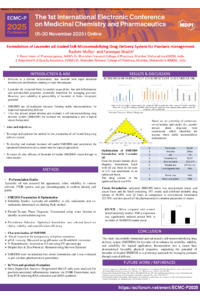
Psoriasis is a chronic, immune-mediated inflammatory skin disorder that demands effective and sustained therapeutic strategies. Conventional topical treatments often suffer from poor drug solubility, limited skin permeability, and systemic side effects. This study aimed to develop a novel Self-Microemulsifying Drug Delivery System (SMEDDS) incorporating lavender oil to enhance drug delivery and therapeutic efficacy for psoriasis management.
Methods
Comprehensive preformulation studies identified ethyl oleate as the oil phase, Tween 80 as the surfactant, and PEG 300 as the co-surfactant. A pseudo-ternary phase diagram guided the selection of an optimized oil-to-Smix ratio. The formulation was characterized for droplet size, zeta potential, and transmittance, and incorporated into cream bases with varying stearic acid concentrations. Analytical techniques including UV spectrophotometry and GC-MS validated the identity and purity of the drug and excipients. In vitro diffusion studies using Franz diffusion cells and cell line assays were conducted to assess drug release and biological activity. The HET-CAM assay was used to evaluate irritation potential.
Results
The optimized SMEDDS exhibited a droplet size of 147.3 nm, zeta potential of -26.1 mV, and transmittance of 92.57%, indicating a stable microemulsion. Among the cream formulations, the one with 10% stearic acid showed the best drug content and release profile. In vitro studies demonstrated sustained drug release over 24 hours, outperforming conventional formulations. Cell line studies revealed a 56% reduction in TNF-α expression and ROS reduction at 1 μg/mL, indicating strong anti-inflammatory potential. The HET-CAM assay confirmed the formulation’s non-irritating nature.
Conclusion
The developed lavender oil-loaded SMEDDS formulation significantly improved solubility, skin permeability, and controlled drug release, while demonstrating anti-inflammatory efficacy and safety. These findings support its potential as a novel, patient-friendly topical treatment for psoriasis.
Keywords
Psoriasis
Lavender oil
Self-Microemulsifying Drug Delivery System
TNF-α and ROS
Topical drug delivery.
Poster
sci poster.pdf
Synthesis of new quinoline analogs of selected neuroleptics
Synthesis of 2-(4-isobutylphenyl)-N-(naphthalen-1-yl)propanamide