Event submissions
EventsThe 1st International Electronic Conference on Medicinal Chemistry and Pharmaceutics
Published
This submission belongs to the session S12. Biopharmaceutics, Pharmacokinetics and Pharmacodynamics of the event The 1st International Electronic Conference on Medicinal Chemistry and Pharmaceutics
Published date
29 Oct, 2025
Academic Editor
'%3e%3cpath%20d='M12.6657%2010.9104C12.4185%2010.325%2012.0599%209.79327%2011.6097%209.34482C11.1609%208.89508%2010.6293%208.5365%2010.0442%208.28888C10.0389%208.28626%2010.0337%208.28495%2010.0285%208.28233C10.8446%207.69279%2011.3752%206.73249%2011.3752%205.64904C11.3752%203.8542%209.92103%202.39999%208.1262%202.39999C6.33136%202.39999%204.87715%203.8542%204.87715%205.64904C4.87715%206.73249%205.40774%207.69279%206.22393%208.28364C6.21869%208.28626%206.21345%208.28757%206.20821%208.29019C5.62129%208.5378%205.09463%208.89284%204.64265%209.34613C4.1929%209.79493%203.83432%2010.3266%203.58671%2010.9117C3.34345%2011.4845%203.21226%2012.0987%203.20023%2012.7209C3.19988%2012.7349%203.20233%2012.7488%203.20744%2012.7619C3.21255%2012.7749%203.22022%2012.7867%203.22998%2012.7968C3.23975%2012.8068%203.25142%2012.8147%203.26431%2012.8202C3.2772%2012.8256%203.29105%2012.8284%203.30504%2012.8284H4.09109C4.14874%2012.8284%204.19459%2012.7825%204.1959%2012.7262C4.2221%2011.7148%204.62823%2010.7676%205.34617%2010.0497C6.08899%209.30683%207.0755%208.89808%208.1262%208.89808C9.17689%208.89808%2010.1634%209.30683%2010.9062%2010.0497C11.6242%2010.7676%2012.0303%2011.7148%2012.0565%2012.7262C12.0578%2012.7838%2012.1037%2012.8284%2012.1613%2012.8284H12.9474C12.9613%2012.8284%2012.9752%2012.8256%2012.9881%2012.8202C13.001%2012.8147%2013.0126%2012.8068%2013.0224%2012.7968C13.0322%2012.7867%2013.0398%2012.7749%2013.0449%2012.7619C13.0501%2012.7488%2013.0525%2012.7349%2013.0522%2012.7209C13.0391%2012.0947%2012.9094%2011.4855%2012.6657%2010.9104ZM8.1262%207.9024C7.52486%207.9024%206.9589%207.6679%206.53312%207.24211C6.10733%206.81633%205.87283%206.25037%205.87283%205.64904C5.87283%205.0477%206.10733%204.48174%206.53312%204.05596C6.9589%203.63018%207.52486%203.39567%208.1262%203.39567C8.72753%203.39567%209.29349%203.63018%209.71927%204.05596C10.1451%204.48174%2010.3796%205.0477%2010.3796%205.64904C10.3796%206.25037%2010.1451%206.81633%209.71927%207.24211C9.29349%207.6679%208.72753%207.9024%208.1262%207.9024Z'%20fill='%235D1EE1'/%3e%3c/g%3e%3c/svg%3e) Maria Sousa
Maria SousaCitation
Sameen Shahid, Muhammad Farooq Sabar, Zafar Iqbal, Muhammad Usman Ghani, Muhammad Abbas Khokhar, Targeting Genetic Mutations in Chronic Myeloid Leukemia: Insights into MUC3A Mutation and Regulatory Alterations in MIR5195 for Personalized Therapeutic Approaches, in Proceedings of The 1st International Electronic Conference on Medicinal Chemistry and Pharmaceutics, 1 November–30 November 2025, MDPI: Basel, Switzerland
Share
Email
Facebook
Twitter
LinkedIn
Targeting Genetic Mutations in Chronic Myeloid Leukemia: Insights into MUC3A Mutation and Regulatory Alterations in MIR5195 for Personalized Therapeutic Approaches
'%3e%3cpath%20d='M12.6647%2010.9104C12.4176%2010.325%2012.0589%209.7933%2011.6088%209.34485C11.16%208.89511%2010.6283%208.53653%2010.0432%208.28891C10.038%208.28629%2010.0327%208.28498%2010.0275%208.28236C10.8437%207.69282%2011.3743%206.73252%2011.3743%205.64907C11.3743%203.85423%209.92005%202.40002%208.12522%202.40002C6.33038%202.40002%204.87618%203.85423%204.87618%205.64907C4.87618%206.73252%205.40677%207.69282%206.22296%208.28367C6.21772%208.28629%206.21248%208.2876%206.20724%208.29022C5.62031%208.53783%205.09365%208.89287%204.64167%209.34616C4.19192%209.79496%203.83334%2010.3266%203.58573%2010.9117C3.34247%2011.4846%203.21128%2012.0987%203.19925%2012.721C3.1989%2012.735%203.20135%2012.7489%203.20646%2012.7619C3.21157%2012.7749%203.21924%2012.7868%203.22901%2012.7968C3.23877%2012.8068%203.25045%2012.8148%203.26334%2012.8202C3.27623%2012.8256%203.29007%2012.8284%203.30406%2012.8284H4.09012C4.14776%2012.8284%204.19362%2012.7825%204.19493%2012.7262C4.22113%2011.7148%204.62726%2010.7676%205.34519%2010.0497C6.08802%209.30686%207.07452%208.89811%208.12522%208.89811C9.17592%208.89811%2010.1624%209.30686%2010.9052%2010.0497C11.6232%2010.7676%2012.0293%2011.7148%2012.0555%2012.7262C12.0568%2012.7839%2012.1027%2012.8284%2012.1603%2012.8284H12.9464C12.9604%2012.8284%2012.9742%2012.8256%2012.9871%2012.8202C13%2012.8148%2013.0117%2012.8068%2013.0214%2012.7968C13.0312%2012.7868%2013.0389%2012.7749%2013.044%2012.7619C13.0491%2012.7489%2013.0515%2012.735%2013.0512%2012.721C13.0381%2012.0947%2012.9084%2011.4856%2012.6647%2010.9104ZM8.12522%207.90243C7.52388%207.90243%206.95792%207.66793%206.53214%207.24215C6.10636%206.81636%205.87185%206.2504%205.87185%205.64907C5.87185%205.04773%206.10636%204.48177%206.53214%204.05599C6.95792%203.63021%207.52388%203.3957%208.12522%203.3957C8.72655%203.3957%209.29252%203.63021%209.7183%204.05599C10.1441%204.48177%2010.3786%205.04773%2010.3786%205.64907C10.3786%206.2504%2010.1441%206.81636%209.7183%207.24215C9.29252%207.66793%208.72655%207.90243%208.12522%207.90243Z'%20fill='%235D1EE1'/%3e%3c/g%3e%3c/svg%3e)
Sameen Shahid 1
Muhammad Farooq Sabar 2
Zafar Iqbal 3

Muhammad Usman Ghani 1
Muhammad Abbas Khokhar 4
1. Centre for Applied Molecular Biology (CAMB), University of the Punjab, Lahore, Pakistan
2. School of Biochemistry and Biotechnology, University of the Punjab, Lahore, Pakistan
3. College of Applied Medical Sciences (CoAMS) King Saud Bin Abdulaziz, University of Health Sciences, Saudi Arabia
4. Oncology Department, Mayo Hospital, King Edward Medical University, Lahore, Pakistan
Abstract
Chronic Myeloid Leukemia (CML) progression from chronic phase (CP) to advanced stages such as accelerated phase (AP) or blast crisis (BC) remains a major clinical challenge, particularly due to limited early detection biomarkers. In this study, we investigate the genetic mutations driving CML progression, focusing on the MUC3A gene and the downstream regulatory region of the MIR5195 gene. We identified a novel missense mutation, P258S, in MUC3A that is exclusively present in AP/BC-CML patients. Structural and physicochemical analyses revealed that the P258S mutation alters protein stability, increasing flexibility in some regions and stabilizing others, which may affect its molecular interactions. Molecular dynamics simulations and docking studies showed enhanced binding affinity of MUC3A P258S with several therapeutic agents, particularly Capmatinib, suggesting potential clinical applications in treating CML. Additionally, mutations in the MIR5195 regulatory region were found to disrupt transcription factor binding, leading to changes in gene expression patterns. MEME and TOMTOM motif analysis revealed the loss of key motifs and the emergence of new ones in the mutant sequences, indicating a shift in the transcriptional regulation landscape. These findings suggest that these mutations may influence the expression of genes involved in CML progression. This study highlights the potential of MUC3A and MIR5195 as biomarkers for CML progression and therapeutic targets for personalized treatment strategies. The identified P258S mutation in MUC3A opens new avenues for targeted therapies, while the regulatory alterations in MIR5195 offer insights into gene expression reprogramming in CML's advanced stages.
Keywords
Chronic Myeloid Leukemia (CML)
CML progression
Chronic phase (CP)
Accelerated phase (AP)
Blast crisis (BC)
Early detection biomarkers
MUC3A gene mutation
P258S mutation
MIR5195 gene
Genetic mutations in CML
Poster
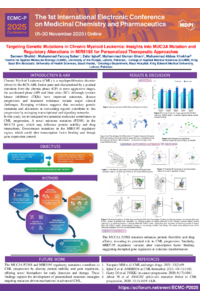
Sameen_Shahid_Poster_MDPI_Conf_2025.pdf
Cu(II) and Zn(II) complexes of salen-type Schiff base ligands as promising anticancer agents in treatment of colorectal adenocarcinoma
Development of a cell-based platform for expression of antimicrobial peptides: modification of HEK-293T cells for expression and extracellular secretion of human β-defensin 1