Event submissions
EventsThe 1st International Electronic Conference on Medicinal Chemistry and Pharmaceutics
Published
This submission belongs to the session S6. Novel and Sustainable approaches in Medicinal Chemistry of the event The 1st International Electronic Conference on Medicinal Chemistry and Pharmaceutics
Published date
29 Oct, 2025
Academic Editor
'%3e%3cpath%20d='M12.6657%2010.9104C12.4185%2010.325%2012.0599%209.79327%2011.6097%209.34482C11.1609%208.89508%2010.6293%208.5365%2010.0442%208.28888C10.0389%208.28626%2010.0337%208.28495%2010.0285%208.28233C10.8446%207.69279%2011.3752%206.73249%2011.3752%205.64904C11.3752%203.8542%209.92103%202.39999%208.1262%202.39999C6.33136%202.39999%204.87715%203.8542%204.87715%205.64904C4.87715%206.73249%205.40774%207.69279%206.22393%208.28364C6.21869%208.28626%206.21345%208.28757%206.20821%208.29019C5.62129%208.5378%205.09463%208.89284%204.64265%209.34613C4.1929%209.79493%203.83432%2010.3266%203.58671%2010.9117C3.34345%2011.4845%203.21226%2012.0987%203.20023%2012.7209C3.19988%2012.7349%203.20233%2012.7488%203.20744%2012.7619C3.21255%2012.7749%203.22022%2012.7867%203.22998%2012.7968C3.23975%2012.8068%203.25142%2012.8147%203.26431%2012.8202C3.2772%2012.8256%203.29105%2012.8284%203.30504%2012.8284H4.09109C4.14874%2012.8284%204.19459%2012.7825%204.1959%2012.7262C4.2221%2011.7148%204.62823%2010.7676%205.34617%2010.0497C6.08899%209.30683%207.0755%208.89808%208.1262%208.89808C9.17689%208.89808%2010.1634%209.30683%2010.9062%2010.0497C11.6242%2010.7676%2012.0303%2011.7148%2012.0565%2012.7262C12.0578%2012.7838%2012.1037%2012.8284%2012.1613%2012.8284H12.9474C12.9613%2012.8284%2012.9752%2012.8256%2012.9881%2012.8202C13.001%2012.8147%2013.0126%2012.8068%2013.0224%2012.7968C13.0322%2012.7867%2013.0398%2012.7749%2013.0449%2012.7619C13.0501%2012.7488%2013.0525%2012.7349%2013.0522%2012.7209C13.0391%2012.0947%2012.9094%2011.4855%2012.6657%2010.9104ZM8.1262%207.9024C7.52486%207.9024%206.9589%207.6679%206.53312%207.24211C6.10733%206.81633%205.87283%206.25037%205.87283%205.64904C5.87283%205.0477%206.10733%204.48174%206.53312%204.05596C6.9589%203.63018%207.52486%203.39567%208.1262%203.39567C8.72753%203.39567%209.29349%203.63018%209.71927%204.05596C10.1451%204.48174%2010.3796%205.0477%2010.3796%205.64904C10.3796%206.25037%2010.1451%206.81633%209.71927%207.24211C9.29349%207.6679%208.72753%207.9024%208.1262%207.9024Z'%20fill='%235D1EE1'/%3e%3c/g%3e%3c/svg%3e) Diego Muñoz-Torrero
Diego Muñoz-TorreroCitation
JAISING TOPPO, Dr. AKHILESH TIWARI, Application of Design of Experiment® AQbD Approach for Systematic Optimization of Reverse-Phase High Performance Liquid Chromatography Method to Analyze Simultaneously Two Drugs (Metformin HCl and Sitagliptin) in Tablet Dosage Form, in Proceedings of The 1st International Electronic Conference on Medicinal Chemistry and Pharmaceutics, 1 November–30 November 2025, MDPI: Basel, Switzerland
Share
Email
Facebook
Twitter
LinkedIn
Application of Design of Experiment® AQbD Approach for Systematic Optimization of Reverse-Phase High Performance Liquid Chromatography Method to Analyze Simultaneously Two Drugs (Metformin HCl and Sitagliptin) in Tablet Dosage Form
'%3e%3cpath%20d='M12.6647%2010.9104C12.4176%2010.325%2012.0589%209.7933%2011.6088%209.34485C11.16%208.89511%2010.6283%208.53653%2010.0432%208.28891C10.038%208.28629%2010.0327%208.28498%2010.0275%208.28236C10.8437%207.69282%2011.3743%206.73252%2011.3743%205.64907C11.3743%203.85423%209.92005%202.40002%208.12522%202.40002C6.33038%202.40002%204.87618%203.85423%204.87618%205.64907C4.87618%206.73252%205.40677%207.69282%206.22296%208.28367C6.21772%208.28629%206.21248%208.2876%206.20724%208.29022C5.62031%208.53783%205.09365%208.89287%204.64167%209.34616C4.19192%209.79496%203.83334%2010.3266%203.58573%2010.9117C3.34247%2011.4846%203.21128%2012.0987%203.19925%2012.721C3.1989%2012.735%203.20135%2012.7489%203.20646%2012.7619C3.21157%2012.7749%203.21924%2012.7868%203.22901%2012.7968C3.23877%2012.8068%203.25045%2012.8148%203.26334%2012.8202C3.27623%2012.8256%203.29007%2012.8284%203.30406%2012.8284H4.09012C4.14776%2012.8284%204.19362%2012.7825%204.19493%2012.7262C4.22113%2011.7148%204.62726%2010.7676%205.34519%2010.0497C6.08802%209.30686%207.07452%208.89811%208.12522%208.89811C9.17592%208.89811%2010.1624%209.30686%2010.9052%2010.0497C11.6232%2010.7676%2012.0293%2011.7148%2012.0555%2012.7262C12.0568%2012.7839%2012.1027%2012.8284%2012.1603%2012.8284H12.9464C12.9604%2012.8284%2012.9742%2012.8256%2012.9871%2012.8202C13%2012.8148%2013.0117%2012.8068%2013.0214%2012.7968C13.0312%2012.7868%2013.0389%2012.7749%2013.044%2012.7619C13.0491%2012.7489%2013.0515%2012.735%2013.0512%2012.721C13.0381%2012.0947%2012.9084%2011.4856%2012.6647%2010.9104ZM8.12522%207.90243C7.52388%207.90243%206.95792%207.66793%206.53214%207.24215C6.10636%206.81636%205.87185%206.2504%205.87185%205.64907C5.87185%205.04773%206.10636%204.48177%206.53214%204.05599C6.95792%203.63021%207.52388%203.3957%208.12522%203.3957C8.72655%203.3957%209.29252%203.63021%209.7183%204.05599C10.1441%204.48177%2010.3786%205.04773%2010.3786%205.64907C10.3786%206.2504%2010.1441%206.81636%209.7183%207.24215C9.29252%207.66793%208.72655%207.90243%208.12522%207.90243Z'%20fill='%235D1EE1'/%3e%3c/g%3e%3c/svg%3e)
JAISING TOPPO 1
Dr. AKHILESH TIWARI 1
1. Department of Pharmacy, Indira Gandhi National Tribal University, Amarkantak, Madhya Pradesh, 484887, India
Abstract
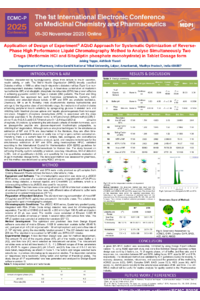
Abstract: Green analytical techniques aim to replace or minimize the use of hazardous organic modifiers with environmentally friendly solvents without compromising chromatographic performance. This shift enables industries and research laboratories to adopt sustainable analytical methods. Metformin HCl (MF) and Sitagliptin (SITA) are widely used in managing type 2 diabetes mellitus to maintain blood sugar levels in adults when combined with a proper diet and regular exercise. The present study focuses on the Analytical Quality by Design (AQbD)-established development of an easy, quick, precise, accurate, cost-effective, and eco-friendly reversed-phase high-performance liquid chromatography (RP-HPLC) method for concurrent estimation of MF and SITA. A Design of Experiments (DoE) strategy was employed for multivariate optimization of chromatographic conditions, while risk assessment using an Ishikawa diagram helped identify the critical method parameters (CMPs). Factor screening was initially executed by the one-factor-at-a-time (OFAT) approach through trial runs under varying chromatographic conditions. Subsequently, a Box-Behnken Design (BBD) was used to study response surface methodology, enabling detailed evaluation of critical analytical attributes (CAAs)- retention time, resolution, symmetry factor, and peak area as indicators of robustness. Optimization was achieved using a desirability function, yielding mobile phase composition with 25 mM CH3COONH4 buffer (pH adjusted to 4.5 using 1 M OPA solution) and ethanol (45:55, v/v) at a flow rate of 1.157 mL/min. Separation was carried out on a HiQ sil C18HS column (4.6 mm I.D. x 250 mm length, 5 µm, 100Å), with the column oven temperature maintained at 25 °C and the detection wavelength at 256 nm. The optimized method was validated according to ICH (Q2R2) guidelines. Overall, the outcomes demonstrate that the AQbD approach effectively facilitates the development and optimization of an eco-friendly RP-HPLC method for the concurrent estimation of MF and SITA in prolonged-release tablets.
Keywords
Metformin HCl (MF)
Sitagliptin (SITA)
Analytical Quality by Design (AQbD)
Box Behnken Design (BBD)
Critical Method Parameters (CCPs)
Critical Analytical Attributes (CAAs)
ICH guidelines
Poster
MDPI Poster Presentation (Jai) Final.pdf
Development of a cell-based platform for expression of antimicrobial peptides: modification of HEK-293T cells for expression and extracellular secretion of human β-defensin 1
In vitro activity of Andrographis paniculata (Burm.f.) Wall.ex Nees leaves ethanolic extract inhibits host cell invasion and intracellular replication of Toxoplasma gondii via modulation of protein kinase G (PKG).