Event submissions
EventsThe 1st International Electronic Conference on Medicinal Chemistry and Pharmaceutics
Published
This submission belongs to the session S5. Natural Products and Biopharmaceuticals of the event The 1st International Electronic Conference on Medicinal Chemistry and Pharmaceutics
Published date
29 Oct, 2025
Academic Editor
'%3e%3cpath%20d='M12.6657%2010.9104C12.4185%2010.325%2012.0599%209.79327%2011.6097%209.34482C11.1609%208.89508%2010.6293%208.5365%2010.0442%208.28888C10.0389%208.28626%2010.0337%208.28495%2010.0285%208.28233C10.8446%207.69279%2011.3752%206.73249%2011.3752%205.64904C11.3752%203.8542%209.92103%202.39999%208.1262%202.39999C6.33136%202.39999%204.87715%203.8542%204.87715%205.64904C4.87715%206.73249%205.40774%207.69279%206.22393%208.28364C6.21869%208.28626%206.21345%208.28757%206.20821%208.29019C5.62129%208.5378%205.09463%208.89284%204.64265%209.34613C4.1929%209.79493%203.83432%2010.3266%203.58671%2010.9117C3.34345%2011.4845%203.21226%2012.0987%203.20023%2012.7209C3.19988%2012.7349%203.20233%2012.7488%203.20744%2012.7619C3.21255%2012.7749%203.22022%2012.7867%203.22998%2012.7968C3.23975%2012.8068%203.25142%2012.8147%203.26431%2012.8202C3.2772%2012.8256%203.29105%2012.8284%203.30504%2012.8284H4.09109C4.14874%2012.8284%204.19459%2012.7825%204.1959%2012.7262C4.2221%2011.7148%204.62823%2010.7676%205.34617%2010.0497C6.08899%209.30683%207.0755%208.89808%208.1262%208.89808C9.17689%208.89808%2010.1634%209.30683%2010.9062%2010.0497C11.6242%2010.7676%2012.0303%2011.7148%2012.0565%2012.7262C12.0578%2012.7838%2012.1037%2012.8284%2012.1613%2012.8284H12.9474C12.9613%2012.8284%2012.9752%2012.8256%2012.9881%2012.8202C13.001%2012.8147%2013.0126%2012.8068%2013.0224%2012.7968C13.0322%2012.7867%2013.0398%2012.7749%2013.0449%2012.7619C13.0501%2012.7488%2013.0525%2012.7349%2013.0522%2012.7209C13.0391%2012.0947%2012.9094%2011.4855%2012.6657%2010.9104ZM8.1262%207.9024C7.52486%207.9024%206.9589%207.6679%206.53312%207.24211C6.10733%206.81633%205.87283%206.25037%205.87283%205.64904C5.87283%205.0477%206.10733%204.48174%206.53312%204.05596C6.9589%203.63018%207.52486%203.39567%208.1262%203.39567C8.72753%203.39567%209.29349%203.63018%209.71927%204.05596C10.1451%204.48174%2010.3796%205.0477%2010.3796%205.64904C10.3796%206.25037%2010.1451%206.81633%209.71927%207.24211C9.29349%207.6679%208.72753%207.9024%208.1262%207.9024Z'%20fill='%235D1EE1'/%3e%3c/g%3e%3c/svg%3e) Daniela De Vita
Daniela De VitaCitation
Sharif Alhassan Abdullahi, Roslaini Abd. Majid, In vitro activity of Andrographis paniculata (Burm.f.) Wall.ex Nees leaves ethanolic extract inhibits host cell invasion and intracellular replication of Toxoplasma gondii via modulation of protein kinase G (PKG)., in Proceedings of The 1st International Electronic Conference on Medicinal Chemistry and Pharmaceutics, 1 November–30 November 2025, MDPI: Basel, Switzerland
Share
Email
Facebook
Twitter
LinkedIn
In vitro activity of Andrographis paniculata (Burm.f.) Wall.ex Nees leaves ethanolic extract inhibits host cell invasion and intracellular replication of Toxoplasma gondii via modulation of protein kinase G (PKG).
'%3e%3cpath%20d='M12.6647%2010.9104C12.4176%2010.325%2012.0589%209.7933%2011.6088%209.34485C11.16%208.89511%2010.6283%208.53653%2010.0432%208.28891C10.038%208.28629%2010.0327%208.28498%2010.0275%208.28236C10.8437%207.69282%2011.3743%206.73252%2011.3743%205.64907C11.3743%203.85423%209.92005%202.40002%208.12522%202.40002C6.33038%202.40002%204.87618%203.85423%204.87618%205.64907C4.87618%206.73252%205.40677%207.69282%206.22296%208.28367C6.21772%208.28629%206.21248%208.2876%206.20724%208.29022C5.62031%208.53783%205.09365%208.89287%204.64167%209.34616C4.19192%209.79496%203.83334%2010.3266%203.58573%2010.9117C3.34247%2011.4846%203.21128%2012.0987%203.19925%2012.721C3.1989%2012.735%203.20135%2012.7489%203.20646%2012.7619C3.21157%2012.7749%203.21924%2012.7868%203.22901%2012.7968C3.23877%2012.8068%203.25045%2012.8148%203.26334%2012.8202C3.27623%2012.8256%203.29007%2012.8284%203.30406%2012.8284H4.09012C4.14776%2012.8284%204.19362%2012.7825%204.19493%2012.7262C4.22113%2011.7148%204.62726%2010.7676%205.34519%2010.0497C6.08802%209.30686%207.07452%208.89811%208.12522%208.89811C9.17592%208.89811%2010.1624%209.30686%2010.9052%2010.0497C11.6232%2010.7676%2012.0293%2011.7148%2012.0555%2012.7262C12.0568%2012.7839%2012.1027%2012.8284%2012.1603%2012.8284H12.9464C12.9604%2012.8284%2012.9742%2012.8256%2012.9871%2012.8202C13%2012.8148%2013.0117%2012.8068%2013.0214%2012.7968C13.0312%2012.7868%2013.0389%2012.7749%2013.044%2012.7619C13.0491%2012.7489%2013.0515%2012.735%2013.0512%2012.721C13.0381%2012.0947%2012.9084%2011.4856%2012.6647%2010.9104ZM8.12522%207.90243C7.52388%207.90243%206.95792%207.66793%206.53214%207.24215C6.10636%206.81636%205.87185%206.2504%205.87185%205.64907C5.87185%205.04773%206.10636%204.48177%206.53214%204.05599C6.95792%203.63021%207.52388%203.3957%208.12522%203.3957C8.72655%203.3957%209.29252%203.63021%209.7183%204.05599C10.1441%204.48177%2010.3786%205.04773%2010.3786%205.64907C10.3786%206.2504%2010.1441%206.81636%209.7183%207.24215C9.29252%207.66793%208.72655%207.90243%208.12522%207.90243Z'%20fill='%235D1EE1'/%3e%3c/g%3e%3c/svg%3e)
Sharif Alhassan Abdullahi 1
Roslaini Abd. Majid 2
1. Department of Medical Microbiology and Parasitology, College of Health Sciences, Bayero University Kano, Kano P.M.B. 3011, Nigeria
2. Faculty of Medicine and Defence Health, National Defence University of Malaysia, Kuala Lumpur 57000, Malaysia
Abstract
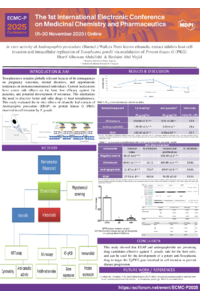
Introduction: Toxoplasmosis remains globally relevant because of its consequences on pregnancy outcomes, mental disorders, and opportunistic tendencies in immunocompromised individuals. Current medications have severe side effects on the host, low efficacy against the parasites, and potential development of resistance. This emphasizes the need to discover better and safer drugs to treat toxoplasmosis. This study evaluated the in vitro effects of ethanolic leaf extracts of Andrographis paniculata (EEAP) on protein kinase G (PKG) involved in cell invasion by T. gondii. Methods: EEAP was obtained through the maceration of dried leaf powder and then subjected to qualitative and quantitative screening of phytochemicals. Vero cells infected with the RH strain of T. gondii were used to evaluate the cytotoxicity and antiparasitic potential of EEAP, andrographolide, and clindamycin using the MTT assay. Microscopy was used to determine the cell invasion and intracellular replication of tachyzoites in the treated infected Vero cells at 24 h using 4 h post-infection treatment models. Gene expression profiling of TgPKG was performed using RT-qPCR. The expression of microneme proteins was determined using immunoblotting. Results: EEAP was found to contain more terpenoids. EEAP, andrographolide, and clindamycin were safe for host cells. EEAP and andrographolide exhibited good anti-parasitic activities against T. gondii. Microscopic assessment revealed a low infection index and intracellular replication by EEAP and andrographolide. RT-qPCR revealed a significant (P=0.002) downregulation of the TgPKG gene by 0.114-fold (88.6% decrease) and 0.068-fold (93.2% decrease), respectively, compared with the control. The expression of TgMIC1(0.442-fold, 55.8% decrease) and TgMIC2 (0.385-fold, 61.5% decrease) proteins significantly (P= 0.0001) decreased compared to the control. Conclusion: This study showed that EEAP and andrographolide are promising drug candidates effective against T. gondii, safe for the host cells, and can be used for the development of a potent anti-Toxoplasma drug to target the TgPKG gene involved in cell invasion to prevent disease progression.
Keywords
Andrographis paniculata
Toxoplasma gondii
Protein Kinase G
Microneme protein
cell invasion
Poster
fe49dbe333cab5083215d7ebcc14de06.pdf
Application of Design of Experiment® AQbD Approach for Systematic Optimization of Reverse-Phase High Performance Liquid Chromatography Method to Analyze Simultaneously Two Drugs (Metformin HCl and Sitagliptin) in Tablet Dosage Form
Rebamipide Loaded Ethosomes as a Potential Trans-Eyelid Delivery