Event submissions
EventsThe 1st International Electronic Conference on Medicinal Chemistry and Pharmaceutics
Published
This submission belongs to the session S4. New Small molecules as drug candidates of the event The 1st International Electronic Conference on Medicinal Chemistry and Pharmaceutics
Published date
29 Oct, 2025
Academic Editor
'%3e%3cpath%20d='M12.6657%2010.9104C12.4185%2010.325%2012.0599%209.79327%2011.6097%209.34482C11.1609%208.89508%2010.6293%208.5365%2010.0442%208.28888C10.0389%208.28626%2010.0337%208.28495%2010.0285%208.28233C10.8446%207.69279%2011.3752%206.73249%2011.3752%205.64904C11.3752%203.8542%209.92103%202.39999%208.1262%202.39999C6.33136%202.39999%204.87715%203.8542%204.87715%205.64904C4.87715%206.73249%205.40774%207.69279%206.22393%208.28364C6.21869%208.28626%206.21345%208.28757%206.20821%208.29019C5.62129%208.5378%205.09463%208.89284%204.64265%209.34613C4.1929%209.79493%203.83432%2010.3266%203.58671%2010.9117C3.34345%2011.4845%203.21226%2012.0987%203.20023%2012.7209C3.19988%2012.7349%203.20233%2012.7488%203.20744%2012.7619C3.21255%2012.7749%203.22022%2012.7867%203.22998%2012.7968C3.23975%2012.8068%203.25142%2012.8147%203.26431%2012.8202C3.2772%2012.8256%203.29105%2012.8284%203.30504%2012.8284H4.09109C4.14874%2012.8284%204.19459%2012.7825%204.1959%2012.7262C4.2221%2011.7148%204.62823%2010.7676%205.34617%2010.0497C6.08899%209.30683%207.0755%208.89808%208.1262%208.89808C9.17689%208.89808%2010.1634%209.30683%2010.9062%2010.0497C11.6242%2010.7676%2012.0303%2011.7148%2012.0565%2012.7262C12.0578%2012.7838%2012.1037%2012.8284%2012.1613%2012.8284H12.9474C12.9613%2012.8284%2012.9752%2012.8256%2012.9881%2012.8202C13.001%2012.8147%2013.0126%2012.8068%2013.0224%2012.7968C13.0322%2012.7867%2013.0398%2012.7749%2013.0449%2012.7619C13.0501%2012.7488%2013.0525%2012.7349%2013.0522%2012.7209C13.0391%2012.0947%2012.9094%2011.4855%2012.6657%2010.9104ZM8.1262%207.9024C7.52486%207.9024%206.9589%207.6679%206.53312%207.24211C6.10733%206.81633%205.87283%206.25037%205.87283%205.64904C5.87283%205.0477%206.10733%204.48174%206.53312%204.05596C6.9589%203.63018%207.52486%203.39567%208.1262%203.39567C8.72753%203.39567%209.29349%203.63018%209.71927%204.05596C10.1451%204.48174%2010.3796%205.0477%2010.3796%205.64904C10.3796%206.25037%2010.1451%206.81633%209.71927%207.24211C9.29349%207.6679%208.72753%207.9024%208.1262%207.9024Z'%20fill='%235D1EE1'/%3e%3c/g%3e%3c/svg%3e) MARIALUIGIA FANTACUZZI
MARIALUIGIA FANTACUZZICitation
Josué Zair Castro Yangali, Cristhian N. Rodríguez-Silva, VICTOR E. VILLARREAL-LA TORRE, Structure-Based Design of Hybrid Molecules Exhibiting Dual SGLT2 and AT1 Inhibition for Cardiorenal Protection: A Computational and Medicinal Chemistry Strategy, in Proceedings of The 1st International Electronic Conference on Medicinal Chemistry and Pharmaceutics, 1 November–30 November 2025, MDPI: Basel, Switzerland
Share
Email
Facebook
Twitter
LinkedIn
Structure-Based Design of Hybrid Molecules Exhibiting Dual SGLT2 and AT1 Inhibition for Cardiorenal Protection: A Computational and Medicinal Chemistry Strategy
'%3e%3cpath%20d='M12.6647%2010.9104C12.4176%2010.325%2012.0589%209.7933%2011.6088%209.34485C11.16%208.89511%2010.6283%208.53653%2010.0432%208.28891C10.038%208.28629%2010.0327%208.28498%2010.0275%208.28236C10.8437%207.69282%2011.3743%206.73252%2011.3743%205.64907C11.3743%203.85423%209.92005%202.40002%208.12522%202.40002C6.33038%202.40002%204.87618%203.85423%204.87618%205.64907C4.87618%206.73252%205.40677%207.69282%206.22296%208.28367C6.21772%208.28629%206.21248%208.2876%206.20724%208.29022C5.62031%208.53783%205.09365%208.89287%204.64167%209.34616C4.19192%209.79496%203.83334%2010.3266%203.58573%2010.9117C3.34247%2011.4846%203.21128%2012.0987%203.19925%2012.721C3.1989%2012.735%203.20135%2012.7489%203.20646%2012.7619C3.21157%2012.7749%203.21924%2012.7868%203.22901%2012.7968C3.23877%2012.8068%203.25045%2012.8148%203.26334%2012.8202C3.27623%2012.8256%203.29007%2012.8284%203.30406%2012.8284H4.09012C4.14776%2012.8284%204.19362%2012.7825%204.19493%2012.7262C4.22113%2011.7148%204.62726%2010.7676%205.34519%2010.0497C6.08802%209.30686%207.07452%208.89811%208.12522%208.89811C9.17592%208.89811%2010.1624%209.30686%2010.9052%2010.0497C11.6232%2010.7676%2012.0293%2011.7148%2012.0555%2012.7262C12.0568%2012.7839%2012.1027%2012.8284%2012.1603%2012.8284H12.9464C12.9604%2012.8284%2012.9742%2012.8256%2012.9871%2012.8202C13%2012.8148%2013.0117%2012.8068%2013.0214%2012.7968C13.0312%2012.7868%2013.0389%2012.7749%2013.044%2012.7619C13.0491%2012.7489%2013.0515%2012.735%2013.0512%2012.721C13.0381%2012.0947%2012.9084%2011.4856%2012.6647%2010.9104ZM8.12522%207.90243C7.52388%207.90243%206.95792%207.66793%206.53214%207.24215C6.10636%206.81636%205.87185%206.2504%205.87185%205.64907C5.87185%205.04773%206.10636%204.48177%206.53214%204.05599C6.95792%203.63021%207.52388%203.3957%208.12522%203.3957C8.72655%203.3957%209.29252%203.63021%209.7183%204.05599C10.1441%204.48177%2010.3786%205.04773%2010.3786%205.64907C10.3786%206.2504%2010.1441%206.81636%209.7183%207.24215C9.29252%207.66793%208.72655%207.90243%208.12522%207.90243Z'%20fill='%235D1EE1'/%3e%3c/g%3e%3c/svg%3e)
Josué Zair Castro Yangali 1
Cristhian N. Rodríguez-Silva 1

VICTOR E. VILLARREAL-LA TORRE 1
1. Bioinformatic and Cheminformatics Group, Pharmacology Department, Faculty of Pharmacy and Biochemistry, Universidad Nacional de Trujillo, 13011 Trujillo, Peru
Abstract
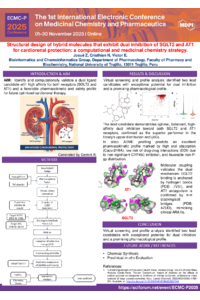
Combination therapy for metabolic diseases has traditionally been associated with an increased risk of chronic kidney disease (CKD). However, the co-administration of sodium-glucose cotransporter 2 (SGLT2) inhibitors and angiotensin II type I receptor antagonist (AT1) have demonstrated a protective effect against CKD progression. To build upon this therapeutic potential, the present study introduces an in silico design of a hybrid molecule as an innovative pharmacological strategy.
This approach integrates the key pharmacophores of empagliflozin (SGLT2 inhibitor) and telmisartan (ARB) into a single molecular entity, aiming to enhance nephroprotective synergy while streamlining the treatment regimen. The computational workflow began with the generation of a bioisostere library comprising 2017 compounds sourced from the Zinc20 database. Molecular docking simulations were conducted using the VINA 1.1.2 algorithm to assess binding affinity and stability toward both target receptors: SGLT2 (PDB: 7VSI) and AT1 (PDB: 4ZUD).
The lead candidate was identified based on its optimal Gibbs free energy values for both receptors and its favorable pharmacokinetic and safety profile, as predicted by ADMETlab 3.0. Visualization and analysis of docking interactions were performed using PyMOL and Discovery Studio.
This study not only confirms the feasibility of combining two complementary mechanisms of action within a single compound but also proposes a promising candidate for subsequent development stages, including chemical synthesis and preclinical evaluation (in vitro and in vivo). These findings lay the groundwork for a new generation of targeted therapies that are safer and more effective in protecting kidney and cardiovascular health.
Keywords
AT1
SGLT2
bioisostere
CKD
hybrid molecule
cardiovascular health
Medicinal Chemistry Strategy.
Poster
Poster.pdf
In silico identification of a new potential drug-binding pocket on the surface of the receptor-binding domain of the SARS-CoV-2 S-glycoprotein
Design of Gadolinium or Iron based contrast agents for senile plaques detection by MRI