Event submissions
EventsThe 1st International Electronic Conference on Medicinal Chemistry and Pharmaceutics
Published
This submission belongs to the session S11. Formulation, Drug Delivery and Controlled Release of the event The 1st International Electronic Conference on Medicinal Chemistry and Pharmaceutics
Published date
29 Oct, 2025
Academic Editor
'%3e%3cpath%20d='M12.6657%2010.9104C12.4185%2010.325%2012.0599%209.79327%2011.6097%209.34482C11.1609%208.89508%2010.6293%208.5365%2010.0442%208.28888C10.0389%208.28626%2010.0337%208.28495%2010.0285%208.28233C10.8446%207.69279%2011.3752%206.73249%2011.3752%205.64904C11.3752%203.8542%209.92103%202.39999%208.1262%202.39999C6.33136%202.39999%204.87715%203.8542%204.87715%205.64904C4.87715%206.73249%205.40774%207.69279%206.22393%208.28364C6.21869%208.28626%206.21345%208.28757%206.20821%208.29019C5.62129%208.5378%205.09463%208.89284%204.64265%209.34613C4.1929%209.79493%203.83432%2010.3266%203.58671%2010.9117C3.34345%2011.4845%203.21226%2012.0987%203.20023%2012.7209C3.19988%2012.7349%203.20233%2012.7488%203.20744%2012.7619C3.21255%2012.7749%203.22022%2012.7867%203.22998%2012.7968C3.23975%2012.8068%203.25142%2012.8147%203.26431%2012.8202C3.2772%2012.8256%203.29105%2012.8284%203.30504%2012.8284H4.09109C4.14874%2012.8284%204.19459%2012.7825%204.1959%2012.7262C4.2221%2011.7148%204.62823%2010.7676%205.34617%2010.0497C6.08899%209.30683%207.0755%208.89808%208.1262%208.89808C9.17689%208.89808%2010.1634%209.30683%2010.9062%2010.0497C11.6242%2010.7676%2012.0303%2011.7148%2012.0565%2012.7262C12.0578%2012.7838%2012.1037%2012.8284%2012.1613%2012.8284H12.9474C12.9613%2012.8284%2012.9752%2012.8256%2012.9881%2012.8202C13.001%2012.8147%2013.0126%2012.8068%2013.0224%2012.7968C13.0322%2012.7867%2013.0398%2012.7749%2013.0449%2012.7619C13.0501%2012.7488%2013.0525%2012.7349%2013.0522%2012.7209C13.0391%2012.0947%2012.9094%2011.4855%2012.6657%2010.9104ZM8.1262%207.9024C7.52486%207.9024%206.9589%207.6679%206.53312%207.24211C6.10733%206.81633%205.87283%206.25037%205.87283%205.64904C5.87283%205.0477%206.10733%204.48174%206.53312%204.05596C6.9589%203.63018%207.52486%203.39567%208.1262%203.39567C8.72753%203.39567%209.29349%203.63018%209.71927%204.05596C10.1451%204.48174%2010.3796%205.0477%2010.3796%205.64904C10.3796%206.25037%2010.1451%206.81633%209.71927%207.24211C9.29349%207.6679%208.72753%207.9024%208.1262%207.9024Z'%20fill='%235D1EE1'/%3e%3c/g%3e%3c/svg%3e) Antonio Vassallo
Antonio VassalloCitation
Shery Jacob, Fathima Sheik Kather, Shakta Mani Satyam, Sai H. S. Boddu, Firas Assaf, Tasnem H Abdelfattah Allam, Anroop B Nair, Injectable In-Situ Forming Thermoreversible Nanoemulgel of Lidocaine for Enhanced and Prolonged Anesthetic Action, in Proceedings of The 1st International Electronic Conference on Medicinal Chemistry and Pharmaceutics, 1 November–30 November 2025, MDPI: Basel, Switzerland
Share
Email
Facebook
Twitter
LinkedIn
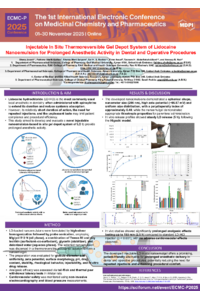
Injectable In-Situ Forming Thermoreversible Nanoemulgel of Lidocaine for Enhanced and Prolonged Anesthetic Action
'%3e%3cpath%20d='M12.6647%2010.9104C12.4176%2010.325%2012.0589%209.7933%2011.6088%209.34485C11.16%208.89511%2010.6283%208.53653%2010.0432%208.28891C10.038%208.28629%2010.0327%208.28498%2010.0275%208.28236C10.8437%207.69282%2011.3743%206.73252%2011.3743%205.64907C11.3743%203.85423%209.92005%202.40002%208.12522%202.40002C6.33038%202.40002%204.87618%203.85423%204.87618%205.64907C4.87618%206.73252%205.40677%207.69282%206.22296%208.28367C6.21772%208.28629%206.21248%208.2876%206.20724%208.29022C5.62031%208.53783%205.09365%208.89287%204.64167%209.34616C4.19192%209.79496%203.83334%2010.3266%203.58573%2010.9117C3.34247%2011.4846%203.21128%2012.0987%203.19925%2012.721C3.1989%2012.735%203.20135%2012.7489%203.20646%2012.7619C3.21157%2012.7749%203.21924%2012.7868%203.22901%2012.7968C3.23877%2012.8068%203.25045%2012.8148%203.26334%2012.8202C3.27623%2012.8256%203.29007%2012.8284%203.30406%2012.8284H4.09012C4.14776%2012.8284%204.19362%2012.7825%204.19493%2012.7262C4.22113%2011.7148%204.62726%2010.7676%205.34519%2010.0497C6.08802%209.30686%207.07452%208.89811%208.12522%208.89811C9.17592%208.89811%2010.1624%209.30686%2010.9052%2010.0497C11.6232%2010.7676%2012.0293%2011.7148%2012.0555%2012.7262C12.0568%2012.7839%2012.1027%2012.8284%2012.1603%2012.8284H12.9464C12.9604%2012.8284%2012.9742%2012.8256%2012.9871%2012.8202C13%2012.8148%2013.0117%2012.8068%2013.0214%2012.7968C13.0312%2012.7868%2013.0389%2012.7749%2013.044%2012.7619C13.0491%2012.7489%2013.0515%2012.735%2013.0512%2012.721C13.0381%2012.0947%2012.9084%2011.4856%2012.6647%2010.9104ZM8.12522%207.90243C7.52388%207.90243%206.95792%207.66793%206.53214%207.24215C6.10636%206.81636%205.87185%206.2504%205.87185%205.64907C5.87185%205.04773%206.10636%204.48177%206.53214%204.05599C6.95792%203.63021%207.52388%203.3957%208.12522%203.3957C8.72655%203.3957%209.29252%203.63021%209.7183%204.05599C10.1441%204.48177%2010.3786%205.04773%2010.3786%205.64907C10.3786%206.2504%2010.1441%206.81636%209.7183%207.24215C9.29252%207.66793%208.72655%207.90243%208.12522%207.90243Z'%20fill='%235D1EE1'/%3e%3c/g%3e%3c/svg%3e)
Shery Jacob 1
Fathima Sheik Kather 1

Shakta Mani Satyam 2
Sai H. S. Boddu 3
Firas Assaf 2
Tasnem H Abdelfattah Allam 3
Anroop B Nair 4
1. Department of Pharmaceutical Sciences, College of Pharmacy, Gulf Medical University,
Ajman P.O. Box 4184, United Arab Emirates
2. Department of Pharmacology, RAK College of Medical Sciences, RAK Medical and Health Sciences University, Ras Al Khaimah P.O. Box 11172, United Arab Emirates
3. Department of Pharmaceutical Sciences, College of Pharmacy and Health Sciences, Ajman University, Ajman P.O. Box 346, United Arab Emirates
4. Department of Pharmaceutical Sciences, College of Clinical Pharmacy, King Faisal University, Al-Ahsa P.O. Box 31982, Saudi Arabia
Abstract
Background and Objectives:
Lidocaine hydrochloride (LD-HCl) is the most widely used local anesthetic in dentistry, commonly combined with epinephrine to prolong anesthesia and limit systemic absorption. However, its short duration of action, need for repeated injections, and bitter taste often reduce patient compliance and procedural efficiency. This study aimed to develop and evaluate an injectable in-situ forming nanoemulsion-based gel depot system of LD designed to provide sustained anesthetic activity.Methods:LD nanoemulsions were prepared by high-shear homogenization followed by probe sonication using Miglyol 812 N (oil phase), Tween 80 and soy lecithin (surfactant–co-surfactant), glycerin, and deionized water (aqueous phase). The optimized formulation (S1) was incorporated into a thermoreversible poloxamer solution to yield a nanoemulgel. The formulation was evaluated for particle size, distribution, zeta potential, morphology, pH, drug content, stability, rheology, injectability, and in vitro release. Analgesic efficacy was assessed in Wistar rats by tail-flick and paw withdrawal latency tests, while cardiovascular safety was monitored using non-invasive electrocardiography and blood pressure measurements.Results:The optimized nanoemulsion exhibited spherical morphology with a mean particle size of 206 nm, high negative zeta potential (-66.67 mV), and narrow distribution (PDI ≈ 0.40). The nanoemulgel demonstrated desirable thixotropic behavior, ensuring ease of injection. In vitro release studies showed sustained lidocaine release for 5 hours, following the Higuchi model. In vivo, the nanoemulgel significantly prolonged analgesia, lasting up to 150 minutes (2.5 h) compared with conventional LD-HCl injection (p < 0.001). No adverse cardiovascular effects were observed.Conclusions:
The developed LD-loaded in-situ nanoemulgel offers a promising and patient-friendly alternative for dental and minor surgical anesthesia. By extending anesthetic duration, it reduces the need for repeated injections, improves patient comfort, and enhances procedural efficiency.
Keywords
Local anesthesia
lidocaine
nanoemulsion
nanoemulgel
characterization
in vivo studies
Poster
MDPI E-Poster-sciforum-151425.pdf
Evaluation of Anticancer Activity of Pyruvamide 4-Allylthiosemicarbazones and Their Copper(II) Complexes Against the Leukemia THP-1 Cell Line
Comparative Evaluation of Transethosomal and Transniosomal Emulgels for Enhanced Transdermal Delivery of Naproxen: A Novel Approach for Managing Musculoskeletal Inflammation