Event submissions
EventsThe 1st International Electronic Conference on Medicinal Chemistry and Pharmaceutics
Published
This submission belongs to the session S3. General of the event The 1st International Electronic Conference on Medicinal Chemistry and Pharmaceutics
Published date
29 Oct, 2025
Academic Editor
'%3e%3cpath%20d='M12.6657%2010.9104C12.4185%2010.325%2012.0599%209.79327%2011.6097%209.34482C11.1609%208.89508%2010.6293%208.5365%2010.0442%208.28888C10.0389%208.28626%2010.0337%208.28495%2010.0285%208.28233C10.8446%207.69279%2011.3752%206.73249%2011.3752%205.64904C11.3752%203.8542%209.92103%202.39999%208.1262%202.39999C6.33136%202.39999%204.87715%203.8542%204.87715%205.64904C4.87715%206.73249%205.40774%207.69279%206.22393%208.28364C6.21869%208.28626%206.21345%208.28757%206.20821%208.29019C5.62129%208.5378%205.09463%208.89284%204.64265%209.34613C4.1929%209.79493%203.83432%2010.3266%203.58671%2010.9117C3.34345%2011.4845%203.21226%2012.0987%203.20023%2012.7209C3.19988%2012.7349%203.20233%2012.7488%203.20744%2012.7619C3.21255%2012.7749%203.22022%2012.7867%203.22998%2012.7968C3.23975%2012.8068%203.25142%2012.8147%203.26431%2012.8202C3.2772%2012.8256%203.29105%2012.8284%203.30504%2012.8284H4.09109C4.14874%2012.8284%204.19459%2012.7825%204.1959%2012.7262C4.2221%2011.7148%204.62823%2010.7676%205.34617%2010.0497C6.08899%209.30683%207.0755%208.89808%208.1262%208.89808C9.17689%208.89808%2010.1634%209.30683%2010.9062%2010.0497C11.6242%2010.7676%2012.0303%2011.7148%2012.0565%2012.7262C12.0578%2012.7838%2012.1037%2012.8284%2012.1613%2012.8284H12.9474C12.9613%2012.8284%2012.9752%2012.8256%2012.9881%2012.8202C13.001%2012.8147%2013.0126%2012.8068%2013.0224%2012.7968C13.0322%2012.7867%2013.0398%2012.7749%2013.0449%2012.7619C13.0501%2012.7488%2013.0525%2012.7349%2013.0522%2012.7209C13.0391%2012.0947%2012.9094%2011.4855%2012.6657%2010.9104ZM8.1262%207.9024C7.52486%207.9024%206.9589%207.6679%206.53312%207.24211C6.10733%206.81633%205.87283%206.25037%205.87283%205.64904C5.87283%205.0477%206.10733%204.48174%206.53312%204.05596C6.9589%203.63018%207.52486%203.39567%208.1262%203.39567C8.72753%203.39567%209.29349%203.63018%209.71927%204.05596C10.1451%204.48174%2010.3796%205.0477%2010.3796%205.64904C10.3796%206.25037%2010.1451%206.81633%209.71927%207.24211C9.29349%207.6679%208.72753%207.9024%208.1262%207.9024Z'%20fill='%235D1EE1'/%3e%3c/g%3e%3c/svg%3e) M. Matilde Marques
M. Matilde MarquesCitation
Elisabet Teixido, Adriana Solange Maddaleno, Laia Guardia-Escoté, Maria Pilar Vinardell, Montserrat Mitjans, Cytotoxicity and DNA Damage Biomarkers in the Assessment of Photogenotoxicity, in Proceedings of The 1st International Electronic Conference on Medicinal Chemistry and Pharmaceutics, 1 November–30 November 2025, MDPI: Basel, Switzerland
Share
Email
Facebook
Twitter
LinkedIn
Cytotoxicity and DNA Damage Biomarkers in the Assessment of Photogenotoxicity

Elisabet Teixido 1
'%3e%3cpath%20d='M12.6647%2010.9104C12.4176%2010.325%2012.0589%209.7933%2011.6088%209.34485C11.16%208.89511%2010.6283%208.53653%2010.0432%208.28891C10.038%208.28629%2010.0327%208.28498%2010.0275%208.28236C10.8437%207.69282%2011.3743%206.73252%2011.3743%205.64907C11.3743%203.85423%209.92005%202.40002%208.12522%202.40002C6.33038%202.40002%204.87618%203.85423%204.87618%205.64907C4.87618%206.73252%205.40677%207.69282%206.22296%208.28367C6.21772%208.28629%206.21248%208.2876%206.20724%208.29022C5.62031%208.53783%205.09365%208.89287%204.64167%209.34616C4.19192%209.79496%203.83334%2010.3266%203.58573%2010.9117C3.34247%2011.4846%203.21128%2012.0987%203.19925%2012.721C3.1989%2012.735%203.20135%2012.7489%203.20646%2012.7619C3.21157%2012.7749%203.21924%2012.7868%203.22901%2012.7968C3.23877%2012.8068%203.25045%2012.8148%203.26334%2012.8202C3.27623%2012.8256%203.29007%2012.8284%203.30406%2012.8284H4.09012C4.14776%2012.8284%204.19362%2012.7825%204.19493%2012.7262C4.22113%2011.7148%204.62726%2010.7676%205.34519%2010.0497C6.08802%209.30686%207.07452%208.89811%208.12522%208.89811C9.17592%208.89811%2010.1624%209.30686%2010.9052%2010.0497C11.6232%2010.7676%2012.0293%2011.7148%2012.0555%2012.7262C12.0568%2012.7839%2012.1027%2012.8284%2012.1603%2012.8284H12.9464C12.9604%2012.8284%2012.9742%2012.8256%2012.9871%2012.8202C13%2012.8148%2013.0117%2012.8068%2013.0214%2012.7968C13.0312%2012.7868%2013.0389%2012.7749%2013.044%2012.7619C13.0491%2012.7489%2013.0515%2012.735%2013.0512%2012.721C13.0381%2012.0947%2012.9084%2011.4856%2012.6647%2010.9104ZM8.12522%207.90243C7.52388%207.90243%206.95792%207.66793%206.53214%207.24215C6.10636%206.81636%205.87185%206.2504%205.87185%205.64907C5.87185%205.04773%206.10636%204.48177%206.53214%204.05599C6.95792%203.63021%207.52388%203.3957%208.12522%203.3957C8.72655%203.3957%209.29252%203.63021%209.7183%204.05599C10.1441%204.48177%2010.3786%205.04773%2010.3786%205.64907C10.3786%206.2504%2010.1441%206.81636%209.7183%207.24215C9.29252%207.66793%208.72655%207.90243%208.12522%207.90243Z'%20fill='%235D1EE1'/%3e%3c/g%3e%3c/svg%3e)
Adriana Solange Maddaleno 2

Laia Guardia-Escoté 1

Maria Pilar Vinardell 2
Montserrat Mitjans 2
1. Department of Pharmacology, Toxicology and Therapeutic Chemistry, Universitat de Barcelona, 08028 Barcelona, Spain
2. Department of Biochemistry and Physiology, Faculty of Pharmacy and Food Sciences, Universitat de Barcelona, 08028 Barcelona, Spain
Abstract
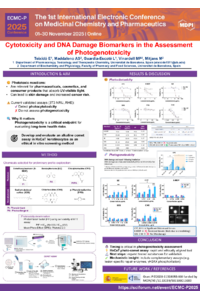
Phototoxic reactions are of particular concern for pharmaceuticals, cosmetics, and other consumer products that absorb UV-visible light, as they can result in skin damage and increased cancer risk. Current in vitro strategies, such as the 3T3 Neutral Red Uptake and reconstructed human epidermis assays, mainly address photocytotoxicity but fail to capture light-induced DNA damage (photogenotoxicity), a key endpoint for long-term health effects. To overcome these limitations, we developed an in vitro alkaline comet assay in HaCaT human keratinocytes, focusing on biomarkers of light-induced DNA damage (photogenotoxicity). Cytotoxicity was monitored through MTT and LDH assays, while DNA strand breaks served as a biomarker of genotoxic stress. Six reference chemicals (sodium dodecyl sulfate, chlorpromazine, benzophenone-3, 8-methoxypsoralen -8-MOP-, p-phenylenediamine, and 6-methylcoumarin – 6-MC-) were tested. Following UV-A irradiation (4 J/cm²), photocytotoxicity was quantified using Photo-Irritation Factor (PIF) and Mean Photo Effect (MPE) values, while genotoxic effects were determined by the comet assay at immediate and 24 h post-exposure. Phototoxicity was evident for benzophenone-3, 8-MOP, 6-MC and chlorpromazine, reflected in elevated PIF/MPE values. DNA damage, as detected by comet assay, was significant for benzophenone-3, p-phenylenediamine, and chlorpromazine, but absent for 8-MOP, consistent with its DNA crosslinking properties. Importantly, no persistence of DNA strand breaks was observed after 24 h, indicating DNA repair biomarkers of recovery. Altogether, cytotoxicity and genotoxicity biomarkers identified in this study highlight the alkaline comet assay as a relevant tool to detect photogenotoxic hazards in vitro.
Acknowledgement: Proyecto PID2020-113186RB-I00 fund by MCIN/AEI/10.13039/501100011033
Keywords
UV light
in vitro
genotoxicity
comet assay
keratinocytes
Poster
Poster_ECMC_2025.pdf
Bioanalytical Method Development and Validation for PLC, RCB, and LIT in Human Plasma Using HPLC-UV
Exploring the Antimicrobial and Anticancer Potentials of 3-Hydrazinoquinoxaline-2-thiol: In vitro and In silico Evaluation