Event submissions
EventsThe 1st International Electronic Conference on Medicinal Chemistry and Pharmaceutics
Published
This submission belongs to the session S4. New Small molecules as drug candidates of the event The 1st International Electronic Conference on Medicinal Chemistry and Pharmaceutics
Published date
29 Oct, 2025
Academic Editor
'%3e%3cpath%20d='M12.6657%2010.9104C12.4185%2010.325%2012.0599%209.79327%2011.6097%209.34482C11.1609%208.89508%2010.6293%208.5365%2010.0442%208.28888C10.0389%208.28626%2010.0337%208.28495%2010.0285%208.28233C10.8446%207.69279%2011.3752%206.73249%2011.3752%205.64904C11.3752%203.8542%209.92103%202.39999%208.1262%202.39999C6.33136%202.39999%204.87715%203.8542%204.87715%205.64904C4.87715%206.73249%205.40774%207.69279%206.22393%208.28364C6.21869%208.28626%206.21345%208.28757%206.20821%208.29019C5.62129%208.5378%205.09463%208.89284%204.64265%209.34613C4.1929%209.79493%203.83432%2010.3266%203.58671%2010.9117C3.34345%2011.4845%203.21226%2012.0987%203.20023%2012.7209C3.19988%2012.7349%203.20233%2012.7488%203.20744%2012.7619C3.21255%2012.7749%203.22022%2012.7867%203.22998%2012.7968C3.23975%2012.8068%203.25142%2012.8147%203.26431%2012.8202C3.2772%2012.8256%203.29105%2012.8284%203.30504%2012.8284H4.09109C4.14874%2012.8284%204.19459%2012.7825%204.1959%2012.7262C4.2221%2011.7148%204.62823%2010.7676%205.34617%2010.0497C6.08899%209.30683%207.0755%208.89808%208.1262%208.89808C9.17689%208.89808%2010.1634%209.30683%2010.9062%2010.0497C11.6242%2010.7676%2012.0303%2011.7148%2012.0565%2012.7262C12.0578%2012.7838%2012.1037%2012.8284%2012.1613%2012.8284H12.9474C12.9613%2012.8284%2012.9752%2012.8256%2012.9881%2012.8202C13.001%2012.8147%2013.0126%2012.8068%2013.0224%2012.7968C13.0322%2012.7867%2013.0398%2012.7749%2013.0449%2012.7619C13.0501%2012.7488%2013.0525%2012.7349%2013.0522%2012.7209C13.0391%2012.0947%2012.9094%2011.4855%2012.6657%2010.9104ZM8.1262%207.9024C7.52486%207.9024%206.9589%207.6679%206.53312%207.24211C6.10733%206.81633%205.87283%206.25037%205.87283%205.64904C5.87283%205.0477%206.10733%204.48174%206.53312%204.05596C6.9589%203.63018%207.52486%203.39567%208.1262%203.39567C8.72753%203.39567%209.29349%203.63018%209.71927%204.05596C10.1451%204.48174%2010.3796%205.0477%2010.3796%205.64904C10.3796%206.25037%2010.1451%206.81633%209.71927%207.24211C9.29349%207.6679%208.72753%207.9024%208.1262%207.9024Z'%20fill='%235D1EE1'/%3e%3c/g%3e%3c/svg%3e) Diego Muñoz-Torrero
Diego Muñoz-TorreroCitation
Elise Charrier, François Peltier, Morgane Choquet, Alexandra Dassonville-Klimpt, Claire Andréjak, Pascal Sonnet, Development of amino-alcohol-quinolines targeting lung diseases caused by non-tuberculous mycobacteria., in Proceedings of The 1st International Electronic Conference on Medicinal Chemistry and Pharmaceutics, 1 November–30 November 2025, MDPI: Basel, Switzerland
Share
Email
Facebook
Twitter
LinkedIn
Development of amino-alcohol-quinolines targeting lung diseases caused by non-tuberculous mycobacteria.
'%3e%3cpath%20d='M12.6647%2010.9104C12.4176%2010.325%2012.0589%209.7933%2011.6088%209.34485C11.16%208.89511%2010.6283%208.53653%2010.0432%208.28891C10.038%208.28629%2010.0327%208.28498%2010.0275%208.28236C10.8437%207.69282%2011.3743%206.73252%2011.3743%205.64907C11.3743%203.85423%209.92005%202.40002%208.12522%202.40002C6.33038%202.40002%204.87618%203.85423%204.87618%205.64907C4.87618%206.73252%205.40677%207.69282%206.22296%208.28367C6.21772%208.28629%206.21248%208.2876%206.20724%208.29022C5.62031%208.53783%205.09365%208.89287%204.64167%209.34616C4.19192%209.79496%203.83334%2010.3266%203.58573%2010.9117C3.34247%2011.4846%203.21128%2012.0987%203.19925%2012.721C3.1989%2012.735%203.20135%2012.7489%203.20646%2012.7619C3.21157%2012.7749%203.21924%2012.7868%203.22901%2012.7968C3.23877%2012.8068%203.25045%2012.8148%203.26334%2012.8202C3.27623%2012.8256%203.29007%2012.8284%203.30406%2012.8284H4.09012C4.14776%2012.8284%204.19362%2012.7825%204.19493%2012.7262C4.22113%2011.7148%204.62726%2010.7676%205.34519%2010.0497C6.08802%209.30686%207.07452%208.89811%208.12522%208.89811C9.17592%208.89811%2010.1624%209.30686%2010.9052%2010.0497C11.6232%2010.7676%2012.0293%2011.7148%2012.0555%2012.7262C12.0568%2012.7839%2012.1027%2012.8284%2012.1603%2012.8284H12.9464C12.9604%2012.8284%2012.9742%2012.8256%2012.9871%2012.8202C13%2012.8148%2013.0117%2012.8068%2013.0214%2012.7968C13.0312%2012.7868%2013.0389%2012.7749%2013.044%2012.7619C13.0491%2012.7489%2013.0515%2012.735%2013.0512%2012.721C13.0381%2012.0947%2012.9084%2011.4856%2012.6647%2010.9104ZM8.12522%207.90243C7.52388%207.90243%206.95792%207.66793%206.53214%207.24215C6.10636%206.81636%205.87185%206.2504%205.87185%205.64907C5.87185%205.04773%206.10636%204.48177%206.53214%204.05599C6.95792%203.63021%207.52388%203.3957%208.12522%203.3957C8.72655%203.3957%209.29252%203.63021%209.7183%204.05599C10.1441%204.48177%2010.3786%205.04773%2010.3786%205.64907C10.3786%206.2504%2010.1441%206.81636%209.7183%207.24215C9.29252%207.66793%208.72655%207.90243%208.12522%207.90243Z'%20fill='%235D1EE1'/%3e%3c/g%3e%3c/svg%3e)
Elise Charrier 1
François Peltier 1
Morgane Choquet 1

Alexandra Dassonville-Klimpt 1
Claire Andréjak 1

Pascal Sonnet 1
1. AGents Infectieux, Résistance et chimiothérapie, UR 4294, Université de Picardie Jules Verne, CURS, CHU Amiens-Picardie, 30 av. de la Croix Jourdain, 80000 Amiens, France
Abstract
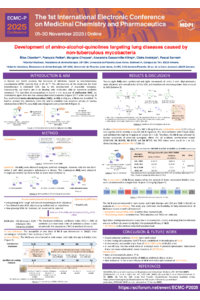
The emergence of non-tuberculous mycobacteria (NTM) infections is outstripping that of Mycobacterium tuberculosis. Some species cause opportunistic infections in humans. In people with bronchiectasis or chronic respiratory disease, 80% of infections are related to NTM, and among these, Mycobacterium avium complex (MAC) is the most common. Guidelines-based treatment consists of a combination of a macrolide, a rifamycin and ethambutol. This treatment is prescribed for at least 12 months and its effectiveness is estimated at 52%, due to the development of macrolide resistance in MAC. These drugs can cause inconveniences or serious effects. Drug interactions can also occur, e.g., clarithromycin and rifampicin are strong inducers of cytochrome P450. Consequently, there is an urgent need to develop safer molecules with novel mechanisms of action that also minimize the risk of antibiotic resistance.
The quinoline-based pharmacophore is found in mefloquine (MQ). MQ has moderate anti-NTM activity in vitro (MIC = 4 µg/mL on MAC), high in vitro toxicity (CC50 = 2.6 µg/mL on HepG2 cells) and a low maximum tolerated in vivo dose (40 mg/kg).
Our aim is to develop new amino-alcohol-quinolines (AAQ), analogues of MQ, by modulating the structural positions of the MQ core, particularly the amino-alcohol chain, in order to improve efficacy and reduce toxicity. Two series of AAQ were developed and thirty-one compounds were obtained. One hit was identified, with the highest selectivity index (SI) on M. avium (SI = 5.8). Additionally, checkerboard assay was demonstrated an additive effect with the antibiotics used in the reference treatment. Finally, this hit was evaluated in BALB/c mice and excellent tolerance was revealed (tolerate dose ≥ 500 mg/kg).
The following topics will be presented: i) the design and synthesis of AAQ, ii) their in vitro activity and toxicity, iii) the potential in vitro synergistic effects of one hit compound, and iv) the in vivo toxicity of this promising compound.
Keywords
amino-alcohol-quinolines
lung diseases
non-tuberculous mycobacteria
Poster
EC-Poster-ECMC-PVF.pdf
In Silico Evaluation of Novel Oxaprozin-Based Anti-Inflammatory Agents Targeting Cyclooxygenases
Stimulation of thyroid hormone synthesis by ethyl-2-(4-(4-(5-amino-6-(tert-butylcarbamoyl)-2-(methylthio)thieno[2,3-d]-pyrimidin-4-yl)phenyl)-1H-1,2,3-triazol-1-yl) acetate (TPY3m) and thyroliberin in aging normal and obese rats