Event submissions
EventsThe 1st International Electronic Conference on Medicinal Chemistry and Pharmaceutics
Published
This submission belongs to the session S4. New Small molecules as drug candidates of the event The 1st International Electronic Conference on Medicinal Chemistry and Pharmaceutics
Published date
29 Oct, 2025
Academic Editor
'%3e%3cpath%20d='M12.6657%2010.9104C12.4185%2010.325%2012.0599%209.79327%2011.6097%209.34482C11.1609%208.89508%2010.6293%208.5365%2010.0442%208.28888C10.0389%208.28626%2010.0337%208.28495%2010.0285%208.28233C10.8446%207.69279%2011.3752%206.73249%2011.3752%205.64904C11.3752%203.8542%209.92103%202.39999%208.1262%202.39999C6.33136%202.39999%204.87715%203.8542%204.87715%205.64904C4.87715%206.73249%205.40774%207.69279%206.22393%208.28364C6.21869%208.28626%206.21345%208.28757%206.20821%208.29019C5.62129%208.5378%205.09463%208.89284%204.64265%209.34613C4.1929%209.79493%203.83432%2010.3266%203.58671%2010.9117C3.34345%2011.4845%203.21226%2012.0987%203.20023%2012.7209C3.19988%2012.7349%203.20233%2012.7488%203.20744%2012.7619C3.21255%2012.7749%203.22022%2012.7867%203.22998%2012.7968C3.23975%2012.8068%203.25142%2012.8147%203.26431%2012.8202C3.2772%2012.8256%203.29105%2012.8284%203.30504%2012.8284H4.09109C4.14874%2012.8284%204.19459%2012.7825%204.1959%2012.7262C4.2221%2011.7148%204.62823%2010.7676%205.34617%2010.0497C6.08899%209.30683%207.0755%208.89808%208.1262%208.89808C9.17689%208.89808%2010.1634%209.30683%2010.9062%2010.0497C11.6242%2010.7676%2012.0303%2011.7148%2012.0565%2012.7262C12.0578%2012.7838%2012.1037%2012.8284%2012.1613%2012.8284H12.9474C12.9613%2012.8284%2012.9752%2012.8256%2012.9881%2012.8202C13.001%2012.8147%2013.0126%2012.8068%2013.0224%2012.7968C13.0322%2012.7867%2013.0398%2012.7749%2013.0449%2012.7619C13.0501%2012.7488%2013.0525%2012.7349%2013.0522%2012.7209C13.0391%2012.0947%2012.9094%2011.4855%2012.6657%2010.9104ZM8.1262%207.9024C7.52486%207.9024%206.9589%207.6679%206.53312%207.24211C6.10733%206.81633%205.87283%206.25037%205.87283%205.64904C5.87283%205.0477%206.10733%204.48174%206.53312%204.05596C6.9589%203.63018%207.52486%203.39567%208.1262%203.39567C8.72753%203.39567%209.29349%203.63018%209.71927%204.05596C10.1451%204.48174%2010.3796%205.0477%2010.3796%205.64904C10.3796%206.25037%2010.1451%206.81633%209.71927%207.24211C9.29349%207.6679%208.72753%207.9024%208.1262%207.9024Z'%20fill='%235D1EE1'/%3e%3c/g%3e%3c/svg%3e) Serena Massari
Serena MassariCitation
Marie Gréverie, François Peltier, Alexandra Dassonville-Klimpt, Claire Andrejak, Pascal Sonnet, From the design to the biological evaluation of quinoline-based carboxamides targeting non-tuberculous mycobacteria, in Proceedings of The 1st International Electronic Conference on Medicinal Chemistry and Pharmaceutics, 1 November–30 November 2025, MDPI: Basel, Switzerland
Share
Email
Facebook
Twitter
LinkedIn
From the design to the biological evaluation of quinoline-based carboxamides targeting non-tuberculous mycobacteria
'%3e%3cpath%20d='M12.6647%2010.9104C12.4176%2010.325%2012.0589%209.7933%2011.6088%209.34485C11.16%208.89511%2010.6283%208.53653%2010.0432%208.28891C10.038%208.28629%2010.0327%208.28498%2010.0275%208.28236C10.8437%207.69282%2011.3743%206.73252%2011.3743%205.64907C11.3743%203.85423%209.92005%202.40002%208.12522%202.40002C6.33038%202.40002%204.87618%203.85423%204.87618%205.64907C4.87618%206.73252%205.40677%207.69282%206.22296%208.28367C6.21772%208.28629%206.21248%208.2876%206.20724%208.29022C5.62031%208.53783%205.09365%208.89287%204.64167%209.34616C4.19192%209.79496%203.83334%2010.3266%203.58573%2010.9117C3.34247%2011.4846%203.21128%2012.0987%203.19925%2012.721C3.1989%2012.735%203.20135%2012.7489%203.20646%2012.7619C3.21157%2012.7749%203.21924%2012.7868%203.22901%2012.7968C3.23877%2012.8068%203.25045%2012.8148%203.26334%2012.8202C3.27623%2012.8256%203.29007%2012.8284%203.30406%2012.8284H4.09012C4.14776%2012.8284%204.19362%2012.7825%204.19493%2012.7262C4.22113%2011.7148%204.62726%2010.7676%205.34519%2010.0497C6.08802%209.30686%207.07452%208.89811%208.12522%208.89811C9.17592%208.89811%2010.1624%209.30686%2010.9052%2010.0497C11.6232%2010.7676%2012.0293%2011.7148%2012.0555%2012.7262C12.0568%2012.7839%2012.1027%2012.8284%2012.1603%2012.8284H12.9464C12.9604%2012.8284%2012.9742%2012.8256%2012.9871%2012.8202C13%2012.8148%2013.0117%2012.8068%2013.0214%2012.7968C13.0312%2012.7868%2013.0389%2012.7749%2013.044%2012.7619C13.0491%2012.7489%2013.0515%2012.735%2013.0512%2012.721C13.0381%2012.0947%2012.9084%2011.4856%2012.6647%2010.9104ZM8.12522%207.90243C7.52388%207.90243%206.95792%207.66793%206.53214%207.24215C6.10636%206.81636%205.87185%206.2504%205.87185%205.64907C5.87185%205.04773%206.10636%204.48177%206.53214%204.05599C6.95792%203.63021%207.52388%203.3957%208.12522%203.3957C8.72655%203.3957%209.29252%203.63021%209.7183%204.05599C10.1441%204.48177%2010.3786%205.04773%2010.3786%205.64907C10.3786%206.2504%2010.1441%206.81636%209.7183%207.24215C9.29252%207.66793%208.72655%207.90243%208.12522%207.90243Z'%20fill='%235D1EE1'/%3e%3c/g%3e%3c/svg%3e)
Marie Gréverie 1
François Peltier 2

Alexandra Dassonville-Klimpt 1
Claire Andrejak 2

Pascal Sonnet 1
1. AGIR Laboratory, UR 4294, Université de Picardie Jules Verne, Building H, Campus du Thil, 80000 Amiens, France
2. AGIR Laboratory, UR 4294, Université de Picardie Jules Verne, CURS, Amiens-Picardie University Hospital (CHU Amiens-Picardie), 30 av. de la Croix Jourdain, 80000 Amiens, France.
Abstract
In recent years, non-tuberculous mycobacterial infections are definitely increasing worldwide. In particular, in Europe and North America, the non-tuberculous mycobacteria’s (NTM) incidence exceeds that of tuberculosis, with 1.0 to 1.8 case per 100,000 individuals. NTM are commonly found in the environment (soils, natural or urban water sources) and can be defined as opportunistic bacteria. Known for their pulmonary pathogenicity, several NTM can be particularly harmful to people with weakened immune system or pre-existing lung diseases such as cystic fibrosis, bronchiectasis or chronic obstructive pulmonary disease (COPD). The NTM classification is based on their type of growth: the slow-growing species include Mycobacterium avium complex (MAC), M. xenopi and M. kansasii, while M. abscessus and its MABSC complex and M. fortuitum belong to the rapid-growing species. Treatment options require a combination of three antibiotics including a macrolide, which depend on the strain. The treatment covers 18 to 24 months, with many associated side effects, and the cure rate remains moderate (e. g. 52 % to 60 % for MAC infections). Otherwise, mycobacterial resistance to macrolides, in particular MAC, represents a major challenge in treating infections. Our drug discovery strategy focuses on the development of a novel family of antibiotics based on a quinoline core, targeting NTM. Some developed or commercial antibiotics such as bedaquiline (BQ) or mefloquine (MQ) containing this scaffold have shown potent antimycobacterial activity. Thus, this work aims to design and synthesize innovative quinoline-based carboxamides, bearing an amide function on the position 4 of the quinoline ring. In addition, the determination of physico-chemical properties and the biological evaluation of synthesized compounds will be presented.
Keywords
Quinoline scaffold
non-tuberculous mycobacteria
pulmonary infections
drug discovery.
Poster
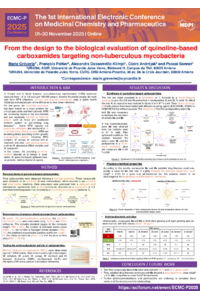
Poster_ECMC_Marie_GREVERIE_VF.pdf
Stimulation of thyroid hormone synthesis by ethyl-2-(4-(4-(5-amino-6-(tert-butylcarbamoyl)-2-(methylthio)thieno[2,3-d]-pyrimidin-4-yl)phenyl)-1H-1,2,3-triazol-1-yl) acetate (TPY3m) and thyroliberin in aging normal and obese rats
A small molecule inhibitor of the main coronavirus protease 3CLPro based on a carbocyclically substituted peptidomimetic.