Event submissions
EventsThe 1st International Electronic Conference on Medicinal Chemistry and Pharmaceutics
Published
This submission belongs to the session S4. New Small molecules as drug candidates of the event The 1st International Electronic Conference on Medicinal Chemistry and Pharmaceutics
Published date
29 Oct, 2025
Academic Editor
'%3e%3cpath%20d='M12.6657%2010.9104C12.4185%2010.325%2012.0599%209.79327%2011.6097%209.34482C11.1609%208.89508%2010.6293%208.5365%2010.0442%208.28888C10.0389%208.28626%2010.0337%208.28495%2010.0285%208.28233C10.8446%207.69279%2011.3752%206.73249%2011.3752%205.64904C11.3752%203.8542%209.92103%202.39999%208.1262%202.39999C6.33136%202.39999%204.87715%203.8542%204.87715%205.64904C4.87715%206.73249%205.40774%207.69279%206.22393%208.28364C6.21869%208.28626%206.21345%208.28757%206.20821%208.29019C5.62129%208.5378%205.09463%208.89284%204.64265%209.34613C4.1929%209.79493%203.83432%2010.3266%203.58671%2010.9117C3.34345%2011.4845%203.21226%2012.0987%203.20023%2012.7209C3.19988%2012.7349%203.20233%2012.7488%203.20744%2012.7619C3.21255%2012.7749%203.22022%2012.7867%203.22998%2012.7968C3.23975%2012.8068%203.25142%2012.8147%203.26431%2012.8202C3.2772%2012.8256%203.29105%2012.8284%203.30504%2012.8284H4.09109C4.14874%2012.8284%204.19459%2012.7825%204.1959%2012.7262C4.2221%2011.7148%204.62823%2010.7676%205.34617%2010.0497C6.08899%209.30683%207.0755%208.89808%208.1262%208.89808C9.17689%208.89808%2010.1634%209.30683%2010.9062%2010.0497C11.6242%2010.7676%2012.0303%2011.7148%2012.0565%2012.7262C12.0578%2012.7838%2012.1037%2012.8284%2012.1613%2012.8284H12.9474C12.9613%2012.8284%2012.9752%2012.8256%2012.9881%2012.8202C13.001%2012.8147%2013.0126%2012.8068%2013.0224%2012.7968C13.0322%2012.7867%2013.0398%2012.7749%2013.0449%2012.7619C13.0501%2012.7488%2013.0525%2012.7349%2013.0522%2012.7209C13.0391%2012.0947%2012.9094%2011.4855%2012.6657%2010.9104ZM8.1262%207.9024C7.52486%207.9024%206.9589%207.6679%206.53312%207.24211C6.10733%206.81633%205.87283%206.25037%205.87283%205.64904C5.87283%205.0477%206.10733%204.48174%206.53312%204.05596C6.9589%203.63018%207.52486%203.39567%208.1262%203.39567C8.72753%203.39567%209.29349%203.63018%209.71927%204.05596C10.1451%204.48174%2010.3796%205.0477%2010.3796%205.64904C10.3796%206.25037%2010.1451%206.81633%209.71927%207.24211C9.29349%207.6679%208.72753%207.9024%208.1262%207.9024Z'%20fill='%235D1EE1'/%3e%3c/g%3e%3c/svg%3e) Serena Massari
Serena MassariCitation
Ilya Yudin, Timur Garaev, Tatyana Grebennikova, A small molecule inhibitor of the main coronavirus protease 3CLPro based on a carbocyclically substituted peptidomimetic., in Proceedings of The 1st International Electronic Conference on Medicinal Chemistry and Pharmaceutics, 1 November–30 November 2025, MDPI: Basel, Switzerland
Share
Email
Facebook
Twitter
LinkedIn
A small molecule inhibitor of the main coronavirus protease 3CLPro based on a carbocyclically substituted peptidomimetic.
'%3e%3cpath%20d='M12.6647%2010.9104C12.4176%2010.325%2012.0589%209.7933%2011.6088%209.34485C11.16%208.89511%2010.6283%208.53653%2010.0432%208.28891C10.038%208.28629%2010.0327%208.28498%2010.0275%208.28236C10.8437%207.69282%2011.3743%206.73252%2011.3743%205.64907C11.3743%203.85423%209.92005%202.40002%208.12522%202.40002C6.33038%202.40002%204.87618%203.85423%204.87618%205.64907C4.87618%206.73252%205.40677%207.69282%206.22296%208.28367C6.21772%208.28629%206.21248%208.2876%206.20724%208.29022C5.62031%208.53783%205.09365%208.89287%204.64167%209.34616C4.19192%209.79496%203.83334%2010.3266%203.58573%2010.9117C3.34247%2011.4846%203.21128%2012.0987%203.19925%2012.721C3.1989%2012.735%203.20135%2012.7489%203.20646%2012.7619C3.21157%2012.7749%203.21924%2012.7868%203.22901%2012.7968C3.23877%2012.8068%203.25045%2012.8148%203.26334%2012.8202C3.27623%2012.8256%203.29007%2012.8284%203.30406%2012.8284H4.09012C4.14776%2012.8284%204.19362%2012.7825%204.19493%2012.7262C4.22113%2011.7148%204.62726%2010.7676%205.34519%2010.0497C6.08802%209.30686%207.07452%208.89811%208.12522%208.89811C9.17592%208.89811%2010.1624%209.30686%2010.9052%2010.0497C11.6232%2010.7676%2012.0293%2011.7148%2012.0555%2012.7262C12.0568%2012.7839%2012.1027%2012.8284%2012.1603%2012.8284H12.9464C12.9604%2012.8284%2012.9742%2012.8256%2012.9871%2012.8202C13%2012.8148%2013.0117%2012.8068%2013.0214%2012.7968C13.0312%2012.7868%2013.0389%2012.7749%2013.044%2012.7619C13.0491%2012.7489%2013.0515%2012.735%2013.0512%2012.721C13.0381%2012.0947%2012.9084%2011.4856%2012.6647%2010.9104ZM8.12522%207.90243C7.52388%207.90243%206.95792%207.66793%206.53214%207.24215C6.10636%206.81636%205.87185%206.2504%205.87185%205.64907C5.87185%205.04773%206.10636%204.48177%206.53214%204.05599C6.95792%203.63021%207.52388%203.3957%208.12522%203.3957C8.72655%203.3957%209.29252%203.63021%209.7183%204.05599C10.1441%204.48177%2010.3786%205.04773%2010.3786%205.64907C10.3786%206.2504%2010.1441%206.81636%209.7183%207.24215C9.29252%207.66793%208.72655%207.90243%208.12522%207.90243Z'%20fill='%235D1EE1'/%3e%3c/g%3e%3c/svg%3e)
Ilya Yudin 1
Timur Garaev 1

Tatyana Grebennikova 1
1. Gamaleya National Research Center for Epidemiology and Microbiology, Ministry of Health of Russian Federation, 123095, Moscow
Abstract
The mechanism of action of peptide inhibitors involves two steps. 3CLpro inhibitors, which mimic natural peptide substrates, initially bind to 3CLpro and form a non-covalent complex, while the attacking group (warhead) undergoes a nucleophilic attack, forming covalent bonds with the Cys145 residue. In this paper, we present a new small-molecule inhibitor of the main coronavirus protease, 3CLPro, based on the carbocyclically substituted peptidomimetic N-(4-methyl-1-oxo-1-((1-oxo-3-(2-oxopyrrolidin-3-yl)propan-2-yl)amino)pentan-2-yl)-(2Z)-3-(thiophen-2-yl)prop-2-enamide (TEA-Leu-Pld-CHO).
This low-toxicity compound (CC50 was 187.5 μg/ml) exhibits antiviral activity against modern coronavirus strains, including SARS-CoV-2. This substance exhibits sufficient solubility in aqueous solutions due to the one-step conversion of the aldehyde group to sodium bisulfite as a prodrug. To study the antiviral properties of the TEA-Leu-Pld-CHO compound, the SARS-CoV-2 human coronavirus strain, passage 4, with an infectious activity of 106 TCID50/mL for Vero-E6 cells, was used.
An experiment to assess cell viability in the antiviral efficacy assay was conducted over a range of drug concentrations from 375.0 to 0.37 μg/mL, by titrating the initial concentration in the wells of a 96-well plate. The antiviral activity of the compounds was assessed visually under a microscope 96 hours after infection by inhibiting the viral CPE in a Vero E6 cell culture. The IC50 for TEA-Leu-Pld-CHO was 5.8 μg/mL. Thus, Si was 32.
The proposed compound, given its high antiviral activity and low cytotoxicity, as well as its economic and synthetic availability, can be recommended as a candidate for preclinical and clinical trials to develop an etiotropic antiviral drug aimed at inhibiting an important enzyme—the main protease of the coronavirus, including modern strains of SARS-CoV-2.
Keywords
SARS-CoV-2
3CLPro
small molecule inhibitor
drug design
Poster
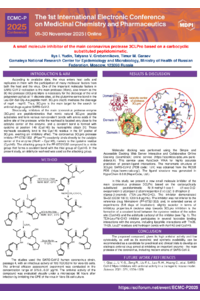
A-small-molecule-inhibitor-of-the-main-coronavirus-protease-3CLPro-based-on-a-carbocyclic-substitute.pdf
From the design to the biological evaluation of quinoline-based carboxamides targeting non-tuberculous mycobacteria
Synthesis, crystallographic structure, and antibacterial activity of new pyrene-based hydrazones