Event submissions
EventsThe 1st International Electronic Conference on Medicinal Chemistry and Pharmaceutics
Published
This submission belongs to the session S4. New Small molecules as drug candidates of the event The 1st International Electronic Conference on Medicinal Chemistry and Pharmaceutics
Published date
29 Oct, 2025
Academic Editor
'%3e%3cpath%20d='M12.6657%2010.9104C12.4185%2010.325%2012.0599%209.79327%2011.6097%209.34482C11.1609%208.89508%2010.6293%208.5365%2010.0442%208.28888C10.0389%208.28626%2010.0337%208.28495%2010.0285%208.28233C10.8446%207.69279%2011.3752%206.73249%2011.3752%205.64904C11.3752%203.8542%209.92103%202.39999%208.1262%202.39999C6.33136%202.39999%204.87715%203.8542%204.87715%205.64904C4.87715%206.73249%205.40774%207.69279%206.22393%208.28364C6.21869%208.28626%206.21345%208.28757%206.20821%208.29019C5.62129%208.5378%205.09463%208.89284%204.64265%209.34613C4.1929%209.79493%203.83432%2010.3266%203.58671%2010.9117C3.34345%2011.4845%203.21226%2012.0987%203.20023%2012.7209C3.19988%2012.7349%203.20233%2012.7488%203.20744%2012.7619C3.21255%2012.7749%203.22022%2012.7867%203.22998%2012.7968C3.23975%2012.8068%203.25142%2012.8147%203.26431%2012.8202C3.2772%2012.8256%203.29105%2012.8284%203.30504%2012.8284H4.09109C4.14874%2012.8284%204.19459%2012.7825%204.1959%2012.7262C4.2221%2011.7148%204.62823%2010.7676%205.34617%2010.0497C6.08899%209.30683%207.0755%208.89808%208.1262%208.89808C9.17689%208.89808%2010.1634%209.30683%2010.9062%2010.0497C11.6242%2010.7676%2012.0303%2011.7148%2012.0565%2012.7262C12.0578%2012.7838%2012.1037%2012.8284%2012.1613%2012.8284H12.9474C12.9613%2012.8284%2012.9752%2012.8256%2012.9881%2012.8202C13.001%2012.8147%2013.0126%2012.8068%2013.0224%2012.7968C13.0322%2012.7867%2013.0398%2012.7749%2013.0449%2012.7619C13.0501%2012.7488%2013.0525%2012.7349%2013.0522%2012.7209C13.0391%2012.0947%2012.9094%2011.4855%2012.6657%2010.9104ZM8.1262%207.9024C7.52486%207.9024%206.9589%207.6679%206.53312%207.24211C6.10733%206.81633%205.87283%206.25037%205.87283%205.64904C5.87283%205.0477%206.10733%204.48174%206.53312%204.05596C6.9589%203.63018%207.52486%203.39567%208.1262%203.39567C8.72753%203.39567%209.29349%203.63018%209.71927%204.05596C10.1451%204.48174%2010.3796%205.0477%2010.3796%205.64904C10.3796%206.25037%2010.1451%206.81633%209.71927%207.24211C9.29349%207.6679%208.72753%207.9024%208.1262%207.9024Z'%20fill='%235D1EE1'/%3e%3c/g%3e%3c/svg%3e) Serena Massari
Serena MassariCitation
David Oliveros Garavito, Luis Alberto Illicachi Romero, Viviana Cuartas Granada, Richard Fernando D´Vries Arturo, Synthesis, crystallographic structure, and antibacterial activity of new pyrene-based hydrazones, in Proceedings of The 1st International Electronic Conference on Medicinal Chemistry and Pharmaceutics, 1 November–30 November 2025, MDPI: Basel, Switzerland
Share
Email
Facebook
Twitter
LinkedIn
Synthesis, crystallographic structure, and antibacterial activity of new pyrene-based hydrazones
'%3e%3cpath%20d='M12.6647%2010.9104C12.4176%2010.325%2012.0589%209.7933%2011.6088%209.34485C11.16%208.89511%2010.6283%208.53653%2010.0432%208.28891C10.038%208.28629%2010.0327%208.28498%2010.0275%208.28236C10.8437%207.69282%2011.3743%206.73252%2011.3743%205.64907C11.3743%203.85423%209.92005%202.40002%208.12522%202.40002C6.33038%202.40002%204.87618%203.85423%204.87618%205.64907C4.87618%206.73252%205.40677%207.69282%206.22296%208.28367C6.21772%208.28629%206.21248%208.2876%206.20724%208.29022C5.62031%208.53783%205.09365%208.89287%204.64167%209.34616C4.19192%209.79496%203.83334%2010.3266%203.58573%2010.9117C3.34247%2011.4846%203.21128%2012.0987%203.19925%2012.721C3.1989%2012.735%203.20135%2012.7489%203.20646%2012.7619C3.21157%2012.7749%203.21924%2012.7868%203.22901%2012.7968C3.23877%2012.8068%203.25045%2012.8148%203.26334%2012.8202C3.27623%2012.8256%203.29007%2012.8284%203.30406%2012.8284H4.09012C4.14776%2012.8284%204.19362%2012.7825%204.19493%2012.7262C4.22113%2011.7148%204.62726%2010.7676%205.34519%2010.0497C6.08802%209.30686%207.07452%208.89811%208.12522%208.89811C9.17592%208.89811%2010.1624%209.30686%2010.9052%2010.0497C11.6232%2010.7676%2012.0293%2011.7148%2012.0555%2012.7262C12.0568%2012.7839%2012.1027%2012.8284%2012.1603%2012.8284H12.9464C12.9604%2012.8284%2012.9742%2012.8256%2012.9871%2012.8202C13%2012.8148%2013.0117%2012.8068%2013.0214%2012.7968C13.0312%2012.7868%2013.0389%2012.7749%2013.044%2012.7619C13.0491%2012.7489%2013.0515%2012.735%2013.0512%2012.721C13.0381%2012.0947%2012.9084%2011.4856%2012.6647%2010.9104ZM8.12522%207.90243C7.52388%207.90243%206.95792%207.66793%206.53214%207.24215C6.10636%206.81636%205.87185%206.2504%205.87185%205.64907C5.87185%205.04773%206.10636%204.48177%206.53214%204.05599C6.95792%203.63021%207.52388%203.3957%208.12522%203.3957C8.72655%203.3957%209.29252%203.63021%209.7183%204.05599C10.1441%204.48177%2010.3786%205.04773%2010.3786%205.64907C10.3786%206.2504%2010.1441%206.81636%209.7183%207.24215C9.29252%207.66793%208.72655%207.90243%208.12522%207.90243Z'%20fill='%235D1EE1'/%3e%3c/g%3e%3c/svg%3e)
David Oliveros Garavito 1
Luis Alberto Illicachi Romero 1

Viviana Cuartas Granada 2
Richard Fernando D´Vries Arturo 3
1. Grupo de investigación en Química y Biotecnología, Universidad Santiago de Cali, Cali, Colombia.
2. Bioprospección de Metabolitos Especializados de Origen Vegetal, Universidad Nacional de Colombia, Palmira, Colombia.
3. Grupo de investigación en Química de Productos Naturales, Universidad del Cauca, Popayán, Colombia.
Abstract
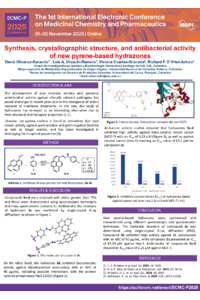
Hydrazones are compounds that exhibit a broad range of biological activities, including anticancer, antifungal, antimicrobial, anti-inflammatory, anticonvulsant properties. On the other hand, pyrene is a highly conjugated polycyclic aromatic hydrocarbon that has been used in antimicrobial and bioimaging studies, showing activity against wild-type bacteria and fungal species. In this work, we synthesized new hydrazones derived from 1-pyrenecarboxaldehyde (1) with various para-substituted phenylhydrazines (2a-d) bearing electron-withdrawing groups such as fluorine, chlorine, and bromine, since these halogens are associated with enhanced biological activity and improved permeability. Additionally, an electron-donating group (4-OCH3) was included due to its prominence in several known derivatives with anticancer activity.
For the synthesis of hydrazones 3a-d, a mixture of 1-pyrenecarboxaldehyde (1) and p-phenylhydrazines (a: 4-Cl, b: 4-Br, c: 4-CF3, d: 4-OCH3) was stirred in ethanol at 80 °C, yielding the desired products (3a-d) in 73-90%, which were characterized by IR spectroscopy, 1H and 13C NMR, mass spectrometry, and single-crystal X-ray diffraction of 3d, obtained by slow evaporation from ethanol. Hydrazones 3a-d exhibited bacteriostatic activity against Mycobacterium tuberculosis, and compound 3d was active with a MIC = 40 µg/mL. Moreover, all compounds showed anticancer activity against breast cancer cells (MCF-7) with and IC50 value <6.25 µg/mL, and compound 3d (4-OCH3) exhibits the highest inhibitory activity against cervical cancer cells (Hep-2) with an IC50 of 67.2 µg/mL. Molecular docking studies were performed using the binding pocket of PDB: 2OZ5. The protein-ligand complex of compound 3d exhibited interactions with catalytic residues Met146, Arg230, and Met226.
Keywords
Hidrazones
1-pyrenecarboxaldehyde.
Poster
Poster.pdf
A small molecule inhibitor of the main coronavirus protease 3CLPro based on a carbocyclically substituted peptidomimetic.
Design and Synthesis of Bioactive Benzofused Nitrogen Containing Heterocyclic Derivatives