Event submissions
EventsThe 1st International Electronic Conference on Medicinal Chemistry and Pharmaceutics
Published
This submission belongs to the session S4. New Small molecules as drug candidates of the event The 1st International Electronic Conference on Medicinal Chemistry and Pharmaceutics
Published date
29 Oct, 2025
Academic Editor
'%3e%3cpath%20d='M12.6657%2010.9104C12.4185%2010.325%2012.0599%209.79327%2011.6097%209.34482C11.1609%208.89508%2010.6293%208.5365%2010.0442%208.28888C10.0389%208.28626%2010.0337%208.28495%2010.0285%208.28233C10.8446%207.69279%2011.3752%206.73249%2011.3752%205.64904C11.3752%203.8542%209.92103%202.39999%208.1262%202.39999C6.33136%202.39999%204.87715%203.8542%204.87715%205.64904C4.87715%206.73249%205.40774%207.69279%206.22393%208.28364C6.21869%208.28626%206.21345%208.28757%206.20821%208.29019C5.62129%208.5378%205.09463%208.89284%204.64265%209.34613C4.1929%209.79493%203.83432%2010.3266%203.58671%2010.9117C3.34345%2011.4845%203.21226%2012.0987%203.20023%2012.7209C3.19988%2012.7349%203.20233%2012.7488%203.20744%2012.7619C3.21255%2012.7749%203.22022%2012.7867%203.22998%2012.7968C3.23975%2012.8068%203.25142%2012.8147%203.26431%2012.8202C3.2772%2012.8256%203.29105%2012.8284%203.30504%2012.8284H4.09109C4.14874%2012.8284%204.19459%2012.7825%204.1959%2012.7262C4.2221%2011.7148%204.62823%2010.7676%205.34617%2010.0497C6.08899%209.30683%207.0755%208.89808%208.1262%208.89808C9.17689%208.89808%2010.1634%209.30683%2010.9062%2010.0497C11.6242%2010.7676%2012.0303%2011.7148%2012.0565%2012.7262C12.0578%2012.7838%2012.1037%2012.8284%2012.1613%2012.8284H12.9474C12.9613%2012.8284%2012.9752%2012.8256%2012.9881%2012.8202C13.001%2012.8147%2013.0126%2012.8068%2013.0224%2012.7968C13.0322%2012.7867%2013.0398%2012.7749%2013.0449%2012.7619C13.0501%2012.7488%2013.0525%2012.7349%2013.0522%2012.7209C13.0391%2012.0947%2012.9094%2011.4855%2012.6657%2010.9104ZM8.1262%207.9024C7.52486%207.9024%206.9589%207.6679%206.53312%207.24211C6.10733%206.81633%205.87283%206.25037%205.87283%205.64904C5.87283%205.0477%206.10733%204.48174%206.53312%204.05596C6.9589%203.63018%207.52486%203.39567%208.1262%203.39567C8.72753%203.39567%209.29349%203.63018%209.71927%204.05596C10.1451%204.48174%2010.3796%205.0477%2010.3796%205.64904C10.3796%206.25037%2010.1451%206.81633%209.71927%207.24211C9.29349%207.6679%208.72753%207.9024%208.1262%207.9024Z'%20fill='%235D1EE1'/%3e%3c/g%3e%3c/svg%3e) MARIALUIGIA FANTACUZZI
MARIALUIGIA FANTACUZZICitation
Arpita Namdeo, Jyoti Kumari paswan, Kumud Pandav, N .S H .N Moorthy, Akhilesh Tiwari, pranay Soni, Amit Kumar Tiwari, Chandrabose Karthikeyan, Synthesis and Evaluation of Anti-Proliferative Potential of 2-((2-chloroquinolin-3-yl)methylene)-3,4-dihydronaphthalen-1(2H)-ones in Breast Cancer, in Proceedings of The 1st International Electronic Conference on Medicinal Chemistry and Pharmaceutics, 1 November–30 November 2025, MDPI: Basel, Switzerland
Share
Email
Facebook
Twitter
LinkedIn
Synthesis and Evaluation of Anti-Proliferative Potential of 2-((2-chloroquinolin-3-yl)methylene)-3,4-dihydronaphthalen-1(2H)-ones in Breast Cancer
'%3e%3cpath%20d='M12.6647%2010.9104C12.4176%2010.325%2012.0589%209.7933%2011.6088%209.34485C11.16%208.89511%2010.6283%208.53653%2010.0432%208.28891C10.038%208.28629%2010.0327%208.28498%2010.0275%208.28236C10.8437%207.69282%2011.3743%206.73252%2011.3743%205.64907C11.3743%203.85423%209.92005%202.40002%208.12522%202.40002C6.33038%202.40002%204.87618%203.85423%204.87618%205.64907C4.87618%206.73252%205.40677%207.69282%206.22296%208.28367C6.21772%208.28629%206.21248%208.2876%206.20724%208.29022C5.62031%208.53783%205.09365%208.89287%204.64167%209.34616C4.19192%209.79496%203.83334%2010.3266%203.58573%2010.9117C3.34247%2011.4846%203.21128%2012.0987%203.19925%2012.721C3.1989%2012.735%203.20135%2012.7489%203.20646%2012.7619C3.21157%2012.7749%203.21924%2012.7868%203.22901%2012.7968C3.23877%2012.8068%203.25045%2012.8148%203.26334%2012.8202C3.27623%2012.8256%203.29007%2012.8284%203.30406%2012.8284H4.09012C4.14776%2012.8284%204.19362%2012.7825%204.19493%2012.7262C4.22113%2011.7148%204.62726%2010.7676%205.34519%2010.0497C6.08802%209.30686%207.07452%208.89811%208.12522%208.89811C9.17592%208.89811%2010.1624%209.30686%2010.9052%2010.0497C11.6232%2010.7676%2012.0293%2011.7148%2012.0555%2012.7262C12.0568%2012.7839%2012.1027%2012.8284%2012.1603%2012.8284H12.9464C12.9604%2012.8284%2012.9742%2012.8256%2012.9871%2012.8202C13%2012.8148%2013.0117%2012.8068%2013.0214%2012.7968C13.0312%2012.7868%2013.0389%2012.7749%2013.044%2012.7619C13.0491%2012.7489%2013.0515%2012.735%2013.0512%2012.721C13.0381%2012.0947%2012.9084%2011.4856%2012.6647%2010.9104ZM8.12522%207.90243C7.52388%207.90243%206.95792%207.66793%206.53214%207.24215C6.10636%206.81636%205.87185%206.2504%205.87185%205.64907C5.87185%205.04773%206.10636%204.48177%206.53214%204.05599C6.95792%203.63021%207.52388%203.3957%208.12522%203.3957C8.72655%203.3957%209.29252%203.63021%209.7183%204.05599C10.1441%204.48177%2010.3786%205.04773%2010.3786%205.64907C10.3786%206.2504%2010.1441%206.81636%209.7183%207.24215C9.29252%207.66793%208.72655%207.90243%208.12522%207.90243Z'%20fill='%235D1EE1'/%3e%3c/g%3e%3c/svg%3e)
Arpita Namdeo 1
Jyoti Kumari paswan 1
Kumud Pandav 2
N .S H .N Moorthy 1
Akhilesh Tiwari 1
pranay Soni 1

Amit Kumar Tiwari 2
Chandrabose Karthikeyan 1,2
1. Cancept Therapeutics Laboratory, Department of Pharmacy, Indira Gandhi National Tribal University, Lalpur, Amarkantak (MP)-484887, India.
2. Department of Pharmaceutical Sciences, College of Pharmacy, University of Arkansas for Medical Sciences, Little Rock, AR 72210, USA.
Abstract
Abstract:
The highly dynamic microtubules of the mitotic spindle are well-established biochemical targets for anticancer drugs such as paclitaxel, vinblastine, and vincristine. However, a significant clinical challenge is the emergence of resistance to these agents, highlighting the urgent need for novel anticancer compounds that target tubulin. In this study, a panel of chloroquinoline derivatives was synthesized and characterized using 1H NMR, FTIR, and mass spectrometry. The antiproliferative activity of these compounds was evaluated against the breast cancer cell lines MCF-7 and MDA-MB-231. Of the tested molecules, CQ-9 and CQ-14 displayed IC₅₀ values of 5.6 μM and 4.55 μM, respectively, against MDA-MB-231 cells, while CQ-9 exhibited an IC₅₀ of 13.05 μM for MCF-7 cells. All compounds (CQ-1 to CQ-14) were subjected to molecular docking studies using the Schrödinger software suite to investigate their interactions with tubulin. The resulting ligand-protein complexes were analyzed for binding energies, and the most stable complexes were selected for further molecular dynamics simulations. Tubulin was chosen as a likely target owing to the structural similarity of the reported compounds to quinolinyl and other herteroaryl chalcones that have shown to inhibit Tubulin by binding to Colchicine binding site. Hence , we used specific crystal structure of tubulin (PDB id: 1SA0) co-complexed with Colchicine for our molecular docking studies.
Keywords
Breast cancer(MCF-7
MDA-MB-231)
Tubulin Inhibitor
Mitotic spindle
chloroquinoline derivative .
Poster
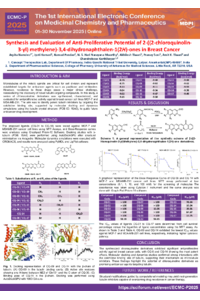
Arpita Poster.pdf
Next-Generation Selenium Compounds as Potential Disease-Modifying Agents in Alzheimer’s
Enantiopure 4-aminoalcohol-pyridines as potent antimalarial agents: synthesis and biological evaluation