Event submissions
EventsThe 1st International Electronic Conference on Medicinal Chemistry and Pharmaceutics
Published
This submission belongs to the session S4. New Small molecules as drug candidates of the event The 1st International Electronic Conference on Medicinal Chemistry and Pharmaceutics
Published date
29 Oct, 2025
Academic Editor
'%3e%3cpath%20d='M12.6657%2010.9104C12.4185%2010.325%2012.0599%209.79327%2011.6097%209.34482C11.1609%208.89508%2010.6293%208.5365%2010.0442%208.28888C10.0389%208.28626%2010.0337%208.28495%2010.0285%208.28233C10.8446%207.69279%2011.3752%206.73249%2011.3752%205.64904C11.3752%203.8542%209.92103%202.39999%208.1262%202.39999C6.33136%202.39999%204.87715%203.8542%204.87715%205.64904C4.87715%206.73249%205.40774%207.69279%206.22393%208.28364C6.21869%208.28626%206.21345%208.28757%206.20821%208.29019C5.62129%208.5378%205.09463%208.89284%204.64265%209.34613C4.1929%209.79493%203.83432%2010.3266%203.58671%2010.9117C3.34345%2011.4845%203.21226%2012.0987%203.20023%2012.7209C3.19988%2012.7349%203.20233%2012.7488%203.20744%2012.7619C3.21255%2012.7749%203.22022%2012.7867%203.22998%2012.7968C3.23975%2012.8068%203.25142%2012.8147%203.26431%2012.8202C3.2772%2012.8256%203.29105%2012.8284%203.30504%2012.8284H4.09109C4.14874%2012.8284%204.19459%2012.7825%204.1959%2012.7262C4.2221%2011.7148%204.62823%2010.7676%205.34617%2010.0497C6.08899%209.30683%207.0755%208.89808%208.1262%208.89808C9.17689%208.89808%2010.1634%209.30683%2010.9062%2010.0497C11.6242%2010.7676%2012.0303%2011.7148%2012.0565%2012.7262C12.0578%2012.7838%2012.1037%2012.8284%2012.1613%2012.8284H12.9474C12.9613%2012.8284%2012.9752%2012.8256%2012.9881%2012.8202C13.001%2012.8147%2013.0126%2012.8068%2013.0224%2012.7968C13.0322%2012.7867%2013.0398%2012.7749%2013.0449%2012.7619C13.0501%2012.7488%2013.0525%2012.7349%2013.0522%2012.7209C13.0391%2012.0947%2012.9094%2011.4855%2012.6657%2010.9104ZM8.1262%207.9024C7.52486%207.9024%206.9589%207.6679%206.53312%207.24211C6.10733%206.81633%205.87283%206.25037%205.87283%205.64904C5.87283%205.0477%206.10733%204.48174%206.53312%204.05596C6.9589%203.63018%207.52486%203.39567%208.1262%203.39567C8.72753%203.39567%209.29349%203.63018%209.71927%204.05596C10.1451%204.48174%2010.3796%205.0477%2010.3796%205.64904C10.3796%206.25037%2010.1451%206.81633%209.71927%207.24211C9.29349%207.6679%208.72753%207.9024%208.1262%207.9024Z'%20fill='%235D1EE1'/%3e%3c/g%3e%3c/svg%3e) Diego Muñoz-Torrero
Diego Muñoz-TorreroCitation
Abhavya Shukla, Md. Haroon Ansari, Digambar Kumar Waiker, Sushant Kumar Shrivastava, Akhilesh Tiwari, N. S. Hari Narayana Moorthy, Chandrabose Karthikeyan, Dual Inhibition of AChE and Amyloid-β Aggregation by 3-Vinyl-Quinoxalin-2(1H)-one Derivatives for Alzheimer's Therapy, in Proceedings of The 1st International Electronic Conference on Medicinal Chemistry and Pharmaceutics, 1 November–30 November 2025, MDPI: Basel, Switzerland
Share
Email
Facebook
Twitter
LinkedIn
Dual Inhibition of AChE and Amyloid-β Aggregation by 3-Vinyl-Quinoxalin-2(1H)-one Derivatives for Alzheimer's Therapy
'%3e%3cpath%20d='M12.6647%2010.9104C12.4176%2010.325%2012.0589%209.7933%2011.6088%209.34485C11.16%208.89511%2010.6283%208.53653%2010.0432%208.28891C10.038%208.28629%2010.0327%208.28498%2010.0275%208.28236C10.8437%207.69282%2011.3743%206.73252%2011.3743%205.64907C11.3743%203.85423%209.92005%202.40002%208.12522%202.40002C6.33038%202.40002%204.87618%203.85423%204.87618%205.64907C4.87618%206.73252%205.40677%207.69282%206.22296%208.28367C6.21772%208.28629%206.21248%208.2876%206.20724%208.29022C5.62031%208.53783%205.09365%208.89287%204.64167%209.34616C4.19192%209.79496%203.83334%2010.3266%203.58573%2010.9117C3.34247%2011.4846%203.21128%2012.0987%203.19925%2012.721C3.1989%2012.735%203.20135%2012.7489%203.20646%2012.7619C3.21157%2012.7749%203.21924%2012.7868%203.22901%2012.7968C3.23877%2012.8068%203.25045%2012.8148%203.26334%2012.8202C3.27623%2012.8256%203.29007%2012.8284%203.30406%2012.8284H4.09012C4.14776%2012.8284%204.19362%2012.7825%204.19493%2012.7262C4.22113%2011.7148%204.62726%2010.7676%205.34519%2010.0497C6.08802%209.30686%207.07452%208.89811%208.12522%208.89811C9.17592%208.89811%2010.1624%209.30686%2010.9052%2010.0497C11.6232%2010.7676%2012.0293%2011.7148%2012.0555%2012.7262C12.0568%2012.7839%2012.1027%2012.8284%2012.1603%2012.8284H12.9464C12.9604%2012.8284%2012.9742%2012.8256%2012.9871%2012.8202C13%2012.8148%2013.0117%2012.8068%2013.0214%2012.7968C13.0312%2012.7868%2013.0389%2012.7749%2013.044%2012.7619C13.0491%2012.7489%2013.0515%2012.735%2013.0512%2012.721C13.0381%2012.0947%2012.9084%2011.4856%2012.6647%2010.9104ZM8.12522%207.90243C7.52388%207.90243%206.95792%207.66793%206.53214%207.24215C6.10636%206.81636%205.87185%206.2504%205.87185%205.64907C5.87185%205.04773%206.10636%204.48177%206.53214%204.05599C6.95792%203.63021%207.52388%203.3957%208.12522%203.3957C8.72655%203.3957%209.29252%203.63021%209.7183%204.05599C10.1441%204.48177%2010.3786%205.04773%2010.3786%205.64907C10.3786%206.2504%2010.1441%206.81636%209.7183%207.24215C9.29252%207.66793%208.72655%207.90243%208.12522%207.90243Z'%20fill='%235D1EE1'/%3e%3c/g%3e%3c/svg%3e)
Abhavya Shukla 1
Md. Haroon Ansari 1
Digambar Kumar Waiker 2
Sushant Kumar Shrivastava 2
Akhilesh Tiwari 1
N. S. Hari Narayana Moorthy 1
Chandrabose Karthikeyan 1,3
1. Cancept Therapeutics Laboratory, Department of Pharmacy, Indira Gandhi National Tribal University, Lalpur, Amarkantak (MP)-484887, India
2. Pharmaceutical Chemistry Research Laboratory, Department of Pharmaceutical Engineering & Technology, Indian Institute of Technology (Banaras Hindu University), Varanasi, India
3. Department of Pharmaceutical Sciences, College of Pharmacy, University of Arkansas for Medical Sciences, Little Rock, AR 72210, USA.
Abstract
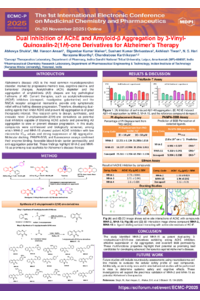
A series of derivatives based on 3-vinyl-quinoxalin-2(1H)-one were designed, synthesized, and screened for their dual activity against amyloid beta (Aβ) aggregation and human acetylcholinesterase (hAChE). In this comprehensive study, sixteen compounds were meticulously evaluated using the Ellman assay, revealing that MHA-2 and MHA-15 emerged as the most effective inhibitors of hAChE, exhibiting low micromolar IC₅₀ values. These values highlight the compounds’ ability to inhibit the enzyme at remarkably low concentrations, suggesting high potency. To further investigate, the molecular docking and dynamics simulations were conducted. These computational approaches provided additional support for the experimental findings, revealing stable interactions with key catalytic and peripheral residues of hAChE enzyme. Furthermore, PAMPA-BBB (Parallel Artificial Membrane Permeability Assay for the Blood-Brain Barrier) analysis confirmed their favourable blood–brain barrier permeability, while competitive displacement of propidium iodide indicated strong binding at the peripheral anionic site (PAS) of hAChE. Moreover, the Thioflavin T fluorescence assays demonstrated that both compounds effectively suppressed Aβ aggregation, inhibiting not only spontaneous self-assembly but also hAChE-induced fibrillization in a concentration-dependent manner. In conclusion, the compounds MHA-2 and MHA-15 emerge as promising lead scaffolds with dual functionality in hAChE inhibition and Aβ aggregation prevention, coupled with favourable BBB permeability, supporting their potential as therapeutic candidates for Alzheimer’s disease.
Keywords
3-vinyl-quinoxalin-2(1H)-one
Alzheimer’s disease (AD)
amyloid beta (Aβ)
human acetylcholinesterase (hAChE)
molecular docking
Poster
Abhavya poster .pdf
Enantiopure 4-aminoalcohol-pyridines as potent antimalarial agents: synthesis and biological evaluation
Bisdithiophosphonic acids and their salts with antibacterial and cytotoxic activities