Event submissions
EventsThe 1st International Electronic Conference on Medicinal Chemistry and Pharmaceutics
Published
This submission belongs to the session S4. New Small molecules as drug candidates of the event The 1st International Electronic Conference on Medicinal Chemistry and Pharmaceutics
Published date
29 Oct, 2025
Academic Editor
'%3e%3cpath%20d='M12.6657%2010.9104C12.4185%2010.325%2012.0599%209.79327%2011.6097%209.34482C11.1609%208.89508%2010.6293%208.5365%2010.0442%208.28888C10.0389%208.28626%2010.0337%208.28495%2010.0285%208.28233C10.8446%207.69279%2011.3752%206.73249%2011.3752%205.64904C11.3752%203.8542%209.92103%202.39999%208.1262%202.39999C6.33136%202.39999%204.87715%203.8542%204.87715%205.64904C4.87715%206.73249%205.40774%207.69279%206.22393%208.28364C6.21869%208.28626%206.21345%208.28757%206.20821%208.29019C5.62129%208.5378%205.09463%208.89284%204.64265%209.34613C4.1929%209.79493%203.83432%2010.3266%203.58671%2010.9117C3.34345%2011.4845%203.21226%2012.0987%203.20023%2012.7209C3.19988%2012.7349%203.20233%2012.7488%203.20744%2012.7619C3.21255%2012.7749%203.22022%2012.7867%203.22998%2012.7968C3.23975%2012.8068%203.25142%2012.8147%203.26431%2012.8202C3.2772%2012.8256%203.29105%2012.8284%203.30504%2012.8284H4.09109C4.14874%2012.8284%204.19459%2012.7825%204.1959%2012.7262C4.2221%2011.7148%204.62823%2010.7676%205.34617%2010.0497C6.08899%209.30683%207.0755%208.89808%208.1262%208.89808C9.17689%208.89808%2010.1634%209.30683%2010.9062%2010.0497C11.6242%2010.7676%2012.0303%2011.7148%2012.0565%2012.7262C12.0578%2012.7838%2012.1037%2012.8284%2012.1613%2012.8284H12.9474C12.9613%2012.8284%2012.9752%2012.8256%2012.9881%2012.8202C13.001%2012.8147%2013.0126%2012.8068%2013.0224%2012.7968C13.0322%2012.7867%2013.0398%2012.7749%2013.0449%2012.7619C13.0501%2012.7488%2013.0525%2012.7349%2013.0522%2012.7209C13.0391%2012.0947%2012.9094%2011.4855%2012.6657%2010.9104ZM8.1262%207.9024C7.52486%207.9024%206.9589%207.6679%206.53312%207.24211C6.10733%206.81633%205.87283%206.25037%205.87283%205.64904C5.87283%205.0477%206.10733%204.48174%206.53312%204.05596C6.9589%203.63018%207.52486%203.39567%208.1262%203.39567C8.72753%203.39567%209.29349%203.63018%209.71927%204.05596C10.1451%204.48174%2010.3796%205.0477%2010.3796%205.64904C10.3796%206.25037%2010.1451%206.81633%209.71927%207.24211C9.29349%207.6679%208.72753%207.9024%208.1262%207.9024Z'%20fill='%235D1EE1'/%3e%3c/g%3e%3c/svg%3e) Thierry Besson
Thierry BessonCitation
Mahrukh Ahmed, Shazia Haider, Ahsaan Ahmed, Mehreen Lateef, Warda Javed, Aisha Iqbal, Zafar Saied Saify, Design and Evaluation of Piperidine-Based Inhibitors targeting Alzheimer’s Disease, in Proceedings of The 1st International Electronic Conference on Medicinal Chemistry and Pharmaceutics, 1 November–30 November 2025, MDPI: Basel, Switzerland
Share
Email
Facebook
Twitter
LinkedIn
Design and Evaluation of Piperidine-Based Inhibitors targeting Alzheimer’s Disease
'%3e%3cpath%20d='M12.6647%2010.9104C12.4176%2010.325%2012.0589%209.7933%2011.6088%209.34485C11.16%208.89511%2010.6283%208.53653%2010.0432%208.28891C10.038%208.28629%2010.0327%208.28498%2010.0275%208.28236C10.8437%207.69282%2011.3743%206.73252%2011.3743%205.64907C11.3743%203.85423%209.92005%202.40002%208.12522%202.40002C6.33038%202.40002%204.87618%203.85423%204.87618%205.64907C4.87618%206.73252%205.40677%207.69282%206.22296%208.28367C6.21772%208.28629%206.21248%208.2876%206.20724%208.29022C5.62031%208.53783%205.09365%208.89287%204.64167%209.34616C4.19192%209.79496%203.83334%2010.3266%203.58573%2010.9117C3.34247%2011.4846%203.21128%2012.0987%203.19925%2012.721C3.1989%2012.735%203.20135%2012.7489%203.20646%2012.7619C3.21157%2012.7749%203.21924%2012.7868%203.22901%2012.7968C3.23877%2012.8068%203.25045%2012.8148%203.26334%2012.8202C3.27623%2012.8256%203.29007%2012.8284%203.30406%2012.8284H4.09012C4.14776%2012.8284%204.19362%2012.7825%204.19493%2012.7262C4.22113%2011.7148%204.62726%2010.7676%205.34519%2010.0497C6.08802%209.30686%207.07452%208.89811%208.12522%208.89811C9.17592%208.89811%2010.1624%209.30686%2010.9052%2010.0497C11.6232%2010.7676%2012.0293%2011.7148%2012.0555%2012.7262C12.0568%2012.7839%2012.1027%2012.8284%2012.1603%2012.8284H12.9464C12.9604%2012.8284%2012.9742%2012.8256%2012.9871%2012.8202C13%2012.8148%2013.0117%2012.8068%2013.0214%2012.7968C13.0312%2012.7868%2013.0389%2012.7749%2013.044%2012.7619C13.0491%2012.7489%2013.0515%2012.735%2013.0512%2012.721C13.0381%2012.0947%2012.9084%2011.4856%2012.6647%2010.9104ZM8.12522%207.90243C7.52388%207.90243%206.95792%207.66793%206.53214%207.24215C6.10636%206.81636%205.87185%206.2504%205.87185%205.64907C5.87185%205.04773%206.10636%204.48177%206.53214%204.05599C6.95792%203.63021%207.52388%203.3957%208.12522%203.3957C8.72655%203.3957%209.29252%203.63021%209.7183%204.05599C10.1441%204.48177%2010.3786%205.04773%2010.3786%205.64907C10.3786%206.2504%2010.1441%206.81636%209.7183%207.24215C9.29252%207.66793%208.72655%207.90243%208.12522%207.90243Z'%20fill='%235D1EE1'/%3e%3c/g%3e%3c/svg%3e)
Mahrukh Ahmed 1
Shazia Haider 1
Ahsaan Ahmed 2
Mehreen Lateef 3
Warda Javed 1
Aisha Iqbal 1
Zafar Saied Saify 4
1. Department of Pharmaceutical Chemistry, Faculty of Pharmacy, University of Karachi, Karachi, 75270, Pakistan
2. Department of Pharmaceutical Chemistry, Institute of Pharmaceutical Sciences, Jinnah Sindh Medical University, 75510, Pakistan
3. MultiDisciplinary Research lab, Bahria University Health Sciences Campus Karachi, Bahria University , Karachi , 73500, Pakistan
4. Department of Pharmaceutical Chemistry, International Center for Chemical and Biological Sciences, 75270, Pakistan
Abstract
Introduction
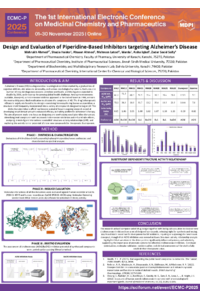
Alzheimer's Disease (AD) is a neurodegenerative illness causing severe cognitive decline, personality changes, and psychological issues, with over 10 million new cases per year which are expected to double by 2036. The most widely prescribed drug to treat symptoms of AD is the cholinesterase inhibitor donepezil, first approved in the US in 1996. Donepezil's activity comes largely from its nitrogen-containing heterocyclic piperidine structure. The piperidine ring appears frequently in other compounds targeting AD and has prompted AD research into piperidine containing derivatives.
Method
In this work, computer-aided drug design (CADD) was used to virtually screen a library of 32 piperidine-containing molecules derived from a lead against co-crystallized human acetylcholinesterase (AChE) and human butyrylcholinesterase (BuChE). Based on docking scores and detailed 2D and 3D interactions with the target, the top eight derivatives were synthesized via N-alkylation reaction, and confirmed with 1H-NMR and EI-MS. Their action on AChE and BuChE was determined via enzyme inhibition assay using Ellman’s method.
Result
The IC50 values of four derivatives showed significant action against both enzymes (MA13 [AChE IC50=69.2 µM; BuChE IC50=19.5 µM], MA29 [21.4; 13.2 µM], MA31 [20.4; 18.5 µM], MA32 [29.6; 23.5 µM]), while 2 within this group showed particularly strong inhibitory action against BuChE when compared with donepezil (MA29, MA31).
Conclusion
Overall, these results reveal new scaffolds with promising anti-Alzheimer’s potential, including two candidates that show particularly strong activity against BuChE. Further development of these molecules may yield viable candidates for next-generation therapeutics, providing new opportunities to slow or lessen the progression of AD.
Keywords
Alzheimer's Disease
Piperidine derivatives
CADD
Donepezil
AChE
BuChE
Poster
Mahrukh-Poster for MDPI.pdf
Chiral dithiophosphonic acids with antibacterial properties
Preliminary Evaluation of New Benzenesulfonamides as Anticancer Agents Against DU-145 Prostate Cancer Cells