Event submissions
EventsThe 1st International Electronic Conference on Medicinal Chemistry and Pharmaceutics
Published
This submission belongs to the session S4. New Small molecules as drug candidates of the event The 1st International Electronic Conference on Medicinal Chemistry and Pharmaceutics
Published date
29 Oct, 2025
Academic Editor
'%3e%3cpath%20d='M12.6657%2010.9104C12.4185%2010.325%2012.0599%209.79327%2011.6097%209.34482C11.1609%208.89508%2010.6293%208.5365%2010.0442%208.28888C10.0389%208.28626%2010.0337%208.28495%2010.0285%208.28233C10.8446%207.69279%2011.3752%206.73249%2011.3752%205.64904C11.3752%203.8542%209.92103%202.39999%208.1262%202.39999C6.33136%202.39999%204.87715%203.8542%204.87715%205.64904C4.87715%206.73249%205.40774%207.69279%206.22393%208.28364C6.21869%208.28626%206.21345%208.28757%206.20821%208.29019C5.62129%208.5378%205.09463%208.89284%204.64265%209.34613C4.1929%209.79493%203.83432%2010.3266%203.58671%2010.9117C3.34345%2011.4845%203.21226%2012.0987%203.20023%2012.7209C3.19988%2012.7349%203.20233%2012.7488%203.20744%2012.7619C3.21255%2012.7749%203.22022%2012.7867%203.22998%2012.7968C3.23975%2012.8068%203.25142%2012.8147%203.26431%2012.8202C3.2772%2012.8256%203.29105%2012.8284%203.30504%2012.8284H4.09109C4.14874%2012.8284%204.19459%2012.7825%204.1959%2012.7262C4.2221%2011.7148%204.62823%2010.7676%205.34617%2010.0497C6.08899%209.30683%207.0755%208.89808%208.1262%208.89808C9.17689%208.89808%2010.1634%209.30683%2010.9062%2010.0497C11.6242%2010.7676%2012.0303%2011.7148%2012.0565%2012.7262C12.0578%2012.7838%2012.1037%2012.8284%2012.1613%2012.8284H12.9474C12.9613%2012.8284%2012.9752%2012.8256%2012.9881%2012.8202C13.001%2012.8147%2013.0126%2012.8068%2013.0224%2012.7968C13.0322%2012.7867%2013.0398%2012.7749%2013.0449%2012.7619C13.0501%2012.7488%2013.0525%2012.7349%2013.0522%2012.7209C13.0391%2012.0947%2012.9094%2011.4855%2012.6657%2010.9104ZM8.1262%207.9024C7.52486%207.9024%206.9589%207.6679%206.53312%207.24211C6.10733%206.81633%205.87283%206.25037%205.87283%205.64904C5.87283%205.0477%206.10733%204.48174%206.53312%204.05596C6.9589%203.63018%207.52486%203.39567%208.1262%203.39567C8.72753%203.39567%209.29349%203.63018%209.71927%204.05596C10.1451%204.48174%2010.3796%205.0477%2010.3796%205.64904C10.3796%206.25037%2010.1451%206.81633%209.71927%207.24211C9.29349%207.6679%208.72753%207.9024%208.1262%207.9024Z'%20fill='%235D1EE1'/%3e%3c/g%3e%3c/svg%3e) Alessandra Ammazzalorso
Alessandra AmmazzalorsoCitation
Kamila Podpłońska, Aneta Pogorzelska, Agata Płoska, Preliminary Evaluation of New Benzenesulfonamides as Anticancer Agents Against DU-145 Prostate Cancer Cells, in Proceedings of The 1st International Electronic Conference on Medicinal Chemistry and Pharmaceutics, 1 November–30 November 2025, MDPI: Basel, Switzerland
Share
Email
Facebook
Twitter
LinkedIn
Preliminary Evaluation of New Benzenesulfonamides as Anticancer Agents Against DU-145 Prostate Cancer Cells
'%3e%3cpath%20d='M12.6647%2010.9104C12.4176%2010.325%2012.0589%209.7933%2011.6088%209.34485C11.16%208.89511%2010.6283%208.53653%2010.0432%208.28891C10.038%208.28629%2010.0327%208.28498%2010.0275%208.28236C10.8437%207.69282%2011.3743%206.73252%2011.3743%205.64907C11.3743%203.85423%209.92005%202.40002%208.12522%202.40002C6.33038%202.40002%204.87618%203.85423%204.87618%205.64907C4.87618%206.73252%205.40677%207.69282%206.22296%208.28367C6.21772%208.28629%206.21248%208.2876%206.20724%208.29022C5.62031%208.53783%205.09365%208.89287%204.64167%209.34616C4.19192%209.79496%203.83334%2010.3266%203.58573%2010.9117C3.34247%2011.4846%203.21128%2012.0987%203.19925%2012.721C3.1989%2012.735%203.20135%2012.7489%203.20646%2012.7619C3.21157%2012.7749%203.21924%2012.7868%203.22901%2012.7968C3.23877%2012.8068%203.25045%2012.8148%203.26334%2012.8202C3.27623%2012.8256%203.29007%2012.8284%203.30406%2012.8284H4.09012C4.14776%2012.8284%204.19362%2012.7825%204.19493%2012.7262C4.22113%2011.7148%204.62726%2010.7676%205.34519%2010.0497C6.08802%209.30686%207.07452%208.89811%208.12522%208.89811C9.17592%208.89811%2010.1624%209.30686%2010.9052%2010.0497C11.6232%2010.7676%2012.0293%2011.7148%2012.0555%2012.7262C12.0568%2012.7839%2012.1027%2012.8284%2012.1603%2012.8284H12.9464C12.9604%2012.8284%2012.9742%2012.8256%2012.9871%2012.8202C13%2012.8148%2013.0117%2012.8068%2013.0214%2012.7968C13.0312%2012.7868%2013.0389%2012.7749%2013.044%2012.7619C13.0491%2012.7489%2013.0515%2012.735%2013.0512%2012.721C13.0381%2012.0947%2012.9084%2011.4856%2012.6647%2010.9104ZM8.12522%207.90243C7.52388%207.90243%206.95792%207.66793%206.53214%207.24215C6.10636%206.81636%205.87185%206.2504%205.87185%205.64907C5.87185%205.04773%206.10636%204.48177%206.53214%204.05599C6.95792%203.63021%207.52388%203.3957%208.12522%203.3957C8.72655%203.3957%209.29252%203.63021%209.7183%204.05599C10.1441%204.48177%2010.3786%205.04773%2010.3786%205.64907C10.3786%206.2504%2010.1441%206.81636%209.7183%207.24215C9.29252%207.66793%208.72655%207.90243%208.12522%207.90243Z'%20fill='%235D1EE1'/%3e%3c/g%3e%3c/svg%3e)
Kamila Podpłońska 1
Aneta Pogorzelska 1
Agata Płoska 2
1. Department of Organic Chemistry, Faculty of Pharmacy, Medical University of Gdańsk, Poland
2. Division of Medical Laboratory Diagnostics, Faculty of Pharmacy, Medical University of Gdańsk, Poland
Abstract
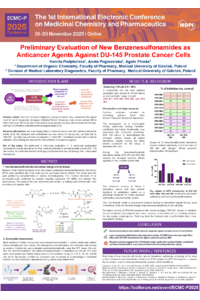
Introduction: The unfolded protein response (UPR), a critical pathway managing endoplasmic reticulum (ER) stress, could be hijacked by malignant cancer cells to promote survival, angiogenesis, and metastasis. Its central sensor, IRE1α, has emerged as a key regulator of cancer cell adaptation and therapeutic resistance. Prostate cancer, the most common malignancy in European men, remains a significant clinical challenge, particularly upon progression to therapy-refractory forms, highlighting the urgent need for novel therapeutic strategies. Pharmacological modulation of IRE1α signaling offers a promising avenue to disrupt cancer cell homeostasis and enhance treatment efficacy.
Methods: In this work, we designed and synthesized a novel series of twelve benzenesulfonamide derivatives (APS) featuring a polynitrogen scaffold, with the goal of targeting the UPR. The compounds’ cytotoxic potential was determined in the DU‑145 prostate cancer cells by XTT assay after 24 and 48 hours of exposure.
Results: The screening identified two lead compounds with distinct activity profiles. APS 600 was the most potent agent at 24 hours (IC₅₀ = 10.23 µM), while APS 597 demonstrated superior activity after 48 hours (IC₅₀ = 14.67 µM). A preliminary structure-activity relationship analysis suggests that the cytotoxic effect could be influenced by the substitution pattern of the 1,2,4-triazole moiety.
Conclusions: These findings designate APS 597 and APS 600 as valuable lead candidates warranting continued development. The study provides compelling support for mechanistic follow‑up to determine their mode of action within IRE1α‑regulated signaling pathways. Further refinement of this scaffold has the potential to generate highly selective ER stress modulators with improved therapeutic specificity and reduced off‑target toxicity.
Keywords
cancer
UPR
IRE1α
prostate cancer
benzenesulfonamides
Endoplasmic Reticulum Stress
cytotoxicity
drug development
Poster
Poster.pdf
Design and Evaluation of Piperidine-Based Inhibitors targeting Alzheimer’s Disease
A Multitarget QSAR Approach for Virtual Screening of Natural Product and Drug Databases to Identify Novel Antifungals for Deep Mycose