Event submissions
EventsThe 1st International Electronic Conference on Medicinal Chemistry and Pharmaceutics
Published
This submission belongs to the session S4. New Small molecules as drug candidates of the event The 1st International Electronic Conference on Medicinal Chemistry and Pharmaceutics
Published date
29 Oct, 2025
Academic Editor
'%3e%3cpath%20d='M12.6657%2010.9104C12.4185%2010.325%2012.0599%209.79327%2011.6097%209.34482C11.1609%208.89508%2010.6293%208.5365%2010.0442%208.28888C10.0389%208.28626%2010.0337%208.28495%2010.0285%208.28233C10.8446%207.69279%2011.3752%206.73249%2011.3752%205.64904C11.3752%203.8542%209.92103%202.39999%208.1262%202.39999C6.33136%202.39999%204.87715%203.8542%204.87715%205.64904C4.87715%206.73249%205.40774%207.69279%206.22393%208.28364C6.21869%208.28626%206.21345%208.28757%206.20821%208.29019C5.62129%208.5378%205.09463%208.89284%204.64265%209.34613C4.1929%209.79493%203.83432%2010.3266%203.58671%2010.9117C3.34345%2011.4845%203.21226%2012.0987%203.20023%2012.7209C3.19988%2012.7349%203.20233%2012.7488%203.20744%2012.7619C3.21255%2012.7749%203.22022%2012.7867%203.22998%2012.7968C3.23975%2012.8068%203.25142%2012.8147%203.26431%2012.8202C3.2772%2012.8256%203.29105%2012.8284%203.30504%2012.8284H4.09109C4.14874%2012.8284%204.19459%2012.7825%204.1959%2012.7262C4.2221%2011.7148%204.62823%2010.7676%205.34617%2010.0497C6.08899%209.30683%207.0755%208.89808%208.1262%208.89808C9.17689%208.89808%2010.1634%209.30683%2010.9062%2010.0497C11.6242%2010.7676%2012.0303%2011.7148%2012.0565%2012.7262C12.0578%2012.7838%2012.1037%2012.8284%2012.1613%2012.8284H12.9474C12.9613%2012.8284%2012.9752%2012.8256%2012.9881%2012.8202C13.001%2012.8147%2013.0126%2012.8068%2013.0224%2012.7968C13.0322%2012.7867%2013.0398%2012.7749%2013.0449%2012.7619C13.0501%2012.7488%2013.0525%2012.7349%2013.0522%2012.7209C13.0391%2012.0947%2012.9094%2011.4855%2012.6657%2010.9104ZM8.1262%207.9024C7.52486%207.9024%206.9589%207.6679%206.53312%207.24211C6.10733%206.81633%205.87283%206.25037%205.87283%205.64904C5.87283%205.0477%206.10733%204.48174%206.53312%204.05596C6.9589%203.63018%207.52486%203.39567%208.1262%203.39567C8.72753%203.39567%209.29349%203.63018%209.71927%204.05596C10.1451%204.48174%2010.3796%205.0477%2010.3796%205.64904C10.3796%206.25037%2010.1451%206.81633%209.71927%207.24211C9.29349%207.6679%208.72753%207.9024%208.1262%207.9024Z'%20fill='%235D1EE1'/%3e%3c/g%3e%3c/svg%3e) Mary Jane Meegan
Mary Jane MeeganCitation
Dilyara O. Mingazhetdinova, Artem S. Agarkov, Svetlana E. Solovieva, Igor S. Antipin, Promising Antitumor Agents: Synthesis and Cytotoxity of New O-Dodecyl-Substituted Arylmethylidene Thiazolo[3,2-a]pyrimidines., in Proceedings of The 1st International Electronic Conference on Medicinal Chemistry and Pharmaceutics, 1 November–30 November 2025, MDPI: Basel, Switzerland
Share
Email
Facebook
Twitter
LinkedIn
Promising Antitumor Agents: Synthesis and Cytotoxity of New O-Dodecyl-Substituted Arylmethylidene Thiazolo[3,2-a]pyrimidines.
'%3e%3cpath%20d='M12.6647%2010.9104C12.4176%2010.325%2012.0589%209.7933%2011.6088%209.34485C11.16%208.89511%2010.6283%208.53653%2010.0432%208.28891C10.038%208.28629%2010.0327%208.28498%2010.0275%208.28236C10.8437%207.69282%2011.3743%206.73252%2011.3743%205.64907C11.3743%203.85423%209.92005%202.40002%208.12522%202.40002C6.33038%202.40002%204.87618%203.85423%204.87618%205.64907C4.87618%206.73252%205.40677%207.69282%206.22296%208.28367C6.21772%208.28629%206.21248%208.2876%206.20724%208.29022C5.62031%208.53783%205.09365%208.89287%204.64167%209.34616C4.19192%209.79496%203.83334%2010.3266%203.58573%2010.9117C3.34247%2011.4846%203.21128%2012.0987%203.19925%2012.721C3.1989%2012.735%203.20135%2012.7489%203.20646%2012.7619C3.21157%2012.7749%203.21924%2012.7868%203.22901%2012.7968C3.23877%2012.8068%203.25045%2012.8148%203.26334%2012.8202C3.27623%2012.8256%203.29007%2012.8284%203.30406%2012.8284H4.09012C4.14776%2012.8284%204.19362%2012.7825%204.19493%2012.7262C4.22113%2011.7148%204.62726%2010.7676%205.34519%2010.0497C6.08802%209.30686%207.07452%208.89811%208.12522%208.89811C9.17592%208.89811%2010.1624%209.30686%2010.9052%2010.0497C11.6232%2010.7676%2012.0293%2011.7148%2012.0555%2012.7262C12.0568%2012.7839%2012.1027%2012.8284%2012.1603%2012.8284H12.9464C12.9604%2012.8284%2012.9742%2012.8256%2012.9871%2012.8202C13%2012.8148%2013.0117%2012.8068%2013.0214%2012.7968C13.0312%2012.7868%2013.0389%2012.7749%2013.044%2012.7619C13.0491%2012.7489%2013.0515%2012.735%2013.0512%2012.721C13.0381%2012.0947%2012.9084%2011.4856%2012.6647%2010.9104ZM8.12522%207.90243C7.52388%207.90243%206.95792%207.66793%206.53214%207.24215C6.10636%206.81636%205.87185%206.2504%205.87185%205.64907C5.87185%205.04773%206.10636%204.48177%206.53214%204.05599C6.95792%203.63021%207.52388%203.3957%208.12522%203.3957C8.72655%203.3957%209.29252%203.63021%209.7183%204.05599C10.1441%204.48177%2010.3786%205.04773%2010.3786%205.64907C10.3786%206.2504%2010.1441%206.81636%209.7183%207.24215C9.29252%207.66793%208.72655%207.90243%208.12522%207.90243Z'%20fill='%235D1EE1'/%3e%3c/g%3e%3c/svg%3e)
Dilyara O. Mingazhetdinova 1
Artem S. Agarkov 1
Svetlana E. Solovieva 1,2
Igor S. Antipin 1,2
1. Arbuzov Institute of Organic and Physical Chemistry, FRC Kazan Scientific Center,
Russian Academy of Sciences, Arbuzova 8, 420088 Kazan, Russia
2. Kazan Federal University, A.M. Butlerov Chemical Institute, 18 Kremlevskaya St., 420008 Kazan, Russia
Abstract
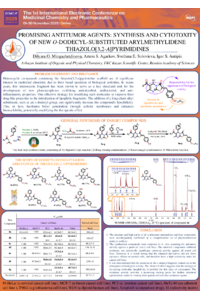
Heterocyclic compounds containing the thiazolo[3,2-a]pyrimidine scaffold are of significant interest in medicinal chemistry due to their broad spectrum of biological activities. In recent years, this heterocyclic fragment has been shown to serve as a key structural unit for the development of new pharmacophores exhibiting antimicrobial, antibacterial, and anti-inflammatory properties. One effective strategy for modifying such molecules to improve their drug-like properties is the introduction of lipophilic fragments. The addition of a long-chain alkyl substituent, such as an n-dodecyl group, can significantly increase the compound's lipophilicity. This, in turn, facilitates better penetration through cellular membranes and enhances bioavailability, potentially amplifying the therapeutic effect.
Within the framework of this study, a four-step synthesis of novel O-dodecyloxybenzylidene derivatives of thiazolo[3,2-a]pyrimidine was designed and accomplished. The synthesis of the target compounds involved the following sequential stages:
1) Conducting a three-component Biginelli reaction to obtain the initial pyrimidinethione precursor.
2) Condensation of the resulting product with ethyl chloroacetate to form the thiazolo[3,2-a]pyrimidine core.
3) Knoevenagel condensation with para-hydroxybenzaldehyde, which introduced the benzylidene fragment and yielded the para-hydroxybenzylidene derivatives.
4) A key alkylation step via a Mitsunobu reaction with n-dodecyl alcohol, which allowed for the introduction of the lipophilic "tail" and afforded the target O-dodecyl derivatives.
The structure and high purity of all synthesized intermediate and final compounds were unambiguously confirmed by a comprehensive set of physicochemical analysis methods, including NMR spectroscopy (¹H and ¹³C), mass spectrometry, and IR spectroscopy.
The synthesized compounds were subjected to in vitro screening for antitumor activity against a panel of cancer cell lines, including M-HeLa, Hutu-80 and PC-3. It was demonstrated that the introduction of the n-dodecyl fragment indeed led to the emergence of biological activity. The obtained compounds exhibited moderate, yet statistically significant, cytotoxic activity against all tested cell lines.
Keywords
thiazolo[3,2-a]pyrimidine
arylmethylidene derivatives
n-dodecyl derivatives
antitumor activity
Poster
poster_Mingazhetdinova.pdf
Design of Aquasome-Based Systems for Brain-Targeted Delivery of DDL-920
Synthesis and evaluation of anticancer activity of pyrrolo[3,4-d]isoxazoles against tumor cell lines