Event submissions
EventsThe 1st International Electronic Conference on Medicinal Chemistry and Pharmaceutics
Published
This submission belongs to the session S4. New Small molecules as drug candidates of the event The 1st International Electronic Conference on Medicinal Chemistry and Pharmaceutics
Published date
29 Oct, 2025
Academic Editor
'%3e%3cpath%20d='M12.6657%2010.9104C12.4185%2010.325%2012.0599%209.79327%2011.6097%209.34482C11.1609%208.89508%2010.6293%208.5365%2010.0442%208.28888C10.0389%208.28626%2010.0337%208.28495%2010.0285%208.28233C10.8446%207.69279%2011.3752%206.73249%2011.3752%205.64904C11.3752%203.8542%209.92103%202.39999%208.1262%202.39999C6.33136%202.39999%204.87715%203.8542%204.87715%205.64904C4.87715%206.73249%205.40774%207.69279%206.22393%208.28364C6.21869%208.28626%206.21345%208.28757%206.20821%208.29019C5.62129%208.5378%205.09463%208.89284%204.64265%209.34613C4.1929%209.79493%203.83432%2010.3266%203.58671%2010.9117C3.34345%2011.4845%203.21226%2012.0987%203.20023%2012.7209C3.19988%2012.7349%203.20233%2012.7488%203.20744%2012.7619C3.21255%2012.7749%203.22022%2012.7867%203.22998%2012.7968C3.23975%2012.8068%203.25142%2012.8147%203.26431%2012.8202C3.2772%2012.8256%203.29105%2012.8284%203.30504%2012.8284H4.09109C4.14874%2012.8284%204.19459%2012.7825%204.1959%2012.7262C4.2221%2011.7148%204.62823%2010.7676%205.34617%2010.0497C6.08899%209.30683%207.0755%208.89808%208.1262%208.89808C9.17689%208.89808%2010.1634%209.30683%2010.9062%2010.0497C11.6242%2010.7676%2012.0303%2011.7148%2012.0565%2012.7262C12.0578%2012.7838%2012.1037%2012.8284%2012.1613%2012.8284H12.9474C12.9613%2012.8284%2012.9752%2012.8256%2012.9881%2012.8202C13.001%2012.8147%2013.0126%2012.8068%2013.0224%2012.7968C13.0322%2012.7867%2013.0398%2012.7749%2013.0449%2012.7619C13.0501%2012.7488%2013.0525%2012.7349%2013.0522%2012.7209C13.0391%2012.0947%2012.9094%2011.4855%2012.6657%2010.9104ZM8.1262%207.9024C7.52486%207.9024%206.9589%207.6679%206.53312%207.24211C6.10733%206.81633%205.87283%206.25037%205.87283%205.64904C5.87283%205.0477%206.10733%204.48174%206.53312%204.05596C6.9589%203.63018%207.52486%203.39567%208.1262%203.39567C8.72753%203.39567%209.29349%203.63018%209.71927%204.05596C10.1451%204.48174%2010.3796%205.0477%2010.3796%205.64904C10.3796%206.25037%2010.1451%206.81633%209.71927%207.24211C9.29349%207.6679%208.72753%207.9024%208.1262%207.9024Z'%20fill='%235D1EE1'/%3e%3c/g%3e%3c/svg%3e) MARIALUIGIA FANTACUZZI
MARIALUIGIA FANTACUZZICitation
Moisés Maia Neto, Bernardo Mussa, Raul Edison Luna Lazo, Roberto Pontarolo, CODRUG: An open-source graphical interface for Ligand-Based Drug Discovery using QSAR and Machine Learning, in Proceedings of The 1st International Electronic Conference on Medicinal Chemistry and Pharmaceutics, 1 November–30 November 2025, MDPI: Basel, Switzerland
Share
Email
Facebook
Twitter
LinkedIn
CODRUG: An open-source graphical interface for Ligand-Based Drug Discovery using QSAR and Machine Learning

Moisés Maia Neto 1
'%3e%3cpath%20d='M12.6647%2010.9104C12.4176%2010.325%2012.0589%209.7933%2011.6088%209.34485C11.16%208.89511%2010.6283%208.53653%2010.0432%208.28891C10.038%208.28629%2010.0327%208.28498%2010.0275%208.28236C10.8437%207.69282%2011.3743%206.73252%2011.3743%205.64907C11.3743%203.85423%209.92005%202.40002%208.12522%202.40002C6.33038%202.40002%204.87618%203.85423%204.87618%205.64907C4.87618%206.73252%205.40677%207.69282%206.22296%208.28367C6.21772%208.28629%206.21248%208.2876%206.20724%208.29022C5.62031%208.53783%205.09365%208.89287%204.64167%209.34616C4.19192%209.79496%203.83334%2010.3266%203.58573%2010.9117C3.34247%2011.4846%203.21128%2012.0987%203.19925%2012.721C3.1989%2012.735%203.20135%2012.7489%203.20646%2012.7619C3.21157%2012.7749%203.21924%2012.7868%203.22901%2012.7968C3.23877%2012.8068%203.25045%2012.8148%203.26334%2012.8202C3.27623%2012.8256%203.29007%2012.8284%203.30406%2012.8284H4.09012C4.14776%2012.8284%204.19362%2012.7825%204.19493%2012.7262C4.22113%2011.7148%204.62726%2010.7676%205.34519%2010.0497C6.08802%209.30686%207.07452%208.89811%208.12522%208.89811C9.17592%208.89811%2010.1624%209.30686%2010.9052%2010.0497C11.6232%2010.7676%2012.0293%2011.7148%2012.0555%2012.7262C12.0568%2012.7839%2012.1027%2012.8284%2012.1603%2012.8284H12.9464C12.9604%2012.8284%2012.9742%2012.8256%2012.9871%2012.8202C13%2012.8148%2013.0117%2012.8068%2013.0214%2012.7968C13.0312%2012.7868%2013.0389%2012.7749%2013.044%2012.7619C13.0491%2012.7489%2013.0515%2012.735%2013.0512%2012.721C13.0381%2012.0947%2012.9084%2011.4856%2012.6647%2010.9104ZM8.12522%207.90243C7.52388%207.90243%206.95792%207.66793%206.53214%207.24215C6.10636%206.81636%205.87185%206.2504%205.87185%205.64907C5.87185%205.04773%206.10636%204.48177%206.53214%204.05599C6.95792%203.63021%207.52388%203.3957%208.12522%203.3957C8.72655%203.3957%209.29252%203.63021%209.7183%204.05599C10.1441%204.48177%2010.3786%205.04773%2010.3786%205.64907C10.3786%206.2504%2010.1441%206.81636%209.7183%207.24215C9.29252%207.66793%208.72655%207.90243%208.12522%207.90243Z'%20fill='%235D1EE1'/%3e%3c/g%3e%3c/svg%3e)
Bernardo Mussa 1

Raul Edison Luna Lazo 1
Roberto Pontarolo 1
1. Postgraduate Program in Pharmaceutical Sciences, Federal University of Paraná, Curitiba 80210-170, Brazil.
Abstract
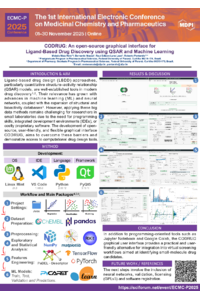
Automated and user-friendly interfaces are essential in drug discovery, as they expand access to in silico tools for professionals without programming expertise and enable more laboratories to adopt virtual screening strategies. Advances in software and hardware have significantly improved the performance and accuracy of in silico methods applied to small molecule screening. Ligand-based drug discovery (LBDD), which explores structure–activity relationships (SAR) across large datasets, has increasingly incorporated machine learning (ML) and deep learning (DL) models, including artificial neural networks (ANNs). However, applying data science tools remains challenging for researchers in small laboratories, as it often requires programming expertise, integrated development environments (IDEs), or access to proprietary software. To address this gap, we developed CODRUG, an open-source, intuitive and flexible graphical user interface (GUI) designed to support ligand-based drug discovery. Together with CODOC (molecular docking interface) and CODYN (molecular dynamics interface), CODRUG forms a comprehensive softwares suite. The tool integrates into a screening pipeline that combines structure-based approaches (molecular docking and dynamics) with ligand-based methods (3D-QSAR), generating ranked compound lists for in vitro and in vivo validation. CODRUG was implemented in Python version 3.10.12 using PyQt5 and the Qt framework version 5.15.14. Its design uses sequential tabs covering the workflow: home, general settings, dataset preparation, preprocessing, exploratory analysis, descriptor generation, models screening, validation and hyperparameter tuning, prediction and result interpretation. This layout guides users through complex processes, reducing the need for coding expertise. By providing an accessible, open-source platform that incorporates advances in ML and DL, CODRUG lowers technical barriers and enhances efficiency of in silico screening. This contribution is expected to facilitate the identification of promising compounds and accelerate the development of novel therapeutic candidates. Next steps, CODRUG will be validated through case studies and integrated into collaborative pipelines, expanding its applicability in drug discovery.
Keywords
Software
Small molecules
Artificial intelligence
Bioinformatics
Drug Discovery.
Poster
ECMC_P.pdf
Fiscalin-Based Compounds as Multifunctional Agents Against Alzheimer’s Pathology: Addressing Amyloid Toxicity, Iron Overload, and Cholinergic Deficits
Design, Synthesis, and Biological Evaluation of Sila-Derivatives of Vitamin D with Application in Breast Cancer Therapy