Event submissions
EventsThe 1st International Electronic Conference on Medicinal Chemistry and Pharmaceutics
Published
This submission belongs to the session S4. New Small molecules as drug candidates of the event The 1st International Electronic Conference on Medicinal Chemistry and Pharmaceutics
Published date
29 Oct, 2025
Academic Editor
'%3e%3cpath%20d='M12.6657%2010.9104C12.4185%2010.325%2012.0599%209.79327%2011.6097%209.34482C11.1609%208.89508%2010.6293%208.5365%2010.0442%208.28888C10.0389%208.28626%2010.0337%208.28495%2010.0285%208.28233C10.8446%207.69279%2011.3752%206.73249%2011.3752%205.64904C11.3752%203.8542%209.92103%202.39999%208.1262%202.39999C6.33136%202.39999%204.87715%203.8542%204.87715%205.64904C4.87715%206.73249%205.40774%207.69279%206.22393%208.28364C6.21869%208.28626%206.21345%208.28757%206.20821%208.29019C5.62129%208.5378%205.09463%208.89284%204.64265%209.34613C4.1929%209.79493%203.83432%2010.3266%203.58671%2010.9117C3.34345%2011.4845%203.21226%2012.0987%203.20023%2012.7209C3.19988%2012.7349%203.20233%2012.7488%203.20744%2012.7619C3.21255%2012.7749%203.22022%2012.7867%203.22998%2012.7968C3.23975%2012.8068%203.25142%2012.8147%203.26431%2012.8202C3.2772%2012.8256%203.29105%2012.8284%203.30504%2012.8284H4.09109C4.14874%2012.8284%204.19459%2012.7825%204.1959%2012.7262C4.2221%2011.7148%204.62823%2010.7676%205.34617%2010.0497C6.08899%209.30683%207.0755%208.89808%208.1262%208.89808C9.17689%208.89808%2010.1634%209.30683%2010.9062%2010.0497C11.6242%2010.7676%2012.0303%2011.7148%2012.0565%2012.7262C12.0578%2012.7838%2012.1037%2012.8284%2012.1613%2012.8284H12.9474C12.9613%2012.8284%2012.9752%2012.8256%2012.9881%2012.8202C13.001%2012.8147%2013.0126%2012.8068%2013.0224%2012.7968C13.0322%2012.7867%2013.0398%2012.7749%2013.0449%2012.7619C13.0501%2012.7488%2013.0525%2012.7349%2013.0522%2012.7209C13.0391%2012.0947%2012.9094%2011.4855%2012.6657%2010.9104ZM8.1262%207.9024C7.52486%207.9024%206.9589%207.6679%206.53312%207.24211C6.10733%206.81633%205.87283%206.25037%205.87283%205.64904C5.87283%205.0477%206.10733%204.48174%206.53312%204.05596C6.9589%203.63018%207.52486%203.39567%208.1262%203.39567C8.72753%203.39567%209.29349%203.63018%209.71927%204.05596C10.1451%204.48174%2010.3796%205.0477%2010.3796%205.64904C10.3796%206.25037%2010.1451%206.81633%209.71927%207.24211C9.29349%207.6679%208.72753%207.9024%208.1262%207.9024Z'%20fill='%235D1EE1'/%3e%3c/g%3e%3c/svg%3e) Alessandra Ammazzalorso
Alessandra AmmazzalorsoCitation
Ivo E. Sampaio-Dias, Hugo F. Costa-Almeida, Xavier C. Correia, Beatriz L. Pires-Lima, Ana Reis-Mendes, Vera M. Costa, Xerardo García-Mera, José E. Rodríguez-Borges, Design-Oriented Synthesis and Biological Evaluation of Melanostatin Neuropeptide Derivatives with Improved Pharmacokinetic Profiles, in Proceedings of The 1st International Electronic Conference on Medicinal Chemistry and Pharmaceutics, 1 November–30 November 2025, MDPI: Basel, Switzerland
Share
Email
Facebook
Twitter
LinkedIn
Design-Oriented Synthesis and Biological Evaluation of Melanostatin Neuropeptide Derivatives with Improved Pharmacokinetic Profiles
'%3e%3cpath%20d='M12.6647%2010.9104C12.4176%2010.325%2012.0589%209.7933%2011.6088%209.34485C11.16%208.89511%2010.6283%208.53653%2010.0432%208.28891C10.038%208.28629%2010.0327%208.28498%2010.0275%208.28236C10.8437%207.69282%2011.3743%206.73252%2011.3743%205.64907C11.3743%203.85423%209.92005%202.40002%208.12522%202.40002C6.33038%202.40002%204.87618%203.85423%204.87618%205.64907C4.87618%206.73252%205.40677%207.69282%206.22296%208.28367C6.21772%208.28629%206.21248%208.2876%206.20724%208.29022C5.62031%208.53783%205.09365%208.89287%204.64167%209.34616C4.19192%209.79496%203.83334%2010.3266%203.58573%2010.9117C3.34247%2011.4846%203.21128%2012.0987%203.19925%2012.721C3.1989%2012.735%203.20135%2012.7489%203.20646%2012.7619C3.21157%2012.7749%203.21924%2012.7868%203.22901%2012.7968C3.23877%2012.8068%203.25045%2012.8148%203.26334%2012.8202C3.27623%2012.8256%203.29007%2012.8284%203.30406%2012.8284H4.09012C4.14776%2012.8284%204.19362%2012.7825%204.19493%2012.7262C4.22113%2011.7148%204.62726%2010.7676%205.34519%2010.0497C6.08802%209.30686%207.07452%208.89811%208.12522%208.89811C9.17592%208.89811%2010.1624%209.30686%2010.9052%2010.0497C11.6232%2010.7676%2012.0293%2011.7148%2012.0555%2012.7262C12.0568%2012.7839%2012.1027%2012.8284%2012.1603%2012.8284H12.9464C12.9604%2012.8284%2012.9742%2012.8256%2012.9871%2012.8202C13%2012.8148%2013.0117%2012.8068%2013.0214%2012.7968C13.0312%2012.7868%2013.0389%2012.7749%2013.044%2012.7619C13.0491%2012.7489%2013.0515%2012.735%2013.0512%2012.721C13.0381%2012.0947%2012.9084%2011.4856%2012.6647%2010.9104ZM8.12522%207.90243C7.52388%207.90243%206.95792%207.66793%206.53214%207.24215C6.10636%206.81636%205.87185%206.2504%205.87185%205.64907C5.87185%205.04773%206.10636%204.48177%206.53214%204.05599C6.95792%203.63021%207.52388%203.3957%208.12522%203.3957C8.72655%203.3957%209.29252%203.63021%209.7183%204.05599C10.1441%204.48177%2010.3786%205.04773%2010.3786%205.64907C10.3786%206.2504%2010.1441%206.81636%209.7183%207.24215C9.29252%207.66793%208.72655%207.90243%208.12522%207.90243Z'%20fill='%235D1EE1'/%3e%3c/g%3e%3c/svg%3e)
Ivo E. Sampaio-Dias 1
Hugo F. Costa-Almeida 1
Xavier C. Correia 1
Beatriz L. Pires-Lima 1
Ana Reis-Mendes 2

Vera M. Costa 2,3
Xerardo García-Mera 4
José E. Rodríguez-Borges 1
1. LAQV/REQUIMTE, Department of Chemistry and Biochemistry, Faculty of Sciences, University of Porto, 4169-007 Porto, Portugal.
2. UCIBIO – Applied Molecular Biosciences Unit, Laboratory of Toxicology, Department of Biological Sciences, Faculty of Pharmacy, University of Porto, 4050-313 Porto, Portugal.
3. Associate Laboratory i4HB – Institute for Health and Bioeconomy, Faculty of Pharmacy, University of Porto, 4050-313 Porto, Portugal.
4. Department of Organic Chemistry, Faculty of Pharmacy, University of Santiago de Compostela, E-15782 Santiago de Compostela, Spain.
Abstract
Melanostatin (MIF-1) is a short endogenous neuropeptide that acts as a highly selective positive allosteric modulator (PAM) of human dopamine D2 receptors (hD2R), exhibiting significant clinical potential for the treatment of dopamine-related central nervous system (CNS) disorders, including depression, drug addiction, obesity, restless legs syndrome, tardive dyskinesia, and Parkinson’s disease. Preliminary studies have shown that substitution of the L-proline residue with L-pipecolic acid generates bioactive derivatives, highlighting the importance of this residue for PAM activity.
In this work, we further explored the role of the L-proline residue by fusing the structural features of L-proline and L-pipecolic acid into a bridged chimera scaffold, (1R,3S,4S)-2-azanorbornane-3-carboxylic acid, and designed a series of 16 bridged melanostatin derivatives to enhance PAM activity and improve pharmacokinetic properties. A concise stereoselective synthetic route afforded the target compounds in high overall yields, with absolute stereochemistry confirmed by X-ray crystallography.
Functional assays at hD₂R identified four compounds exhibiting potent PAM activity at 0.01 nM, producing a 5- to 6.6-fold increase in dopamine potency. Toxicological profiling in HepG2 and differentiated SH-SY5Y neuronal cells revealed no hepatotoxicity (up to 100 µM) and generally favorable neurotoxicological profiles (up to 200 µM). Permeability studies demonstrated negligible P-glycoprotein interaction and favorable Caco-2 transport, suggesting improved CNS penetration relative to the parent neuropeptide.
Collectively, these findings establish 2-azanorbornane as a privileged scaffold for the development of potent, selective, and brain-penetrant PAMs targeting hD2R signaling. This work provides a strong basis for the discovery of novel therapeutics for dopamine-related neurological disorders, combining enhanced pharmacokinetic properties, safety, and high PAM efficacy.
Keywords
2-Azanorbornane
Dopamine D2 Receptors
Melanostatin Neuropeptide
Parkinson's Disease
Positive Allosteric Modulators
Poster
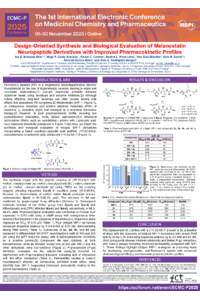
Poster_IVO_DIAS_International Electronic Conference on Medicinal Chemistry and Pharmaceutics.pdf
Integrated Study of Novel Triazole-Linked Schiff Bases: From Efficient Synthesis and Structural Elucidation to Antimicrobial Activity, DFT, and Molecular Docking
Synthesis and Cytotoxicity Profiling of Pyridine-Based Melanostatin Peptidomimetics Targeting Parkinson's Disease