Event submissions
EventsThe 1st International Electronic Conference on Medicinal Chemistry and Pharmaceutics
Published
This submission belongs to the session S5. Natural Products and Biopharmaceuticals of the event The 1st International Electronic Conference on Medicinal Chemistry and Pharmaceutics
Published date
29 Oct, 2025
Academic Editor
'%3e%3cpath%20d='M12.6657%2010.9104C12.4185%2010.325%2012.0599%209.79327%2011.6097%209.34482C11.1609%208.89508%2010.6293%208.5365%2010.0442%208.28888C10.0389%208.28626%2010.0337%208.28495%2010.0285%208.28233C10.8446%207.69279%2011.3752%206.73249%2011.3752%205.64904C11.3752%203.8542%209.92103%202.39999%208.1262%202.39999C6.33136%202.39999%204.87715%203.8542%204.87715%205.64904C4.87715%206.73249%205.40774%207.69279%206.22393%208.28364C6.21869%208.28626%206.21345%208.28757%206.20821%208.29019C5.62129%208.5378%205.09463%208.89284%204.64265%209.34613C4.1929%209.79493%203.83432%2010.3266%203.58671%2010.9117C3.34345%2011.4845%203.21226%2012.0987%203.20023%2012.7209C3.19988%2012.7349%203.20233%2012.7488%203.20744%2012.7619C3.21255%2012.7749%203.22022%2012.7867%203.22998%2012.7968C3.23975%2012.8068%203.25142%2012.8147%203.26431%2012.8202C3.2772%2012.8256%203.29105%2012.8284%203.30504%2012.8284H4.09109C4.14874%2012.8284%204.19459%2012.7825%204.1959%2012.7262C4.2221%2011.7148%204.62823%2010.7676%205.34617%2010.0497C6.08899%209.30683%207.0755%208.89808%208.1262%208.89808C9.17689%208.89808%2010.1634%209.30683%2010.9062%2010.0497C11.6242%2010.7676%2012.0303%2011.7148%2012.0565%2012.7262C12.0578%2012.7838%2012.1037%2012.8284%2012.1613%2012.8284H12.9474C12.9613%2012.8284%2012.9752%2012.8256%2012.9881%2012.8202C13.001%2012.8147%2013.0126%2012.8068%2013.0224%2012.7968C13.0322%2012.7867%2013.0398%2012.7749%2013.0449%2012.7619C13.0501%2012.7488%2013.0525%2012.7349%2013.0522%2012.7209C13.0391%2012.0947%2012.9094%2011.4855%2012.6657%2010.9104ZM8.1262%207.9024C7.52486%207.9024%206.9589%207.6679%206.53312%207.24211C6.10733%206.81633%205.87283%206.25037%205.87283%205.64904C5.87283%205.0477%206.10733%204.48174%206.53312%204.05596C6.9589%203.63018%207.52486%203.39567%208.1262%203.39567C8.72753%203.39567%209.29349%203.63018%209.71927%204.05596C10.1451%204.48174%2010.3796%205.0477%2010.3796%205.64904C10.3796%206.25037%2010.1451%206.81633%209.71927%207.24211C9.29349%207.6679%208.72753%207.9024%208.1262%207.9024Z'%20fill='%235D1EE1'/%3e%3c/g%3e%3c/svg%3e) Gill Diamond
Gill DiamondCitation
Mohammad Aslam, Wed Omar Ayad, Yaqeen Imad Abdulsattar, Comparative in vitro assessment of antibacterial activity of prepared Propolis ointment against common wound pathogens., in Proceedings of The 1st International Electronic Conference on Medicinal Chemistry and Pharmaceutics, 1 November–30 November 2025, MDPI: Basel, Switzerland
Share
Email
Facebook
Twitter
LinkedIn
Comparative in vitro assessment of antibacterial activity of prepared Propolis ointment against common wound pathogens.
'%3e%3cpath%20d='M12.6647%2010.9104C12.4176%2010.325%2012.0589%209.7933%2011.6088%209.34485C11.16%208.89511%2010.6283%208.53653%2010.0432%208.28891C10.038%208.28629%2010.0327%208.28498%2010.0275%208.28236C10.8437%207.69282%2011.3743%206.73252%2011.3743%205.64907C11.3743%203.85423%209.92005%202.40002%208.12522%202.40002C6.33038%202.40002%204.87618%203.85423%204.87618%205.64907C4.87618%206.73252%205.40677%207.69282%206.22296%208.28367C6.21772%208.28629%206.21248%208.2876%206.20724%208.29022C5.62031%208.53783%205.09365%208.89287%204.64167%209.34616C4.19192%209.79496%203.83334%2010.3266%203.58573%2010.9117C3.34247%2011.4846%203.21128%2012.0987%203.19925%2012.721C3.1989%2012.735%203.20135%2012.7489%203.20646%2012.7619C3.21157%2012.7749%203.21924%2012.7868%203.22901%2012.7968C3.23877%2012.8068%203.25045%2012.8148%203.26334%2012.8202C3.27623%2012.8256%203.29007%2012.8284%203.30406%2012.8284H4.09012C4.14776%2012.8284%204.19362%2012.7825%204.19493%2012.7262C4.22113%2011.7148%204.62726%2010.7676%205.34519%2010.0497C6.08802%209.30686%207.07452%208.89811%208.12522%208.89811C9.17592%208.89811%2010.1624%209.30686%2010.9052%2010.0497C11.6232%2010.7676%2012.0293%2011.7148%2012.0555%2012.7262C12.0568%2012.7839%2012.1027%2012.8284%2012.1603%2012.8284H12.9464C12.9604%2012.8284%2012.9742%2012.8256%2012.9871%2012.8202C13%2012.8148%2013.0117%2012.8068%2013.0214%2012.7968C13.0312%2012.7868%2013.0389%2012.7749%2013.044%2012.7619C13.0491%2012.7489%2013.0515%2012.735%2013.0512%2012.721C13.0381%2012.0947%2012.9084%2011.4856%2012.6647%2010.9104ZM8.12522%207.90243C7.52388%207.90243%206.95792%207.66793%206.53214%207.24215C6.10636%206.81636%205.87185%206.2504%205.87185%205.64907C5.87185%205.04773%206.10636%204.48177%206.53214%204.05599C6.95792%203.63021%207.52388%203.3957%208.12522%203.3957C8.72655%203.3957%209.29252%203.63021%209.7183%204.05599C10.1441%204.48177%2010.3786%205.04773%2010.3786%205.64907C10.3786%206.2504%2010.1441%206.81636%209.7183%207.24215C9.29252%207.66793%208.72655%207.90243%208.12522%207.90243Z'%20fill='%235D1EE1'/%3e%3c/g%3e%3c/svg%3e)
Mohammad Aslam 1
Wed Omar Ayad 1

Yaqeen Imad Abdulsattar 1
1. Faculty of Pharmacy, Tishk International University, Erbil, KRG, 44001, Iraq
Abstract
Introduction:
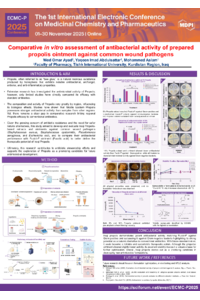
Propolis, a resinous material collected by honeybees from plant exudates, possesses strong antimicrobial properties. However, its composition and potency vary geographically. Despite extensive research, few studies have directly compared its antibacterial efficacy with standard antibiotics. This study aimed to evaluate the antibacterial activity of Iraqi propolis and compare it with Fucidin® to assess its therapeutic potential.
Methods:
Propolis soft extract was obtained by maceration in 70% ethanol (1:10 w/v). Ethanolic extracts (5% and 10%) were prepared from the soft extract, and ointments (5%, 10%) were formulated with petroleum jelly, paraffin, wool fat, and stearyl alcohol. Physicochemical parameters (spreadability, viscosity, pH, stability) were evaluated. Antibacterial activity was assessed against S. aureus, S. epidermidis, E. coli, and P. aeruginosa using the Kirby–Bauer disk diffusion method, with Fucidin® as control. MICs for Gram-positive isolates were estimated from inhibition zone diameters, and results were statistically analyzed (p < 0.05). GC–MS was employed to identify volatile constituents not typically detected by HPLC, contributing to the antibacterial profile of Iraqi propolis.
Results:
Both ointments showed semi-stiff consistency, pseudoplastic behavior, and a pH of 5, suitable for topical use. They remained stable at 25 °C for 90 days and at –20 °C and 40 °C for 30 days. The 5% extract produced inhibition zones of 25 ± 0.81 mm (S. aureus), 21 ± 0.81 mm (S. epidermidis), 13.33 ± 1.24 mm (E. coli), and 12.75 ± 0.54 mm (P. aeruginosa), surpassing Fucidin® against Gram-negatives (p < 0.001) and showing comparable efficacy for Gram-positives (p > 0.05). Ointments showed smaller inhibition zones (15–18 mm), MIC was 1% for Gram-positive isolates. GC–MS revealed 20 volatile compounds.
Conclusion:
Iraqi propolis demonstrated potent antibacterial activity comparable to Fucidin®, with superior efficacy against Gram-negative bacteria. It represents a promising natural antimicrobial requiring further optimization and standardization.
Keywords
Propolis
Propolis Extract
Propolis Ointment
Antimicrobial Activity
Fusidic acid ointment (Fucidin®).
Poster
poster-Wed Omar Ayad.pdf
Characterization of the cytotoxic activity of naphthoxyacetamide hydrochlorides in the A549 lung adenocarcinoma cell line
PROBING THE INHIBITORY EFFCTS OF BARTERIA NIGRITANA SYNTHESIZED ZINC OXIDE NANOPARTICLES AGAINST ALPHA GLUCOSIDASE IMPLICATED IN DIABETES UPSURGE