Event submissions
EventsThe 1st International Electronic Conference on Medicinal Chemistry and Pharmaceutics
Published
This submission belongs to the session S5. Natural Products and Biopharmaceuticals of the event The 1st International Electronic Conference on Medicinal Chemistry and Pharmaceutics
Published date
29 Oct, 2025
Academic Editor
'%3e%3cpath%20d='M12.6657%2010.9104C12.4185%2010.325%2012.0599%209.79327%2011.6097%209.34482C11.1609%208.89508%2010.6293%208.5365%2010.0442%208.28888C10.0389%208.28626%2010.0337%208.28495%2010.0285%208.28233C10.8446%207.69279%2011.3752%206.73249%2011.3752%205.64904C11.3752%203.8542%209.92103%202.39999%208.1262%202.39999C6.33136%202.39999%204.87715%203.8542%204.87715%205.64904C4.87715%206.73249%205.40774%207.69279%206.22393%208.28364C6.21869%208.28626%206.21345%208.28757%206.20821%208.29019C5.62129%208.5378%205.09463%208.89284%204.64265%209.34613C4.1929%209.79493%203.83432%2010.3266%203.58671%2010.9117C3.34345%2011.4845%203.21226%2012.0987%203.20023%2012.7209C3.19988%2012.7349%203.20233%2012.7488%203.20744%2012.7619C3.21255%2012.7749%203.22022%2012.7867%203.22998%2012.7968C3.23975%2012.8068%203.25142%2012.8147%203.26431%2012.8202C3.2772%2012.8256%203.29105%2012.8284%203.30504%2012.8284H4.09109C4.14874%2012.8284%204.19459%2012.7825%204.1959%2012.7262C4.2221%2011.7148%204.62823%2010.7676%205.34617%2010.0497C6.08899%209.30683%207.0755%208.89808%208.1262%208.89808C9.17689%208.89808%2010.1634%209.30683%2010.9062%2010.0497C11.6242%2010.7676%2012.0303%2011.7148%2012.0565%2012.7262C12.0578%2012.7838%2012.1037%2012.8284%2012.1613%2012.8284H12.9474C12.9613%2012.8284%2012.9752%2012.8256%2012.9881%2012.8202C13.001%2012.8147%2013.0126%2012.8068%2013.0224%2012.7968C13.0322%2012.7867%2013.0398%2012.7749%2013.0449%2012.7619C13.0501%2012.7488%2013.0525%2012.7349%2013.0522%2012.7209C13.0391%2012.0947%2012.9094%2011.4855%2012.6657%2010.9104ZM8.1262%207.9024C7.52486%207.9024%206.9589%207.6679%206.53312%207.24211C6.10733%206.81633%205.87283%206.25037%205.87283%205.64904C5.87283%205.0477%206.10733%204.48174%206.53312%204.05596C6.9589%203.63018%207.52486%203.39567%208.1262%203.39567C8.72753%203.39567%209.29349%203.63018%209.71927%204.05596C10.1451%204.48174%2010.3796%205.0477%2010.3796%205.64904C10.3796%206.25037%2010.1451%206.81633%209.71927%207.24211C9.29349%207.6679%208.72753%207.9024%208.1262%207.9024Z'%20fill='%235D1EE1'/%3e%3c/g%3e%3c/svg%3e) Daniela De Vita
Daniela De VitaCitation
Vera M. S. Isca, Gabrielle Bangay, Elizabeth A. Lopes, Rebeca André, Jennifer Fernández Alarcón, Epole Ntungwe, Catarina P. Reis, Ana M. Díaz-Lanza, Cristina Puigvert, Patricia Rijo, Nanoparticle Systems for Improved Delivery of Plectranthus-Derived Abietane Diterpenoids in Breast Cancer Therapy, in Proceedings of The 1st International Electronic Conference on Medicinal Chemistry and Pharmaceutics, 1 November–30 November 2025, MDPI: Basel, Switzerland
Share
Email
Facebook
Twitter
LinkedIn
Nanoparticle Systems for Improved Delivery of Plectranthus-Derived Abietane Diterpenoids in Breast Cancer Therapy

Vera M. S. Isca 1
'%3e%3cpath%20d='M12.6647%2010.9104C12.4176%2010.325%2012.0589%209.7933%2011.6088%209.34485C11.16%208.89511%2010.6283%208.53653%2010.0432%208.28891C10.038%208.28629%2010.0327%208.28498%2010.0275%208.28236C10.8437%207.69282%2011.3743%206.73252%2011.3743%205.64907C11.3743%203.85423%209.92005%202.40002%208.12522%202.40002C6.33038%202.40002%204.87618%203.85423%204.87618%205.64907C4.87618%206.73252%205.40677%207.69282%206.22296%208.28367C6.21772%208.28629%206.21248%208.2876%206.20724%208.29022C5.62031%208.53783%205.09365%208.89287%204.64167%209.34616C4.19192%209.79496%203.83334%2010.3266%203.58573%2010.9117C3.34247%2011.4846%203.21128%2012.0987%203.19925%2012.721C3.1989%2012.735%203.20135%2012.7489%203.20646%2012.7619C3.21157%2012.7749%203.21924%2012.7868%203.22901%2012.7968C3.23877%2012.8068%203.25045%2012.8148%203.26334%2012.8202C3.27623%2012.8256%203.29007%2012.8284%203.30406%2012.8284H4.09012C4.14776%2012.8284%204.19362%2012.7825%204.19493%2012.7262C4.22113%2011.7148%204.62726%2010.7676%205.34519%2010.0497C6.08802%209.30686%207.07452%208.89811%208.12522%208.89811C9.17592%208.89811%2010.1624%209.30686%2010.9052%2010.0497C11.6232%2010.7676%2012.0293%2011.7148%2012.0555%2012.7262C12.0568%2012.7839%2012.1027%2012.8284%2012.1603%2012.8284H12.9464C12.9604%2012.8284%2012.9742%2012.8256%2012.9871%2012.8202C13%2012.8148%2013.0117%2012.8068%2013.0214%2012.7968C13.0312%2012.7868%2013.0389%2012.7749%2013.044%2012.7619C13.0491%2012.7489%2013.0515%2012.735%2013.0512%2012.721C13.0381%2012.0947%2012.9084%2011.4856%2012.6647%2010.9104ZM8.12522%207.90243C7.52388%207.90243%206.95792%207.66793%206.53214%207.24215C6.10636%206.81636%205.87185%206.2504%205.87185%205.64907C5.87185%205.04773%206.10636%204.48177%206.53214%204.05599C6.95792%203.63021%207.52388%203.3957%208.12522%203.3957C8.72655%203.3957%209.29252%203.63021%209.7183%204.05599C10.1441%204.48177%2010.3786%205.04773%2010.3786%205.64907C10.3786%206.2504%2010.1441%206.81636%209.7183%207.24215C9.29252%207.66793%208.72655%207.90243%208.12522%207.90243Z'%20fill='%235D1EE1'/%3e%3c/g%3e%3c/svg%3e)
Gabrielle Bangay 2,3
Elizabeth A. Lopes 2,4

Rebeca André 2
Jennifer Fernández Alarcón 5
Epole Ntungwe 5

Catarina P. Reis 4
Ana M. Díaz-Lanza 3

Cristina Puigvert 5

Patricia Rijo 2,4
1. Center for Research in Biosciences & Health Technologies (CBIOS), Universidade Lusófona de Humanidades e Tecnologias, Lisboa, Portugal
2. CBIOS – Universidade Lusófona’s Research Center for Biosciences & Health Technologies, Lisbon, Portugal
3. Universidad de Alcalá de Henares. Facultad de Farmacia, Departamento de Ciencias Biomédicas (Área de Farmacología; Nuevos agentes antitumorales, Acción tóxica sobre células leucémicas. Alcalá de Henares, Madrid, España, Spain
4. iMed.ULisboa – Research Institute for Medicines, Faculty of Pharmacy, Universidade de Lisboa, Portugal
5. Grup d’Enginyeria de Materials (GEMAT), Institut Químic de Sarrià (IQS), Universitat Ramon Llull (URL), 08017, Barcelona, España, Spain
Abstract
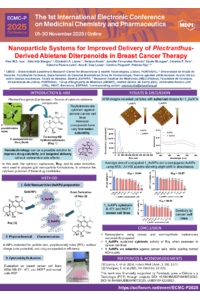
Nanoparticles (NPs) have become key tools in modern drug delivery, especially when used alongside natural compounds. This combination can improve how drugs are absorbed and directed to specific targets in the body. Benefits include higher drug loading, controlled and sustained release, longer presence in the bloodstream, and reduced side effects. These advantages contribute to safer and more efficient therapies.
Among the various nanoparticle types, gold nanoparticles (AuNPs) stand out due to their easy production, strong stability, and unique physical and chemical traits. These properties make them excellent carriers for both drugs and genetic material, especially in cancer-related applications.
One group of natural compounds with promising anticancer activity is the abietane diterpenoids, such as 7α-acetoxy-6β-hydroxyroyleanone (Roy), found in Plectranthus species. Despite their potential, their clinical use is limited by poor water solubility and low bioavailability. To overcome these issues, Roy and one Roy-esterified derivative were incorporated into gold nanoparticle-based systems.
These nanoformulations were evaluated for characteristics like particle size (29.37 nm), polydispersity index (PDI, 0.399), surface charge (zeta potential, −6.84), and drug encapsulation efficiency (79.4%). In vitro experiments using breast cancer cell lines (MDA-MB-231, 4T1, and MCF7) showed that Roy-loaded AuNPs had significantly stronger anticancer effects than Roy alone or unmodified AuNPs. Notably, these systems also demonstrated selectivity, affecting cancer cells while sparing healthy human dermal fibroblasts (HDFs), suggesting strong potential for targeted cancer therapy. These results represent meaningful progress in the development of innovative drug delivery systems for cancer therapy.
Keywords
Plectranthus
Diterpenoids
Anticancer activity
Nanoparticles
Poster
Poster Isca_poster.pdf
Nanostructured lipid carriers for enhanced oral bioavailability and antibacterial efficacy of curcumin against multidrug-resistant pathogens
Comparative Assessment of Nigerian and Yemeni Garlic as Phospholipase A2 (PLA2) Inhibitors in Snakebite Envenomation Therapy