Event submissions
EventsThe 1st International Electronic Conference on Medicinal Chemistry and Pharmaceutics
Published
This submission belongs to the session S5. Natural Products and Biopharmaceuticals of the event The 1st International Electronic Conference on Medicinal Chemistry and Pharmaceutics
Published date
29 Oct, 2025
Academic Editor
'%3e%3cpath%20d='M12.6657%2010.9104C12.4185%2010.325%2012.0599%209.79327%2011.6097%209.34482C11.1609%208.89508%2010.6293%208.5365%2010.0442%208.28888C10.0389%208.28626%2010.0337%208.28495%2010.0285%208.28233C10.8446%207.69279%2011.3752%206.73249%2011.3752%205.64904C11.3752%203.8542%209.92103%202.39999%208.1262%202.39999C6.33136%202.39999%204.87715%203.8542%204.87715%205.64904C4.87715%206.73249%205.40774%207.69279%206.22393%208.28364C6.21869%208.28626%206.21345%208.28757%206.20821%208.29019C5.62129%208.5378%205.09463%208.89284%204.64265%209.34613C4.1929%209.79493%203.83432%2010.3266%203.58671%2010.9117C3.34345%2011.4845%203.21226%2012.0987%203.20023%2012.7209C3.19988%2012.7349%203.20233%2012.7488%203.20744%2012.7619C3.21255%2012.7749%203.22022%2012.7867%203.22998%2012.7968C3.23975%2012.8068%203.25142%2012.8147%203.26431%2012.8202C3.2772%2012.8256%203.29105%2012.8284%203.30504%2012.8284H4.09109C4.14874%2012.8284%204.19459%2012.7825%204.1959%2012.7262C4.2221%2011.7148%204.62823%2010.7676%205.34617%2010.0497C6.08899%209.30683%207.0755%208.89808%208.1262%208.89808C9.17689%208.89808%2010.1634%209.30683%2010.9062%2010.0497C11.6242%2010.7676%2012.0303%2011.7148%2012.0565%2012.7262C12.0578%2012.7838%2012.1037%2012.8284%2012.1613%2012.8284H12.9474C12.9613%2012.8284%2012.9752%2012.8256%2012.9881%2012.8202C13.001%2012.8147%2013.0126%2012.8068%2013.0224%2012.7968C13.0322%2012.7867%2013.0398%2012.7749%2013.0449%2012.7619C13.0501%2012.7488%2013.0525%2012.7349%2013.0522%2012.7209C13.0391%2012.0947%2012.9094%2011.4855%2012.6657%2010.9104ZM8.1262%207.9024C7.52486%207.9024%206.9589%207.6679%206.53312%207.24211C6.10733%206.81633%205.87283%206.25037%205.87283%205.64904C5.87283%205.0477%206.10733%204.48174%206.53312%204.05596C6.9589%203.63018%207.52486%203.39567%208.1262%203.39567C8.72753%203.39567%209.29349%203.63018%209.71927%204.05596C10.1451%204.48174%2010.3796%205.0477%2010.3796%205.64904C10.3796%206.25037%2010.1451%206.81633%209.71927%207.24211C9.29349%207.6679%208.72753%207.9024%208.1262%207.9024Z'%20fill='%235D1EE1'/%3e%3c/g%3e%3c/svg%3e) Gill Diamond
Gill DiamondCitation
Claudia Owsianik, Marta Sánchez Gómez-Serranillos, Pradeep Kumar Divakar, Parmeliaceae Lichens as Sources of Antioxidant Metabolites with Pharmacological Value, in Proceedings of The 1st International Electronic Conference on Medicinal Chemistry and Pharmaceutics, 1 November–30 November 2025, MDPI: Basel, Switzerland
Share
Email
Facebook
Twitter
LinkedIn
Parmeliaceae Lichens as Sources of Antioxidant Metabolites with Pharmacological Value
'%3e%3cpath%20d='M12.6647%2010.9104C12.4176%2010.325%2012.0589%209.7933%2011.6088%209.34485C11.16%208.89511%2010.6283%208.53653%2010.0432%208.28891C10.038%208.28629%2010.0327%208.28498%2010.0275%208.28236C10.8437%207.69282%2011.3743%206.73252%2011.3743%205.64907C11.3743%203.85423%209.92005%202.40002%208.12522%202.40002C6.33038%202.40002%204.87618%203.85423%204.87618%205.64907C4.87618%206.73252%205.40677%207.69282%206.22296%208.28367C6.21772%208.28629%206.21248%208.2876%206.20724%208.29022C5.62031%208.53783%205.09365%208.89287%204.64167%209.34616C4.19192%209.79496%203.83334%2010.3266%203.58573%2010.9117C3.34247%2011.4846%203.21128%2012.0987%203.19925%2012.721C3.1989%2012.735%203.20135%2012.7489%203.20646%2012.7619C3.21157%2012.7749%203.21924%2012.7868%203.22901%2012.7968C3.23877%2012.8068%203.25045%2012.8148%203.26334%2012.8202C3.27623%2012.8256%203.29007%2012.8284%203.30406%2012.8284H4.09012C4.14776%2012.8284%204.19362%2012.7825%204.19493%2012.7262C4.22113%2011.7148%204.62726%2010.7676%205.34519%2010.0497C6.08802%209.30686%207.07452%208.89811%208.12522%208.89811C9.17592%208.89811%2010.1624%209.30686%2010.9052%2010.0497C11.6232%2010.7676%2012.0293%2011.7148%2012.0555%2012.7262C12.0568%2012.7839%2012.1027%2012.8284%2012.1603%2012.8284H12.9464C12.9604%2012.8284%2012.9742%2012.8256%2012.9871%2012.8202C13%2012.8148%2013.0117%2012.8068%2013.0214%2012.7968C13.0312%2012.7868%2013.0389%2012.7749%2013.044%2012.7619C13.0491%2012.7489%2013.0515%2012.735%2013.0512%2012.721C13.0381%2012.0947%2012.9084%2011.4856%2012.6647%2010.9104ZM8.12522%207.90243C7.52388%207.90243%206.95792%207.66793%206.53214%207.24215C6.10636%206.81636%205.87185%206.2504%205.87185%205.64907C5.87185%205.04773%206.10636%204.48177%206.53214%204.05599C6.95792%203.63021%207.52388%203.3957%208.12522%203.3957C8.72655%203.3957%209.29252%203.63021%209.7183%204.05599C10.1441%204.48177%2010.3786%205.04773%2010.3786%205.64907C10.3786%206.2504%2010.1441%206.81636%209.7183%207.24215C9.29252%207.66793%208.72655%207.90243%208.12522%207.90243Z'%20fill='%235D1EE1'/%3e%3c/g%3e%3c/svg%3e)
Claudia Owsianik 1
Marta Sánchez Gómez-Serranillos 1

Pradeep Kumar Divakar 1
1. Department of Pharmacology, Pharmacognosy and Botany, Faculty of Pharmacy, Complutense University of Madrid, 28040 Madrid, Spain
Abstract
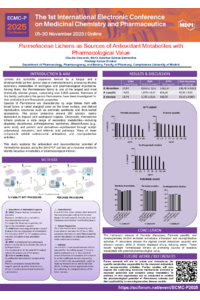
Lichens are a valuable source of secondary metabolites with high antioxidant and therapeutic potential. This study evaluated the antioxidant activity of methanolic extracts from three species of the Parmeliaceae family—Parmelia discordans, Parmelia saxatilis, and Xanthoparmelia tinctina—. Antioxidant activity was determined using ORAC, FRAP and DPPH assays. The phenolic compound content was also evaluated, using the Folin-Ciocalteu assay.
Parmelia discordans showed the highest ORAC value (24.94 µmol TE/mg) and a considerable phenolic content (106.49 µg AG/mg), indicating strong radical scavenging capacity associated with phenolic metabolites. Parmelia saxatilis exhibited a balanced profile, with high ORAC activity (19.03 µmol TE/mg), relevant reducing power (FRAP = 1.029 Eq Fe²⁺/g), and strong DPPH activity (IC₅₀ = 814.42 µg/mL), together with high phenolic content (97.86 µg AG/mg). Xanthoparmelia tinctina displayed the highest reducing capacity (FRAP = 2.295 Eq Fe²⁺/g) and the most potent DPPH activity (IC₅₀ = 642.93 µg/mL), despite its low phenolic content (20.13 µg AG/mg). This finding suggests that non-phenolic compounds may play a central role in its antioxidant potential.
Additionally, methanolic extracts were tested on human neuroblastoma SH-SY5Y cells to assess their effects on cell viability, resistance to oxidative stress, and intracellular generation of reactive oxygen species (ROS). The combined biochemical and cellular data highlight complementary antioxidant strategies: phenolic-driven activity in P. discordans, a robust and balanced profile in P. saxatilis, and non-phenolic but highly effective mechanisms in X. tinctina.
These findings support lichens as promising candidates for further phytochemical and pharmacological research focused on natural antioxidant agents. Nevertheless, it is necessary to continue researching.
Keywords
lichens
methanolic extracts
antioxidants
SH-SY5Y cells
oxidative stress
ROS
Poster
POSTER CONGRESO NIEMCY (1).pdf
Effects of Copaiba Oil on Myocardial Morphology in Streptozotocin-Induced Diabetic Rats
Phytochemical Analysis, Quantification of Flavonoids and Phenols, and Assessment of Anti-Tubercular Activity of Citrus jambhiri Fruit Peel Extract