Event submissions
EventsThe 1st International Electronic Conference on Medicinal Chemistry and Pharmaceutics
Published
This submission belongs to the session S5. Natural Products and Biopharmaceuticals of the event The 1st International Electronic Conference on Medicinal Chemistry and Pharmaceutics
Published date
29 Oct, 2025
Academic Editor
'%3e%3cpath%20d='M12.6657%2010.9104C12.4185%2010.325%2012.0599%209.79327%2011.6097%209.34482C11.1609%208.89508%2010.6293%208.5365%2010.0442%208.28888C10.0389%208.28626%2010.0337%208.28495%2010.0285%208.28233C10.8446%207.69279%2011.3752%206.73249%2011.3752%205.64904C11.3752%203.8542%209.92103%202.39999%208.1262%202.39999C6.33136%202.39999%204.87715%203.8542%204.87715%205.64904C4.87715%206.73249%205.40774%207.69279%206.22393%208.28364C6.21869%208.28626%206.21345%208.28757%206.20821%208.29019C5.62129%208.5378%205.09463%208.89284%204.64265%209.34613C4.1929%209.79493%203.83432%2010.3266%203.58671%2010.9117C3.34345%2011.4845%203.21226%2012.0987%203.20023%2012.7209C3.19988%2012.7349%203.20233%2012.7488%203.20744%2012.7619C3.21255%2012.7749%203.22022%2012.7867%203.22998%2012.7968C3.23975%2012.8068%203.25142%2012.8147%203.26431%2012.8202C3.2772%2012.8256%203.29105%2012.8284%203.30504%2012.8284H4.09109C4.14874%2012.8284%204.19459%2012.7825%204.1959%2012.7262C4.2221%2011.7148%204.62823%2010.7676%205.34617%2010.0497C6.08899%209.30683%207.0755%208.89808%208.1262%208.89808C9.17689%208.89808%2010.1634%209.30683%2010.9062%2010.0497C11.6242%2010.7676%2012.0303%2011.7148%2012.0565%2012.7262C12.0578%2012.7838%2012.1037%2012.8284%2012.1613%2012.8284H12.9474C12.9613%2012.8284%2012.9752%2012.8256%2012.9881%2012.8202C13.001%2012.8147%2013.0126%2012.8068%2013.0224%2012.7968C13.0322%2012.7867%2013.0398%2012.7749%2013.0449%2012.7619C13.0501%2012.7488%2013.0525%2012.7349%2013.0522%2012.7209C13.0391%2012.0947%2012.9094%2011.4855%2012.6657%2010.9104ZM8.1262%207.9024C7.52486%207.9024%206.9589%207.6679%206.53312%207.24211C6.10733%206.81633%205.87283%206.25037%205.87283%205.64904C5.87283%205.0477%206.10733%204.48174%206.53312%204.05596C6.9589%203.63018%207.52486%203.39567%208.1262%203.39567C8.72753%203.39567%209.29349%203.63018%209.71927%204.05596C10.1451%204.48174%2010.3796%205.0477%2010.3796%205.64904C10.3796%206.25037%2010.1451%206.81633%209.71927%207.24211C9.29349%207.6679%208.72753%207.9024%208.1262%207.9024Z'%20fill='%235D1EE1'/%3e%3c/g%3e%3c/svg%3e) Daniela De Vita
Daniela De VitaCitation
Maryem Bouabidi, Maroua Ait Tastift, Chemseddoha Gadhi, Hafida Bouamama, Anti-Elastase and Anti-Tyrosinase Activities of Cistus salviifolius and Cistus laurifolius Leaf Extracts: Potential Natural Agents for Skin Regeneration and Depigmentation., in Proceedings of The 1st International Electronic Conference on Medicinal Chemistry and Pharmaceutics, 1 November–30 November 2025, MDPI: Basel, Switzerland
Share
Email
Facebook
Twitter
LinkedIn
Anti-Elastase and Anti-Tyrosinase Activities of Cistus salviifolius and Cistus laurifolius Leaf Extracts: Potential Natural Agents for Skin Regeneration and Depigmentation.
'%3e%3cpath%20d='M12.6647%2010.9104C12.4176%2010.325%2012.0589%209.7933%2011.6088%209.34485C11.16%208.89511%2010.6283%208.53653%2010.0432%208.28891C10.038%208.28629%2010.0327%208.28498%2010.0275%208.28236C10.8437%207.69282%2011.3743%206.73252%2011.3743%205.64907C11.3743%203.85423%209.92005%202.40002%208.12522%202.40002C6.33038%202.40002%204.87618%203.85423%204.87618%205.64907C4.87618%206.73252%205.40677%207.69282%206.22296%208.28367C6.21772%208.28629%206.21248%208.2876%206.20724%208.29022C5.62031%208.53783%205.09365%208.89287%204.64167%209.34616C4.19192%209.79496%203.83334%2010.3266%203.58573%2010.9117C3.34247%2011.4846%203.21128%2012.0987%203.19925%2012.721C3.1989%2012.735%203.20135%2012.7489%203.20646%2012.7619C3.21157%2012.7749%203.21924%2012.7868%203.22901%2012.7968C3.23877%2012.8068%203.25045%2012.8148%203.26334%2012.8202C3.27623%2012.8256%203.29007%2012.8284%203.30406%2012.8284H4.09012C4.14776%2012.8284%204.19362%2012.7825%204.19493%2012.7262C4.22113%2011.7148%204.62726%2010.7676%205.34519%2010.0497C6.08802%209.30686%207.07452%208.89811%208.12522%208.89811C9.17592%208.89811%2010.1624%209.30686%2010.9052%2010.0497C11.6232%2010.7676%2012.0293%2011.7148%2012.0555%2012.7262C12.0568%2012.7839%2012.1027%2012.8284%2012.1603%2012.8284H12.9464C12.9604%2012.8284%2012.9742%2012.8256%2012.9871%2012.8202C13%2012.8148%2013.0117%2012.8068%2013.0214%2012.7968C13.0312%2012.7868%2013.0389%2012.7749%2013.044%2012.7619C13.0491%2012.7489%2013.0515%2012.735%2013.0512%2012.721C13.0381%2012.0947%2012.9084%2011.4856%2012.6647%2010.9104ZM8.12522%207.90243C7.52388%207.90243%206.95792%207.66793%206.53214%207.24215C6.10636%206.81636%205.87185%206.2504%205.87185%205.64907C5.87185%205.04773%206.10636%204.48177%206.53214%204.05599C6.95792%203.63021%207.52388%203.3957%208.12522%203.3957C8.72655%203.3957%209.29252%203.63021%209.7183%204.05599C10.1441%204.48177%2010.3786%205.04773%2010.3786%205.64907C10.3786%206.2504%2010.1441%206.81636%209.7183%207.24215C9.29252%207.66793%208.72655%207.90243%208.12522%207.90243Z'%20fill='%235D1EE1'/%3e%3c/g%3e%3c/svg%3e)
Maryem Bouabidi 1
Maroua Ait Tastift 2
Chemseddoha Gadhi 2
Hafida Bouamama 1
1. Laboratory of Sustainable Development and Health Research (LRDDS), Faculty of Sciences and Technology,
Cadi Ayyad University, 549 Bd Abdelkrim Al Khattabi, Marrakesh 40000, Morocco
2. Laboratory of Agri-Food, Biotechnology and Valorization of Plant Bioresources, Faculty of Sciences Semlalia,
Cadi Ayyad University, Bd. Prince My Abdellah, B.P. 2390, Marrakesh 40000, Morocco
Abstract
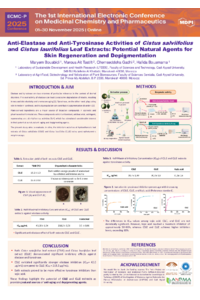
Background: Skin aging and pigmentation disorders are influenced by both intrinsic factors (genetics, metabolism, hormones) and extrinsic factors (ultraviolet radiation, pollution, chemicals). These factors contribute to progressive structural and functional alterations of the skin, clinically manifested as wrinkles, loss of elasticity, and hyperpigmentation. Among the key enzymes implicated in these processes are elastase and tyrosinase. In response to the growing demand for safer and more sustainable cosmetic ingredients, plant-derived extracts have attracted considerable interest as sources of natural anti-aging and depigmenting agents.
Methods: The present study investigated in vitro the inhibitory activities of hydroethanolic leaf extracts of Cistus salviifolius (CSLE) and Cistus laurifolius (CLLE) using spectrophotometric enzyme assays. Enzymatic inhibition was assessed using N-succinyl-Ala-Ala-Ala-p-nitroanilide as substrate for elastase and L-DOPA for tyrosinase, with elastatinal and kojic acid employed as reference inhibitors, respectively.
Results: CSLE exhibited notable anti-elastase activity with an IC₅₀ value of 43.0 µg/mL, significantly lower than that of CLLE (IC₅₀ =218.2 µg/mL), while the positive control elastatinal displayed an IC₅₀ of 0.5 µg/mL. Regarding tyrosinase inhibition, CSLE (IC₅₀ = 28.7 µg/mL) and CLLE (IC₅₀ = 30.2 µg/mL) demonstrated comparable activities, both slightly exceeding the efficacy of kojic acid (IC₅₀ = 31.1 µg/mL).
Conclusion: These findings highlight the potential of CSLE and CLLE extracts, particularly CSLE, as valuable natural sources of elastase and tyrosinase inhibitors, thereby supporting their prospective application in the formulation of cosmeceutical products.
Keywords
Keywords: Anti-aging
Cistus salviifolius
Cistus laurifolius
elastase
tyrosinase
skin lightening
Poster
Poster ECMC-P2025_M.Bouabidi.pdf
Chemical Characterization of Coleus aromaticus (Roxb.) Benth. Leaves: Chromatography and NMR Analysis
NMR AND DFT STUDY OF CHONDROITIN SULPHATE