Event submissions
EventsThe 1st International Electronic Conference on Medicinal Chemistry and Pharmaceutics
Published
This submission belongs to the session S5. Natural Products and Biopharmaceuticals of the event The 1st International Electronic Conference on Medicinal Chemistry and Pharmaceutics
Published date
29 Oct, 2025
Academic Editor
'%3e%3cpath%20d='M12.6657%2010.9104C12.4185%2010.325%2012.0599%209.79327%2011.6097%209.34482C11.1609%208.89508%2010.6293%208.5365%2010.0442%208.28888C10.0389%208.28626%2010.0337%208.28495%2010.0285%208.28233C10.8446%207.69279%2011.3752%206.73249%2011.3752%205.64904C11.3752%203.8542%209.92103%202.39999%208.1262%202.39999C6.33136%202.39999%204.87715%203.8542%204.87715%205.64904C4.87715%206.73249%205.40774%207.69279%206.22393%208.28364C6.21869%208.28626%206.21345%208.28757%206.20821%208.29019C5.62129%208.5378%205.09463%208.89284%204.64265%209.34613C4.1929%209.79493%203.83432%2010.3266%203.58671%2010.9117C3.34345%2011.4845%203.21226%2012.0987%203.20023%2012.7209C3.19988%2012.7349%203.20233%2012.7488%203.20744%2012.7619C3.21255%2012.7749%203.22022%2012.7867%203.22998%2012.7968C3.23975%2012.8068%203.25142%2012.8147%203.26431%2012.8202C3.2772%2012.8256%203.29105%2012.8284%203.30504%2012.8284H4.09109C4.14874%2012.8284%204.19459%2012.7825%204.1959%2012.7262C4.2221%2011.7148%204.62823%2010.7676%205.34617%2010.0497C6.08899%209.30683%207.0755%208.89808%208.1262%208.89808C9.17689%208.89808%2010.1634%209.30683%2010.9062%2010.0497C11.6242%2010.7676%2012.0303%2011.7148%2012.0565%2012.7262C12.0578%2012.7838%2012.1037%2012.8284%2012.1613%2012.8284H12.9474C12.9613%2012.8284%2012.9752%2012.8256%2012.9881%2012.8202C13.001%2012.8147%2013.0126%2012.8068%2013.0224%2012.7968C13.0322%2012.7867%2013.0398%2012.7749%2013.0449%2012.7619C13.0501%2012.7488%2013.0525%2012.7349%2013.0522%2012.7209C13.0391%2012.0947%2012.9094%2011.4855%2012.6657%2010.9104ZM8.1262%207.9024C7.52486%207.9024%206.9589%207.6679%206.53312%207.24211C6.10733%206.81633%205.87283%206.25037%205.87283%205.64904C5.87283%205.0477%206.10733%204.48174%206.53312%204.05596C6.9589%203.63018%207.52486%203.39567%208.1262%203.39567C8.72753%203.39567%209.29349%203.63018%209.71927%204.05596C10.1451%204.48174%2010.3796%205.0477%2010.3796%205.64904C10.3796%206.25037%2010.1451%206.81633%209.71927%207.24211C9.29349%207.6679%208.72753%207.9024%208.1262%207.9024Z'%20fill='%235D1EE1'/%3e%3c/g%3e%3c/svg%3e) Ilkay Erdogan Orhan
Ilkay Erdogan OrhanCitation
Michal Hricovíni, Miloš Hricovíni, NMR AND DFT STUDY OF CHONDROITIN SULPHATE , in Proceedings of The 1st International Electronic Conference on Medicinal Chemistry and Pharmaceutics, 1 November–30 November 2025, MDPI: Basel, Switzerland
Share
Email
Facebook
Twitter
LinkedIn
NMR AND DFT STUDY OF CHONDROITIN SULPHATE
'%3e%3cpath%20d='M12.6647%2010.9104C12.4176%2010.325%2012.0589%209.7933%2011.6088%209.34485C11.16%208.89511%2010.6283%208.53653%2010.0432%208.28891C10.038%208.28629%2010.0327%208.28498%2010.0275%208.28236C10.8437%207.69282%2011.3743%206.73252%2011.3743%205.64907C11.3743%203.85423%209.92005%202.40002%208.12522%202.40002C6.33038%202.40002%204.87618%203.85423%204.87618%205.64907C4.87618%206.73252%205.40677%207.69282%206.22296%208.28367C6.21772%208.28629%206.21248%208.2876%206.20724%208.29022C5.62031%208.53783%205.09365%208.89287%204.64167%209.34616C4.19192%209.79496%203.83334%2010.3266%203.58573%2010.9117C3.34247%2011.4846%203.21128%2012.0987%203.19925%2012.721C3.1989%2012.735%203.20135%2012.7489%203.20646%2012.7619C3.21157%2012.7749%203.21924%2012.7868%203.22901%2012.7968C3.23877%2012.8068%203.25045%2012.8148%203.26334%2012.8202C3.27623%2012.8256%203.29007%2012.8284%203.30406%2012.8284H4.09012C4.14776%2012.8284%204.19362%2012.7825%204.19493%2012.7262C4.22113%2011.7148%204.62726%2010.7676%205.34519%2010.0497C6.08802%209.30686%207.07452%208.89811%208.12522%208.89811C9.17592%208.89811%2010.1624%209.30686%2010.9052%2010.0497C11.6232%2010.7676%2012.0293%2011.7148%2012.0555%2012.7262C12.0568%2012.7839%2012.1027%2012.8284%2012.1603%2012.8284H12.9464C12.9604%2012.8284%2012.9742%2012.8256%2012.9871%2012.8202C13%2012.8148%2013.0117%2012.8068%2013.0214%2012.7968C13.0312%2012.7868%2013.0389%2012.7749%2013.044%2012.7619C13.0491%2012.7489%2013.0515%2012.735%2013.0512%2012.721C13.0381%2012.0947%2012.9084%2011.4856%2012.6647%2010.9104ZM8.12522%207.90243C7.52388%207.90243%206.95792%207.66793%206.53214%207.24215C6.10636%206.81636%205.87185%206.2504%205.87185%205.64907C5.87185%205.04773%206.10636%204.48177%206.53214%204.05599C6.95792%203.63021%207.52388%203.3957%208.12522%203.3957C8.72655%203.3957%209.29252%203.63021%209.7183%204.05599C10.1441%204.48177%2010.3786%205.04773%2010.3786%205.64907C10.3786%206.2504%2010.1441%206.81636%209.7183%207.24215C9.29252%207.66793%208.72655%207.90243%208.12522%207.90243Z'%20fill='%235D1EE1'/%3e%3c/g%3e%3c/svg%3e)
Michal Hricovíni 1
Miloš Hricovíni 1
1. Institute of Chemistry, Slovak Academy of Sciences, Dúbravská cesta 9, 845 38 Bratislava, Slovak Republic
Abstract
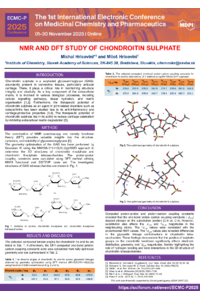
Chondroitin sulphate is a sulphated glycosaminoglycan (GAG), abundantly present in connective tissues, particularly articular cartilage. There, it plays a critical role in maintaining structural integrity and elasticity. As a key component of the extracellular matrix, it is involved in various biological processes, including cellular signalling pathways, tissue hydration, and matrix organisation [1,2]. Furthermore, the therapeutic potential of chondroitin sulphate as an agent in joint-related disorders such as osteoarthritis has been studied due to its anti-inflammatory and cartilage-protective properties [3,4]. The therapeutic potential of chondroitin sulphate lies in its ability to reduce cartilage catabolism by inhibiting extracellular matrix degradation [5].
The combination of NMR spectroscopy and density functional theory (DFT) provides valuable insights into the structure, dynamics, and solubility of glycosaminoglycans [6]. In this study, DFT calculations were performed using the MN15/6-311++G(2d,2p)//SMD approach to determine the 3D structures of chondroitin 6-sulphate and chondroitin 4-sulphate tetrasaccharides. Computed proton–proton and proton–carbon coupling constants revealed that the one-bond proton–carbon coupling constants (1JC-H) depend strongly on the substitution position (C-6 vs. C-4). However, substitution also affects the 1JC-H and 3JC-H magnitudes in the neighbouring atoms. The 1JC-H values were consistent with the experimental NMR values. The 3JC-H values also revealed differences in the glycosidic linkages in chondroitin tetrasaccharides. These findings demonstrate that the position of sulphate groups on the chondroitin backbone significantly affects electronic distribution, geometry, and nJC-H magnitudes, thereby highlighting the role of hydrogen bonding and ionic interactions in the 3D structure of chondroitin tetrasaccharides.
This work was financially supported by Slovak grant agency VEGA 2/0071/22.
- Mizumoto S., Yamada S., Sugahara K. Opin. Struct. Biol. 34 (2015) 35–42.
- Schwartz N., Domowicz M. S. Cell Dev. Biol. 10 (2022) 745372.
- Wildi L. et al. Rheum. Dis. 70 (2011) 982–989.
- Shen Q. et al.: Molecules 28 (2023) 7093–7126.
- Ma Y. et al. Orthoped. Surg. Res. 20 (2025) 11–23.
- Perez S. et al.: JACS Au. 3 (2023) 628–656.
Keywords
Glycosaminoglycans
Chondroitin sulphate
NMR
DFT
Poster
Hricovini_poster_ECMCP_2025_final.pdf
Anti-Elastase and Anti-Tyrosinase Activities of Cistus salviifolius and Cistus laurifolius Leaf Extracts: Potential Natural Agents for Skin Regeneration and Depigmentation.
Antimycobacterial and Anti-Inflammatory Potential of the Antarctic Alga Desmarestia anceps: Identification of Potential Leads