Event submissions
EventsThe 1st International Electronic Conference on Medicinal Chemistry and Pharmaceutics
Published
This submission belongs to the session S5. Natural Products and Biopharmaceuticals of the event The 1st International Electronic Conference on Medicinal Chemistry and Pharmaceutics
Published date
29 Oct, 2025
Academic Editor
'%3e%3cpath%20d='M12.6657%2010.9104C12.4185%2010.325%2012.0599%209.79327%2011.6097%209.34482C11.1609%208.89508%2010.6293%208.5365%2010.0442%208.28888C10.0389%208.28626%2010.0337%208.28495%2010.0285%208.28233C10.8446%207.69279%2011.3752%206.73249%2011.3752%205.64904C11.3752%203.8542%209.92103%202.39999%208.1262%202.39999C6.33136%202.39999%204.87715%203.8542%204.87715%205.64904C4.87715%206.73249%205.40774%207.69279%206.22393%208.28364C6.21869%208.28626%206.21345%208.28757%206.20821%208.29019C5.62129%208.5378%205.09463%208.89284%204.64265%209.34613C4.1929%209.79493%203.83432%2010.3266%203.58671%2010.9117C3.34345%2011.4845%203.21226%2012.0987%203.20023%2012.7209C3.19988%2012.7349%203.20233%2012.7488%203.20744%2012.7619C3.21255%2012.7749%203.22022%2012.7867%203.22998%2012.7968C3.23975%2012.8068%203.25142%2012.8147%203.26431%2012.8202C3.2772%2012.8256%203.29105%2012.8284%203.30504%2012.8284H4.09109C4.14874%2012.8284%204.19459%2012.7825%204.1959%2012.7262C4.2221%2011.7148%204.62823%2010.7676%205.34617%2010.0497C6.08899%209.30683%207.0755%208.89808%208.1262%208.89808C9.17689%208.89808%2010.1634%209.30683%2010.9062%2010.0497C11.6242%2010.7676%2012.0303%2011.7148%2012.0565%2012.7262C12.0578%2012.7838%2012.1037%2012.8284%2012.1613%2012.8284H12.9474C12.9613%2012.8284%2012.9752%2012.8256%2012.9881%2012.8202C13.001%2012.8147%2013.0126%2012.8068%2013.0224%2012.7968C13.0322%2012.7867%2013.0398%2012.7749%2013.0449%2012.7619C13.0501%2012.7488%2013.0525%2012.7349%2013.0522%2012.7209C13.0391%2012.0947%2012.9094%2011.4855%2012.6657%2010.9104ZM8.1262%207.9024C7.52486%207.9024%206.9589%207.6679%206.53312%207.24211C6.10733%206.81633%205.87283%206.25037%205.87283%205.64904C5.87283%205.0477%206.10733%204.48174%206.53312%204.05596C6.9589%203.63018%207.52486%203.39567%208.1262%203.39567C8.72753%203.39567%209.29349%203.63018%209.71927%204.05596C10.1451%204.48174%2010.3796%205.0477%2010.3796%205.64904C10.3796%206.25037%2010.1451%206.81633%209.71927%207.24211C9.29349%207.6679%208.72753%207.9024%208.1262%207.9024Z'%20fill='%235D1EE1'/%3e%3c/g%3e%3c/svg%3e) Daniela De Vita
Daniela De VitaCitation
DEROUICHE Salima, BABA AHMED Fatima Zohra, Aissaoui Nadia, AISSAOUI Mohamed, MAKHLOUF Mustapha, MOKHTARI Nabila, AGHA Roumaissa, Bioactivity of Pseudevernia furfuracea Extracts: Antioxidant and Antibacterial Assessment, in Proceedings of The 1st International Electronic Conference on Medicinal Chemistry and Pharmaceutics, 1 November–30 November 2025, MDPI: Basel, Switzerland
Share
Email
Facebook
Twitter
LinkedIn
Bioactivity of Pseudevernia furfuracea Extracts: Antioxidant and Antibacterial Assessment
'%3e%3cpath%20d='M12.6647%2010.9104C12.4176%2010.325%2012.0589%209.7933%2011.6088%209.34485C11.16%208.89511%2010.6283%208.53653%2010.0432%208.28891C10.038%208.28629%2010.0327%208.28498%2010.0275%208.28236C10.8437%207.69282%2011.3743%206.73252%2011.3743%205.64907C11.3743%203.85423%209.92005%202.40002%208.12522%202.40002C6.33038%202.40002%204.87618%203.85423%204.87618%205.64907C4.87618%206.73252%205.40677%207.69282%206.22296%208.28367C6.21772%208.28629%206.21248%208.2876%206.20724%208.29022C5.62031%208.53783%205.09365%208.89287%204.64167%209.34616C4.19192%209.79496%203.83334%2010.3266%203.58573%2010.9117C3.34247%2011.4846%203.21128%2012.0987%203.19925%2012.721C3.1989%2012.735%203.20135%2012.7489%203.20646%2012.7619C3.21157%2012.7749%203.21924%2012.7868%203.22901%2012.7968C3.23877%2012.8068%203.25045%2012.8148%203.26334%2012.8202C3.27623%2012.8256%203.29007%2012.8284%203.30406%2012.8284H4.09012C4.14776%2012.8284%204.19362%2012.7825%204.19493%2012.7262C4.22113%2011.7148%204.62726%2010.7676%205.34519%2010.0497C6.08802%209.30686%207.07452%208.89811%208.12522%208.89811C9.17592%208.89811%2010.1624%209.30686%2010.9052%2010.0497C11.6232%2010.7676%2012.0293%2011.7148%2012.0555%2012.7262C12.0568%2012.7839%2012.1027%2012.8284%2012.1603%2012.8284H12.9464C12.9604%2012.8284%2012.9742%2012.8256%2012.9871%2012.8202C13%2012.8148%2013.0117%2012.8068%2013.0214%2012.7968C13.0312%2012.7868%2013.0389%2012.7749%2013.044%2012.7619C13.0491%2012.7489%2013.0515%2012.735%2013.0512%2012.721C13.0381%2012.0947%2012.9084%2011.4856%2012.6647%2010.9104ZM8.12522%207.90243C7.52388%207.90243%206.95792%207.66793%206.53214%207.24215C6.10636%206.81636%205.87185%206.2504%205.87185%205.64907C5.87185%205.04773%206.10636%204.48177%206.53214%204.05599C6.95792%203.63021%207.52388%203.3957%208.12522%203.3957C8.72655%203.3957%209.29252%203.63021%209.7183%204.05599C10.1441%204.48177%2010.3786%205.04773%2010.3786%205.64907C10.3786%206.2504%2010.1441%206.81636%209.7183%207.24215C9.29252%207.66793%208.72655%207.90243%208.12522%207.90243Z'%20fill='%235D1EE1'/%3e%3c/g%3e%3c/svg%3e)
DEROUICHE Salima 1,2
BABA AHMED Fatima Zohra 1
Aissaoui Nadia 3
AISSAOUI Mohamed 4
MAKHLOUF Mustapha 5
MOKHTARI Nabila 5
AGHA Roumaissa 5
1. Department of Biology, Faculty of Sciences of Nature and Life, Earth Sciences and Universe , University of Tlemcen
Laboratory Physiology, Pathophysiology and Biochemistry of Nutrition PPABIONUT, Tlemcen, Algeria
2. Laboratory for the sustainable management of natural resources in arid and semi-arid areas, Institute of Science, Salhi-Ahmed university center, Naâma, Algeria
3. Laboratory of Sustainable Management of Natural Resources in Arid and Semi-Arid Zones, Salhi-Ahmed University Center, P B 66, Naâma 45000, Algeria
4. Laboratory Antibiotics Antifungals: physico-chemistry, synthesis and biological activity, Department of Biology, Faculty of Sciences of Nature and Life, Earth Sciences and Universe, University of Tlemcen, Tlemcen, Algeria
5. Institute of Science, Salhi-Ahmed university center, PB 66, 45000 Naâma, Algeria
Abstract
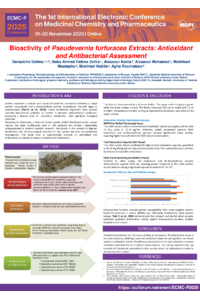
Lichens represent a promising source of novel molecules with diverse biological activities. This study aims to evaluate the antioxidant and antibacterial properties of extracts from the lichen Pseudevernia furfuracea to assess its potential for valorization in the pharmaceutical and food industries. Following a preliminary morphological characterization of the thallus, extraction was performed via maceration using three solvents: methanol, ethyl acetate, and dichloromethane. Antioxidant activity was quantified through three distinct methods (DPPH, CAT, and FRAP assays), while antibacterial efficacy was tested against four ATCC-referenced bacterial strains (Enterobacter cloacae ATCC 13047; Klebsiella pneumoniae ATCC 700603; Staphylococcus aureus ATCC 25923 and Staphylococcus aureus ATCC 43300 ) using the agar diffusion technique. The results demonstrated significant antioxidant activity of the ethyl acetate extract (IC50=71,72 µg/ml of DPPH assay and 66,66 mg EAA/g extract of cat assay), whereas the methanolic and dichloromethane extracts exhibited moderate activity. The results of the antibacterial activity assessment revealed that all tested strains exhibited susceptibility to the extracts. Notably, the ethyl acetate extract was found to be the most effective, demonstrating significantly greater efficacy than the other solvents used. The pronounced efficacy of the ethyl acetate extract is attributed to its richness in bioactive secondary metabolites, underscoring its potential for applications in medicinal and cosmetic formulations.
Keywords
Antioxidant activity
Antibacterial activity
CAT
DPPH
FRAP
Pseudevernia furfuracea
Poster
DEROUICHE SALIMA MDPI.pdf
Assessment of Hepato-Protective Potential of a Sinapic Acid on Animal Model of Alcohol Induced Hepatotoxicity
Antibacterial potential of Emblica officinalis endophytes against multidrug-resistant avian pathogenic Escherichia coli (APEC)