Event submissions
EventsThe 1st International Electronic Conference on Medicinal Chemistry and Pharmaceutics
Published
This submission belongs to the session S5. Natural Products and Biopharmaceuticals of the event The 1st International Electronic Conference on Medicinal Chemistry and Pharmaceutics
Published date
29 Oct, 2025
Academic Editor
'%3e%3cpath%20d='M12.6657%2010.9104C12.4185%2010.325%2012.0599%209.79327%2011.6097%209.34482C11.1609%208.89508%2010.6293%208.5365%2010.0442%208.28888C10.0389%208.28626%2010.0337%208.28495%2010.0285%208.28233C10.8446%207.69279%2011.3752%206.73249%2011.3752%205.64904C11.3752%203.8542%209.92103%202.39999%208.1262%202.39999C6.33136%202.39999%204.87715%203.8542%204.87715%205.64904C4.87715%206.73249%205.40774%207.69279%206.22393%208.28364C6.21869%208.28626%206.21345%208.28757%206.20821%208.29019C5.62129%208.5378%205.09463%208.89284%204.64265%209.34613C4.1929%209.79493%203.83432%2010.3266%203.58671%2010.9117C3.34345%2011.4845%203.21226%2012.0987%203.20023%2012.7209C3.19988%2012.7349%203.20233%2012.7488%203.20744%2012.7619C3.21255%2012.7749%203.22022%2012.7867%203.22998%2012.7968C3.23975%2012.8068%203.25142%2012.8147%203.26431%2012.8202C3.2772%2012.8256%203.29105%2012.8284%203.30504%2012.8284H4.09109C4.14874%2012.8284%204.19459%2012.7825%204.1959%2012.7262C4.2221%2011.7148%204.62823%2010.7676%205.34617%2010.0497C6.08899%209.30683%207.0755%208.89808%208.1262%208.89808C9.17689%208.89808%2010.1634%209.30683%2010.9062%2010.0497C11.6242%2010.7676%2012.0303%2011.7148%2012.0565%2012.7262C12.0578%2012.7838%2012.1037%2012.8284%2012.1613%2012.8284H12.9474C12.9613%2012.8284%2012.9752%2012.8256%2012.9881%2012.8202C13.001%2012.8147%2013.0126%2012.8068%2013.0224%2012.7968C13.0322%2012.7867%2013.0398%2012.7749%2013.0449%2012.7619C13.0501%2012.7488%2013.0525%2012.7349%2013.0522%2012.7209C13.0391%2012.0947%2012.9094%2011.4855%2012.6657%2010.9104ZM8.1262%207.9024C7.52486%207.9024%206.9589%207.6679%206.53312%207.24211C6.10733%206.81633%205.87283%206.25037%205.87283%205.64904C5.87283%205.0477%206.10733%204.48174%206.53312%204.05596C6.9589%203.63018%207.52486%203.39567%208.1262%203.39567C8.72753%203.39567%209.29349%203.63018%209.71927%204.05596C10.1451%204.48174%2010.3796%205.0477%2010.3796%205.64904C10.3796%206.25037%2010.1451%206.81633%209.71927%207.24211C9.29349%207.6679%208.72753%207.9024%208.1262%207.9024Z'%20fill='%235D1EE1'/%3e%3c/g%3e%3c/svg%3e) Daniela De Vita
Daniela De VitaCitation
Vitalia Sergeevna Novikova, Olesya Olegovna Klychkova, Dmitry Alexandrovich Kashirskikh, Arthur Anatolievich Lee, Victoria Alexandrovna Khotina, Vagif Ali oglu Gasanov, Engineering a Bacterial Platform for Efficient Expression of Histatin 5: A Promising Candidate for Antimicrobial Therapy, in Proceedings of The 1st International Electronic Conference on Medicinal Chemistry and Pharmaceutics, 1 November–30 November 2025, MDPI: Basel, Switzerland
Share
Email
Facebook
Twitter
LinkedIn
Engineering a Bacterial Platform for Efficient Expression of Histatin 5: A Promising Candidate for Antimicrobial Therapy
'%3e%3cpath%20d='M12.6647%2010.9104C12.4176%2010.325%2012.0589%209.7933%2011.6088%209.34485C11.16%208.89511%2010.6283%208.53653%2010.0432%208.28891C10.038%208.28629%2010.0327%208.28498%2010.0275%208.28236C10.8437%207.69282%2011.3743%206.73252%2011.3743%205.64907C11.3743%203.85423%209.92005%202.40002%208.12522%202.40002C6.33038%202.40002%204.87618%203.85423%204.87618%205.64907C4.87618%206.73252%205.40677%207.69282%206.22296%208.28367C6.21772%208.28629%206.21248%208.2876%206.20724%208.29022C5.62031%208.53783%205.09365%208.89287%204.64167%209.34616C4.19192%209.79496%203.83334%2010.3266%203.58573%2010.9117C3.34247%2011.4846%203.21128%2012.0987%203.19925%2012.721C3.1989%2012.735%203.20135%2012.7489%203.20646%2012.7619C3.21157%2012.7749%203.21924%2012.7868%203.22901%2012.7968C3.23877%2012.8068%203.25045%2012.8148%203.26334%2012.8202C3.27623%2012.8256%203.29007%2012.8284%203.30406%2012.8284H4.09012C4.14776%2012.8284%204.19362%2012.7825%204.19493%2012.7262C4.22113%2011.7148%204.62726%2010.7676%205.34519%2010.0497C6.08802%209.30686%207.07452%208.89811%208.12522%208.89811C9.17592%208.89811%2010.1624%209.30686%2010.9052%2010.0497C11.6232%2010.7676%2012.0293%2011.7148%2012.0555%2012.7262C12.0568%2012.7839%2012.1027%2012.8284%2012.1603%2012.8284H12.9464C12.9604%2012.8284%2012.9742%2012.8256%2012.9871%2012.8202C13%2012.8148%2013.0117%2012.8068%2013.0214%2012.7968C13.0312%2012.7868%2013.0389%2012.7749%2013.044%2012.7619C13.0491%2012.7489%2013.0515%2012.735%2013.0512%2012.721C13.0381%2012.0947%2012.9084%2011.4856%2012.6647%2010.9104ZM8.12522%207.90243C7.52388%207.90243%206.95792%207.66793%206.53214%207.24215C6.10636%206.81636%205.87185%206.2504%205.87185%205.64907C5.87185%205.04773%206.10636%204.48177%206.53214%204.05599C6.95792%203.63021%207.52388%203.3957%208.12522%203.3957C8.72655%203.3957%209.29252%203.63021%209.7183%204.05599C10.1441%204.48177%2010.3786%205.04773%2010.3786%205.64907C10.3786%206.2504%2010.1441%206.81636%209.7183%207.24215C9.29252%207.66793%208.72655%207.90243%208.12522%207.90243Z'%20fill='%235D1EE1'/%3e%3c/g%3e%3c/svg%3e)
Vitalia Sergeevna Novikova 1,2
Olesya Olegovna Klychkova 1
Dmitry Alexandrovich Kashirskikh 1
Arthur Anatolievich Lee 1

Victoria Alexandrovna Khotina 1
Vagif Ali oglu Gasanov 1
1. Koltzov Institute of Developmental Biology of the Russian Academy of Sciences (IDB RAS), Moscow 119334, Russia
2. Institute of Agrobiotechnology, Russian State Agrarian University - Moscow Timiryazev Agricultural Academy, Moscow 127434, Russia
Abstract
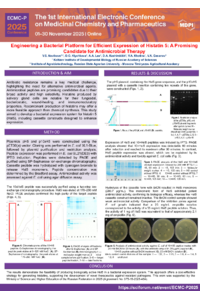
Introduction: Antibiotic resistance remains a key medical challenge, highlighting the need for alternative antimicrobial agents. Antimicrobial peptides are promising candidates due to their broad activity and high selectivity. Histatins produced by salivary gland cells are notable for their fungicidal, bacteriostatic, wound-healing, and immunomodulatory properties. Recombinant production of histatins may offer a more feasible approach than chemical synthesis. This study aimed to develop a bacterial expression system for histatin 5 (Hst5), including cassette constructs designed to enhance expression.
Methods: Plasmids pH5 and p10xH5 were constructed using the pET30(a) vector. Cloning was performed in E. coli XL1-Blue, followed by plasmid purification and restriction analysis. Peptide expression was performed in E. coli BL21(DE3) with IPTG induction. Peptides were detected by PAGE and purified using SP-Sepharose ion-exchange chromatography. Cassette peptide was hydrolyzed with cyanogen bromide to release Hst5 monomers. Peptide concentration was determined by the Bradford assay. Antimicrobial activity was assessed against E. coli using agar diffusion assay.
Results: Both vectors encoding the monomeric and cassette Hst5 were obtained. Optimal induction conditions were established (200 μM IPTG, 90 min), and Hst5 was eluted at 170–290 mM NaCl. Hydrolysis of the cassette form resulted in Hst5 monomers (280.7 μg/mL). The recombinant peptide displayed pronounced antimicrobial activity comparable to ampicillin.
Conclusions: The results demonstrate the feasibility of producing biologically active Hst5 in a bacterial expression system. This approach offers a cost-effective strategy for generating histatins, supporting the development of novel therapeutics against resistant pathogens. This work was supported by the Ministry of Science and Higher Education of the Russian Federation in 2025 (Agreement No. 075-15-2025-464).
Keywords
antimicrobial peptides
histatins
histatin 5
recombinant peptide
Poster
Sciforum_Poster_NovikovaVS.pdf
Antibacterial potential of Emblica officinalis endophytes against multidrug-resistant avian pathogenic Escherichia coli (APEC)
Unraveling the Antidiabetic and Antidepressant Effects of Crude Methanolic Extracts of Clitoria ternetea Flower in Diabetic Mice