Event submissions
EventsThe 1st International Electronic Conference on Medicinal Chemistry and Pharmaceutics
Published
This submission belongs to the session S5. Natural Products and Biopharmaceuticals of the event The 1st International Electronic Conference on Medicinal Chemistry and Pharmaceutics
Published date
29 Oct, 2025
Academic Editor
'%3e%3cpath%20d='M12.6657%2010.9104C12.4185%2010.325%2012.0599%209.79327%2011.6097%209.34482C11.1609%208.89508%2010.6293%208.5365%2010.0442%208.28888C10.0389%208.28626%2010.0337%208.28495%2010.0285%208.28233C10.8446%207.69279%2011.3752%206.73249%2011.3752%205.64904C11.3752%203.8542%209.92103%202.39999%208.1262%202.39999C6.33136%202.39999%204.87715%203.8542%204.87715%205.64904C4.87715%206.73249%205.40774%207.69279%206.22393%208.28364C6.21869%208.28626%206.21345%208.28757%206.20821%208.29019C5.62129%208.5378%205.09463%208.89284%204.64265%209.34613C4.1929%209.79493%203.83432%2010.3266%203.58671%2010.9117C3.34345%2011.4845%203.21226%2012.0987%203.20023%2012.7209C3.19988%2012.7349%203.20233%2012.7488%203.20744%2012.7619C3.21255%2012.7749%203.22022%2012.7867%203.22998%2012.7968C3.23975%2012.8068%203.25142%2012.8147%203.26431%2012.8202C3.2772%2012.8256%203.29105%2012.8284%203.30504%2012.8284H4.09109C4.14874%2012.8284%204.19459%2012.7825%204.1959%2012.7262C4.2221%2011.7148%204.62823%2010.7676%205.34617%2010.0497C6.08899%209.30683%207.0755%208.89808%208.1262%208.89808C9.17689%208.89808%2010.1634%209.30683%2010.9062%2010.0497C11.6242%2010.7676%2012.0303%2011.7148%2012.0565%2012.7262C12.0578%2012.7838%2012.1037%2012.8284%2012.1613%2012.8284H12.9474C12.9613%2012.8284%2012.9752%2012.8256%2012.9881%2012.8202C13.001%2012.8147%2013.0126%2012.8068%2013.0224%2012.7968C13.0322%2012.7867%2013.0398%2012.7749%2013.0449%2012.7619C13.0501%2012.7488%2013.0525%2012.7349%2013.0522%2012.7209C13.0391%2012.0947%2012.9094%2011.4855%2012.6657%2010.9104ZM8.1262%207.9024C7.52486%207.9024%206.9589%207.6679%206.53312%207.24211C6.10733%206.81633%205.87283%206.25037%205.87283%205.64904C5.87283%205.0477%206.10733%204.48174%206.53312%204.05596C6.9589%203.63018%207.52486%203.39567%208.1262%203.39567C8.72753%203.39567%209.29349%203.63018%209.71927%204.05596C10.1451%204.48174%2010.3796%205.0477%2010.3796%205.64904C10.3796%206.25037%2010.1451%206.81633%209.71927%207.24211C9.29349%207.6679%208.72753%207.9024%208.1262%207.9024Z'%20fill='%235D1EE1'/%3e%3c/g%3e%3c/svg%3e) Ilkay Erdogan Orhan
Ilkay Erdogan OrhanCitation
Adel Esmail, Mahmoud Samy, Tarek Mohamed, Mona Alsherbeny, Tarek Salah, Sara Helmy, Abdelrahman Mohamed, Nouran Hesham, sara selim, Mary Albair Sedrak, Anti-Inflammatory Potential of Albizia lebbeck: In Vivo Evidence and Scientometric Analysis, in Proceedings of The 1st International Electronic Conference on Medicinal Chemistry and Pharmaceutics, 1 November–30 November 2025, MDPI: Basel, Switzerland
Share
Email
Facebook
Twitter
LinkedIn
Anti-Inflammatory Potential of Albizia lebbeck: In Vivo Evidence and Scientometric Analysis
'%3e%3cpath%20d='M12.6647%2010.9104C12.4176%2010.325%2012.0589%209.7933%2011.6088%209.34485C11.16%208.89511%2010.6283%208.53653%2010.0432%208.28891C10.038%208.28629%2010.0327%208.28498%2010.0275%208.28236C10.8437%207.69282%2011.3743%206.73252%2011.3743%205.64907C11.3743%203.85423%209.92005%202.40002%208.12522%202.40002C6.33038%202.40002%204.87618%203.85423%204.87618%205.64907C4.87618%206.73252%205.40677%207.69282%206.22296%208.28367C6.21772%208.28629%206.21248%208.2876%206.20724%208.29022C5.62031%208.53783%205.09365%208.89287%204.64167%209.34616C4.19192%209.79496%203.83334%2010.3266%203.58573%2010.9117C3.34247%2011.4846%203.21128%2012.0987%203.19925%2012.721C3.1989%2012.735%203.20135%2012.7489%203.20646%2012.7619C3.21157%2012.7749%203.21924%2012.7868%203.22901%2012.7968C3.23877%2012.8068%203.25045%2012.8148%203.26334%2012.8202C3.27623%2012.8256%203.29007%2012.8284%203.30406%2012.8284H4.09012C4.14776%2012.8284%204.19362%2012.7825%204.19493%2012.7262C4.22113%2011.7148%204.62726%2010.7676%205.34519%2010.0497C6.08802%209.30686%207.07452%208.89811%208.12522%208.89811C9.17592%208.89811%2010.1624%209.30686%2010.9052%2010.0497C11.6232%2010.7676%2012.0293%2011.7148%2012.0555%2012.7262C12.0568%2012.7839%2012.1027%2012.8284%2012.1603%2012.8284H12.9464C12.9604%2012.8284%2012.9742%2012.8256%2012.9871%2012.8202C13%2012.8148%2013.0117%2012.8068%2013.0214%2012.7968C13.0312%2012.7868%2013.0389%2012.7749%2013.044%2012.7619C13.0491%2012.7489%2013.0515%2012.735%2013.0512%2012.721C13.0381%2012.0947%2012.9084%2011.4856%2012.6647%2010.9104ZM8.12522%207.90243C7.52388%207.90243%206.95792%207.66793%206.53214%207.24215C6.10636%206.81636%205.87185%206.2504%205.87185%205.64907C5.87185%205.04773%206.10636%204.48177%206.53214%204.05599C6.95792%203.63021%207.52388%203.3957%208.12522%203.3957C8.72655%203.3957%209.29252%203.63021%209.7183%204.05599C10.1441%204.48177%2010.3786%205.04773%2010.3786%205.64907C10.3786%206.2504%2010.1441%206.81636%209.7183%207.24215C9.29252%207.66793%208.72655%207.90243%208.12522%207.90243Z'%20fill='%235D1EE1'/%3e%3c/g%3e%3c/svg%3e)
Adel Esmail 1
Mahmoud Samy 2
Tarek Mohamed 3
Mona Alsherbeny 4
Tarek Salah 2
Sara Helmy 2
Abdelrahman Mohamed 2
Nouran Hesham 4
sara selim 2
Mary Albair Sedrak 2
1. School of Science and Engineering, The American University in Cairo, New Cairo, Cairo, 11835, Egypt
2. Faculty of Pharmacy, Cairo University, Cairo, 11562, Egypt
3. Faculty of Pharmacy, Future University in Egypt, Cairo, 11835, Egypt
4. Faculty of Pharmacy, AinShams University, Cairo, 11566, Egypt
Abstract
A
Introduction: Albizia lebbeck is widely used in traditional Indian folk medicine to treat several inflammatory pathologies, such as asthma and arthritis. Objectives and Methods: The present study aims to scientifically investigate A. lebbeck claimed anti-inflammatory effect using the rat paw edema model. Additionally, a co-occurrence analysis of the available literature from Scopus, Dimensions, PubMed, and lens.com databases was conducted using network and overlay visualization (VOS viewer) to present a detailed bibliometric and scientometric analysis concerning its potent anti-inflammatory potential and to explore the existing knowledge gaps and the required future research directions. Results: The in vivo results revealed that A. lebbeck (100 mg/kg) reduced significantly the edema volume by 37.27% and 31.43% compared to the carrageenan/diclofenac group (35.90% and 51.79%) after 1 and 3 hrs of carrageenan injection, respectively. This observed anti-inflammatory potential represents 103.8% (1 hr) and 60.7% (3 hrs) of diclofenac sodium efficacy. Luteolin and kaempferol were detected in the extract under investigation and they contribute to the proven anti-inflammatory potential. Networking analysis revealed that the Journal of Ethnopharmacology is the most productive publisher concerning A. lebbeck anti-inflammatory potential. The publication volume showed steady growth, increasing from 65 documents in 2015 to 182 in 2025, with notable peaks observed in 2021 and 2024. Over half of these publications were original research articles, with Biomedical and clinical sciences being the leading subject area. Terms such as terpenoids, flavonoids, saponins, and tannins are common search terms exhibited strong associations with A. lebbeck anti-inflammatory properties. Conclusions: This study scientifically supports the traditional anti-inflammatory use of A. lebbeck and recommends further mechanistic studies on its isolated phytochemicals to link this potent activity with the bioactive compounds. Detailed clinical studies are urgently needed to confirm its efficacy and therapeutic potential.
Keywords
Albizia
inflammation
bioassay
scientometric.
Poster
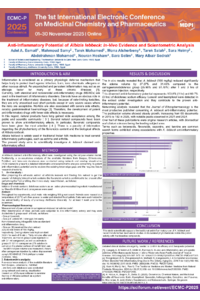
Anti-Inflammatory Potential of Albizia lebbeck In Vivo Evidence and Scientometric Analysis Poster.pdf
Grape Antioxidant Dietary Fibre Modulates Apoptosis-Autophagy Balance via Bcl-2/Beclin-1 Axis in Healthy Colon
Identification of Cyclocurcumin and Curcumin Analogues as Potential MMP13 Inhibitors: Network Pharmacology and Computational Study