Event submissions
EventsThe 1st International Electronic Conference on Medicinal Chemistry and Pharmaceutics
Published
This submission belongs to the session S5. Natural Products and Biopharmaceuticals of the event The 1st International Electronic Conference on Medicinal Chemistry and Pharmaceutics
Published date
29 Oct, 2025
Academic Editor
'%3e%3cpath%20d='M12.6657%2010.9104C12.4185%2010.325%2012.0599%209.79327%2011.6097%209.34482C11.1609%208.89508%2010.6293%208.5365%2010.0442%208.28888C10.0389%208.28626%2010.0337%208.28495%2010.0285%208.28233C10.8446%207.69279%2011.3752%206.73249%2011.3752%205.64904C11.3752%203.8542%209.92103%202.39999%208.1262%202.39999C6.33136%202.39999%204.87715%203.8542%204.87715%205.64904C4.87715%206.73249%205.40774%207.69279%206.22393%208.28364C6.21869%208.28626%206.21345%208.28757%206.20821%208.29019C5.62129%208.5378%205.09463%208.89284%204.64265%209.34613C4.1929%209.79493%203.83432%2010.3266%203.58671%2010.9117C3.34345%2011.4845%203.21226%2012.0987%203.20023%2012.7209C3.19988%2012.7349%203.20233%2012.7488%203.20744%2012.7619C3.21255%2012.7749%203.22022%2012.7867%203.22998%2012.7968C3.23975%2012.8068%203.25142%2012.8147%203.26431%2012.8202C3.2772%2012.8256%203.29105%2012.8284%203.30504%2012.8284H4.09109C4.14874%2012.8284%204.19459%2012.7825%204.1959%2012.7262C4.2221%2011.7148%204.62823%2010.7676%205.34617%2010.0497C6.08899%209.30683%207.0755%208.89808%208.1262%208.89808C9.17689%208.89808%2010.1634%209.30683%2010.9062%2010.0497C11.6242%2010.7676%2012.0303%2011.7148%2012.0565%2012.7262C12.0578%2012.7838%2012.1037%2012.8284%2012.1613%2012.8284H12.9474C12.9613%2012.8284%2012.9752%2012.8256%2012.9881%2012.8202C13.001%2012.8147%2013.0126%2012.8068%2013.0224%2012.7968C13.0322%2012.7867%2013.0398%2012.7749%2013.0449%2012.7619C13.0501%2012.7488%2013.0525%2012.7349%2013.0522%2012.7209C13.0391%2012.0947%2012.9094%2011.4855%2012.6657%2010.9104ZM8.1262%207.9024C7.52486%207.9024%206.9589%207.6679%206.53312%207.24211C6.10733%206.81633%205.87283%206.25037%205.87283%205.64904C5.87283%205.0477%206.10733%204.48174%206.53312%204.05596C6.9589%203.63018%207.52486%203.39567%208.1262%203.39567C8.72753%203.39567%209.29349%203.63018%209.71927%204.05596C10.1451%204.48174%2010.3796%205.0477%2010.3796%205.64904C10.3796%206.25037%2010.1451%206.81633%209.71927%207.24211C9.29349%207.6679%208.72753%207.9024%208.1262%207.9024Z'%20fill='%235D1EE1'/%3e%3c/g%3e%3c/svg%3e) Maria Camilla Bergonzi
Maria Camilla BergonziCitation
Angella Milagritos Cordova-Muñoz, Víctor Eduardo Villarreal-LaTorre, Cristhian Neil Rodriguez-Silva, César Demófilo Gamarra-Sanchez, Jesus Antonio Alvarado-Huayhuaz, In silico prediction of the antagonistic activity of natural compounds on neuropeptide S receptor 1 in endometriosis, in Proceedings of The 1st International Electronic Conference on Medicinal Chemistry and Pharmaceutics, 1 November–30 November 2025, MDPI: Basel, Switzerland
Share
Email
Facebook
Twitter
LinkedIn
In silico prediction of the antagonistic activity of natural compounds on neuropeptide S receptor 1 in endometriosis
'%3e%3cpath%20d='M12.6647%2010.9104C12.4176%2010.325%2012.0589%209.7933%2011.6088%209.34485C11.16%208.89511%2010.6283%208.53653%2010.0432%208.28891C10.038%208.28629%2010.0327%208.28498%2010.0275%208.28236C10.8437%207.69282%2011.3743%206.73252%2011.3743%205.64907C11.3743%203.85423%209.92005%202.40002%208.12522%202.40002C6.33038%202.40002%204.87618%203.85423%204.87618%205.64907C4.87618%206.73252%205.40677%207.69282%206.22296%208.28367C6.21772%208.28629%206.21248%208.2876%206.20724%208.29022C5.62031%208.53783%205.09365%208.89287%204.64167%209.34616C4.19192%209.79496%203.83334%2010.3266%203.58573%2010.9117C3.34247%2011.4846%203.21128%2012.0987%203.19925%2012.721C3.1989%2012.735%203.20135%2012.7489%203.20646%2012.7619C3.21157%2012.7749%203.21924%2012.7868%203.22901%2012.7968C3.23877%2012.8068%203.25045%2012.8148%203.26334%2012.8202C3.27623%2012.8256%203.29007%2012.8284%203.30406%2012.8284H4.09012C4.14776%2012.8284%204.19362%2012.7825%204.19493%2012.7262C4.22113%2011.7148%204.62726%2010.7676%205.34519%2010.0497C6.08802%209.30686%207.07452%208.89811%208.12522%208.89811C9.17592%208.89811%2010.1624%209.30686%2010.9052%2010.0497C11.6232%2010.7676%2012.0293%2011.7148%2012.0555%2012.7262C12.0568%2012.7839%2012.1027%2012.8284%2012.1603%2012.8284H12.9464C12.9604%2012.8284%2012.9742%2012.8256%2012.9871%2012.8202C13%2012.8148%2013.0117%2012.8068%2013.0214%2012.7968C13.0312%2012.7868%2013.0389%2012.7749%2013.044%2012.7619C13.0491%2012.7489%2013.0515%2012.735%2013.0512%2012.721C13.0381%2012.0947%2012.9084%2011.4856%2012.6647%2010.9104ZM8.12522%207.90243C7.52388%207.90243%206.95792%207.66793%206.53214%207.24215C6.10636%206.81636%205.87185%206.2504%205.87185%205.64907C5.87185%205.04773%206.10636%204.48177%206.53214%204.05599C6.95792%203.63021%207.52388%203.3957%208.12522%203.3957C8.72655%203.3957%209.29252%203.63021%209.7183%204.05599C10.1441%204.48177%2010.3786%205.04773%2010.3786%205.64907C10.3786%206.2504%2010.1441%206.81636%209.7183%207.24215C9.29252%207.66793%208.72655%207.90243%208.12522%207.90243Z'%20fill='%235D1EE1'/%3e%3c/g%3e%3c/svg%3e)
Angella Milagritos Cordova-Muñoz 1

Víctor Eduardo Villarreal-LaTorre 1
Cristhian Neil Rodriguez-Silva 1
César Demófilo Gamarra-Sanchez 2
Jesus Antonio Alvarado-Huayhuaz 3
1. Bioinformatic and Cheminformatics Group, Pharmacology Department, Faculty of Pharmacy and Biochemistry, National University of Trujillo, Trujillo 13011, Peru
2. Laboratory of Medicinal Chemistry, Pharmacology Department, Faculty of Pharmacy and Biochemistry, National University of Trujillo, Trujillo 13011, Peru
3. Laboratory of Research in Biopolymers and Metallopharmaceuticals (LIBIPMET), Faculty of Sciences, National University of Engineering, Lima 150128, Peru.
Abstract
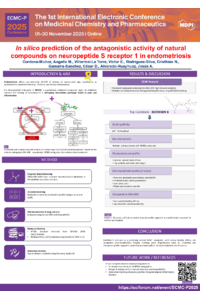
Endometriosis, an emerging disease affecting approximately 25% of women of reproductive age, presents a complex clinical profile, primarily characterized by dysmenorrhea, bleeding, infertility, and chronic inflammation. Currently, the Neuropeptide S Receptor 1 (NPSR1) is the genetically validated therapeutic target for the treatment of endometriosis, as its blockade prevents the binding of its endogenous ligand (neuropeptide S), thereby inactivating intracellular metabolic pathways related to pain and inflammation mechanisms. Natural compounds have served as structural models for the development of new drugs. Based on the mechanism of its selective antagonist SHA-68R, the structural fragment “CNC(=O)N” was searched across various natural product databases, selecting 54 molecules. These were subsequently analyzed through 2D-QSAR of their molecular descriptors to predict antagonist activity (pKB). Their physicochemical and pharmacokinetic properties were evaluated in silico using SwissADME and Deep-pkCSM, along with their interactions with the NPSR1 receptor (retrieved in PDB format from the GPCR database using the code npsr1_human). To predict binding affinity energy (ΔG°), VINA 1.1.2 was used, and the molecules with the best parameters were visualized using the 2D tool in Discovery Studio. Rotihibin B exhibited optimal binding affinity (-8.7 kcal/mol), likely due to the formation of multiple hydrogen bonds. Its physicochemical profile exceeds Lipinski’s parameters, with a suitable pharmacokinetic profile compared to the antagonist SHA-68R. This research proposes this metabolite as a starting molecule for the design of more potent compounds for the treatment of this disease, thereby improving the quality of life for those affected.
Keywords
Endometriosis
Quantitative Structure-Activity Relationship (QSAR)
Molecular Modeling
Chemoinformatics
Poster
In silico prediction of the antagonistic activity of natural compounds on neuropeptide S receptor 1 in endometriosis.pdf
Identification of Cyclocurcumin and Curcumin Analogues as Potential MMP13 Inhibitors: Network Pharmacology and Computational Study
Essential oils and the post COVID-19 mental health crisis: literature analysis based on VOSviewer