Event submissions
EventsThe 1st International Electronic Conference on Medicinal Chemistry and Pharmaceutics
Published
This submission belongs to the session S5. Natural Products and Biopharmaceuticals of the event The 1st International Electronic Conference on Medicinal Chemistry and Pharmaceutics
Published date
29 Oct, 2025
Academic Editor
'%3e%3cpath%20d='M12.6657%2010.9104C12.4185%2010.325%2012.0599%209.79327%2011.6097%209.34482C11.1609%208.89508%2010.6293%208.5365%2010.0442%208.28888C10.0389%208.28626%2010.0337%208.28495%2010.0285%208.28233C10.8446%207.69279%2011.3752%206.73249%2011.3752%205.64904C11.3752%203.8542%209.92103%202.39999%208.1262%202.39999C6.33136%202.39999%204.87715%203.8542%204.87715%205.64904C4.87715%206.73249%205.40774%207.69279%206.22393%208.28364C6.21869%208.28626%206.21345%208.28757%206.20821%208.29019C5.62129%208.5378%205.09463%208.89284%204.64265%209.34613C4.1929%209.79493%203.83432%2010.3266%203.58671%2010.9117C3.34345%2011.4845%203.21226%2012.0987%203.20023%2012.7209C3.19988%2012.7349%203.20233%2012.7488%203.20744%2012.7619C3.21255%2012.7749%203.22022%2012.7867%203.22998%2012.7968C3.23975%2012.8068%203.25142%2012.8147%203.26431%2012.8202C3.2772%2012.8256%203.29105%2012.8284%203.30504%2012.8284H4.09109C4.14874%2012.8284%204.19459%2012.7825%204.1959%2012.7262C4.2221%2011.7148%204.62823%2010.7676%205.34617%2010.0497C6.08899%209.30683%207.0755%208.89808%208.1262%208.89808C9.17689%208.89808%2010.1634%209.30683%2010.9062%2010.0497C11.6242%2010.7676%2012.0303%2011.7148%2012.0565%2012.7262C12.0578%2012.7838%2012.1037%2012.8284%2012.1613%2012.8284H12.9474C12.9613%2012.8284%2012.9752%2012.8256%2012.9881%2012.8202C13.001%2012.8147%2013.0126%2012.8068%2013.0224%2012.7968C13.0322%2012.7867%2013.0398%2012.7749%2013.0449%2012.7619C13.0501%2012.7488%2013.0525%2012.7349%2013.0522%2012.7209C13.0391%2012.0947%2012.9094%2011.4855%2012.6657%2010.9104ZM8.1262%207.9024C7.52486%207.9024%206.9589%207.6679%206.53312%207.24211C6.10733%206.81633%205.87283%206.25037%205.87283%205.64904C5.87283%205.0477%206.10733%204.48174%206.53312%204.05596C6.9589%203.63018%207.52486%203.39567%208.1262%203.39567C8.72753%203.39567%209.29349%203.63018%209.71927%204.05596C10.1451%204.48174%2010.3796%205.0477%2010.3796%205.64904C10.3796%206.25037%2010.1451%206.81633%209.71927%207.24211C9.29349%207.6679%208.72753%207.9024%208.1262%207.9024Z'%20fill='%235D1EE1'/%3e%3c/g%3e%3c/svg%3e) Gill Diamond
Gill DiamondCitation
Ahmad Kassem El Zein, Raul Edison Luna Lazo, Bernardo Mussa, Kevin Alves Antunes, Jane Manfron, Luana Mota Ferreira, Roberto Pontarolo, CHEMOMETRIC MULTIVARIATE ANALYSIS FOR SPECIES CLASSIFICATION IN THE GENUS BACCHARIS (ASTERACEAE), in Proceedings of The 1st International Electronic Conference on Medicinal Chemistry and Pharmaceutics, 1 November–30 November 2025, MDPI: Basel, Switzerland
Share
Email
Facebook
Twitter
LinkedIn
CHEMOMETRIC MULTIVARIATE ANALYSIS FOR SPECIES CLASSIFICATION IN THE GENUS BACCHARIS (ASTERACEAE)
'%3e%3cpath%20d='M12.6647%2010.9104C12.4176%2010.325%2012.0589%209.7933%2011.6088%209.34485C11.16%208.89511%2010.6283%208.53653%2010.0432%208.28891C10.038%208.28629%2010.0327%208.28498%2010.0275%208.28236C10.8437%207.69282%2011.3743%206.73252%2011.3743%205.64907C11.3743%203.85423%209.92005%202.40002%208.12522%202.40002C6.33038%202.40002%204.87618%203.85423%204.87618%205.64907C4.87618%206.73252%205.40677%207.69282%206.22296%208.28367C6.21772%208.28629%206.21248%208.2876%206.20724%208.29022C5.62031%208.53783%205.09365%208.89287%204.64167%209.34616C4.19192%209.79496%203.83334%2010.3266%203.58573%2010.9117C3.34247%2011.4846%203.21128%2012.0987%203.19925%2012.721C3.1989%2012.735%203.20135%2012.7489%203.20646%2012.7619C3.21157%2012.7749%203.21924%2012.7868%203.22901%2012.7968C3.23877%2012.8068%203.25045%2012.8148%203.26334%2012.8202C3.27623%2012.8256%203.29007%2012.8284%203.30406%2012.8284H4.09012C4.14776%2012.8284%204.19362%2012.7825%204.19493%2012.7262C4.22113%2011.7148%204.62726%2010.7676%205.34519%2010.0497C6.08802%209.30686%207.07452%208.89811%208.12522%208.89811C9.17592%208.89811%2010.1624%209.30686%2010.9052%2010.0497C11.6232%2010.7676%2012.0293%2011.7148%2012.0555%2012.7262C12.0568%2012.7839%2012.1027%2012.8284%2012.1603%2012.8284H12.9464C12.9604%2012.8284%2012.9742%2012.8256%2012.9871%2012.8202C13%2012.8148%2013.0117%2012.8068%2013.0214%2012.7968C13.0312%2012.7868%2013.0389%2012.7749%2013.044%2012.7619C13.0491%2012.7489%2013.0515%2012.735%2013.0512%2012.721C13.0381%2012.0947%2012.9084%2011.4856%2012.6647%2010.9104ZM8.12522%207.90243C7.52388%207.90243%206.95792%207.66793%206.53214%207.24215C6.10636%206.81636%205.87185%206.2504%205.87185%205.64907C5.87185%205.04773%206.10636%204.48177%206.53214%204.05599C6.95792%203.63021%207.52388%203.3957%208.12522%203.3957C8.72655%203.3957%209.29252%203.63021%209.7183%204.05599C10.1441%204.48177%2010.3786%205.04773%2010.3786%205.64907C10.3786%206.2504%2010.1441%206.81636%209.7183%207.24215C9.29252%207.66793%208.72655%207.90243%208.12522%207.90243Z'%20fill='%235D1EE1'/%3e%3c/g%3e%3c/svg%3e)
Ahmad Kassem El Zein 1

Raul Edison Luna Lazo 1
Bernardo Mussa 1

Kevin Alves Antunes 2
Jane Manfron 2

Luana Mota Ferreira 1
Roberto Pontarolo 1
1. Department of Pharmacy, Federal University of Paraná, Curitiba, 80210-170, Paraná, Brazil
2. State University of Ponta Grossa, Ponta Grossa, 84010-790, Paraná, Brazil
Abstract
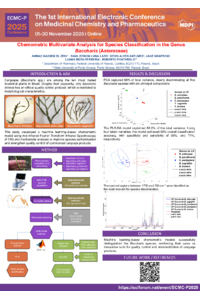
Within the genus Baccharis (Asteraceae), about 50 species collectively known as “Carquejas” are notable for their high content of essential oils and their widespread use in Brazilian folk medicine, particularly for their digestive, anti-inflammatory, and hepatoprotective properties. Despite this extensive use, only Baccharis trimera (Less.) DC. currently has an officially established quality control protocol in Brazil. This protocol, however, relies exclusively on morphological analysis, a restricted approach that is insufficient to ensure the rigorous quality standards required for commercially available products, such as capsules, extracts, and sachets. This study aimed to develop a chemometric exploratory and classification model using the MATLAB toolbox (version R2025a) to analyze hydroalcoholic extracts from five Carqueja species (B. trimera; B. articulata (Lam.) Pers.; B. sagittalis (Less.) DC; B. junciformis DC.; B. pentaptera (Less.) DC.). The dataset comprised 250 mid-infrared Fourier Transform spectroscopy spectra (4000–400 cm⁻¹), with 50 spectra per species. Principal Component Analysis (PCA) and Partial Least Squares - Discriminant Analysis (PLS-DA) were employed to construct the exploratory and classification models, respectively. PCA explained 98,0% of the total variance, allowing clear separation of the five Baccharis species using six principal components. The model with PLS-DA algorithm was built using the same dataset and evaluated through 10-fold Venetian Blinds cross-validation. It achieved a total explained variance of 88,9%, with an overall classification accuracy across classes of 90,0%, and specificity and sensitivity values of 90,0% and 71,0%, respectively, using four latent variables. The most relevant spectral regions contributing to the discrimination were located between 1750 cm⁻¹ and 750 cm⁻¹. Both models, the exploratory and the classification approaches, proved effective in evaluating and highlighting the differences among the Baccharis species, confirming the potential of chemometric tools as an innovative strategy for the quality control and regulatory monitoring of Carqueja-based products.
Keywords
Baccharis trimera
Multivariate Chemometric analysis
Plant classification
Poster
E-POSTER ECMC.pdf
Mansonone G as a Natural Neuroprotective Compound in a Zebrafish Model of Alzheimer’s Disease
Integrative Transcriptomics and In Silico Screening Identify Withaferin A as a Potential PSMB7 Inhibitor in Ovarian Cancer