Event submissions
EventsThe 1st International Electronic Conference on Medicinal Chemistry and Pharmaceutics
Published
This submission belongs to the session S5. Natural Products and Biopharmaceuticals of the event The 1st International Electronic Conference on Medicinal Chemistry and Pharmaceutics
Published date
29 Oct, 2025
Academic Editor
'%3e%3cpath%20d='M12.6657%2010.9104C12.4185%2010.325%2012.0599%209.79327%2011.6097%209.34482C11.1609%208.89508%2010.6293%208.5365%2010.0442%208.28888C10.0389%208.28626%2010.0337%208.28495%2010.0285%208.28233C10.8446%207.69279%2011.3752%206.73249%2011.3752%205.64904C11.3752%203.8542%209.92103%202.39999%208.1262%202.39999C6.33136%202.39999%204.87715%203.8542%204.87715%205.64904C4.87715%206.73249%205.40774%207.69279%206.22393%208.28364C6.21869%208.28626%206.21345%208.28757%206.20821%208.29019C5.62129%208.5378%205.09463%208.89284%204.64265%209.34613C4.1929%209.79493%203.83432%2010.3266%203.58671%2010.9117C3.34345%2011.4845%203.21226%2012.0987%203.20023%2012.7209C3.19988%2012.7349%203.20233%2012.7488%203.20744%2012.7619C3.21255%2012.7749%203.22022%2012.7867%203.22998%2012.7968C3.23975%2012.8068%203.25142%2012.8147%203.26431%2012.8202C3.2772%2012.8256%203.29105%2012.8284%203.30504%2012.8284H4.09109C4.14874%2012.8284%204.19459%2012.7825%204.1959%2012.7262C4.2221%2011.7148%204.62823%2010.7676%205.34617%2010.0497C6.08899%209.30683%207.0755%208.89808%208.1262%208.89808C9.17689%208.89808%2010.1634%209.30683%2010.9062%2010.0497C11.6242%2010.7676%2012.0303%2011.7148%2012.0565%2012.7262C12.0578%2012.7838%2012.1037%2012.8284%2012.1613%2012.8284H12.9474C12.9613%2012.8284%2012.9752%2012.8256%2012.9881%2012.8202C13.001%2012.8147%2013.0126%2012.8068%2013.0224%2012.7968C13.0322%2012.7867%2013.0398%2012.7749%2013.0449%2012.7619C13.0501%2012.7488%2013.0525%2012.7349%2013.0522%2012.7209C13.0391%2012.0947%2012.9094%2011.4855%2012.6657%2010.9104ZM8.1262%207.9024C7.52486%207.9024%206.9589%207.6679%206.53312%207.24211C6.10733%206.81633%205.87283%206.25037%205.87283%205.64904C5.87283%205.0477%206.10733%204.48174%206.53312%204.05596C6.9589%203.63018%207.52486%203.39567%208.1262%203.39567C8.72753%203.39567%209.29349%203.63018%209.71927%204.05596C10.1451%204.48174%2010.3796%205.0477%2010.3796%205.64904C10.3796%206.25037%2010.1451%206.81633%209.71927%207.24211C9.29349%207.6679%208.72753%207.9024%208.1262%207.9024Z'%20fill='%235D1EE1'/%3e%3c/g%3e%3c/svg%3e) Daniela De Vita
Daniela De VitaCitation
Tatiane Machado, Andrea Susana Vargas-Trinidad, Helena Kodel, Benoit Bach, Marcos dos Santos Lima, Klebson Santos, Cláudio Dariva, Flavonoid Profile of BRS Violeta Grape Pomace Extract Obtained via Pressurized Liquid Extraction, in Proceedings of The 1st International Electronic Conference on Medicinal Chemistry and Pharmaceutics, 1 November–30 November 2025, MDPI: Basel, Switzerland
Share
Email
Facebook
Twitter
LinkedIn
Flavonoid Profile of BRS Violeta Grape Pomace Extract Obtained via Pressurized Liquid Extraction
'%3e%3cpath%20d='M12.6647%2010.9104C12.4176%2010.325%2012.0589%209.7933%2011.6088%209.34485C11.16%208.89511%2010.6283%208.53653%2010.0432%208.28891C10.038%208.28629%2010.0327%208.28498%2010.0275%208.28236C10.8437%207.69282%2011.3743%206.73252%2011.3743%205.64907C11.3743%203.85423%209.92005%202.40002%208.12522%202.40002C6.33038%202.40002%204.87618%203.85423%204.87618%205.64907C4.87618%206.73252%205.40677%207.69282%206.22296%208.28367C6.21772%208.28629%206.21248%208.2876%206.20724%208.29022C5.62031%208.53783%205.09365%208.89287%204.64167%209.34616C4.19192%209.79496%203.83334%2010.3266%203.58573%2010.9117C3.34247%2011.4846%203.21128%2012.0987%203.19925%2012.721C3.1989%2012.735%203.20135%2012.7489%203.20646%2012.7619C3.21157%2012.7749%203.21924%2012.7868%203.22901%2012.7968C3.23877%2012.8068%203.25045%2012.8148%203.26334%2012.8202C3.27623%2012.8256%203.29007%2012.8284%203.30406%2012.8284H4.09012C4.14776%2012.8284%204.19362%2012.7825%204.19493%2012.7262C4.22113%2011.7148%204.62726%2010.7676%205.34519%2010.0497C6.08802%209.30686%207.07452%208.89811%208.12522%208.89811C9.17592%208.89811%2010.1624%209.30686%2010.9052%2010.0497C11.6232%2010.7676%2012.0293%2011.7148%2012.0555%2012.7262C12.0568%2012.7839%2012.1027%2012.8284%2012.1603%2012.8284H12.9464C12.9604%2012.8284%2012.9742%2012.8256%2012.9871%2012.8202C13%2012.8148%2013.0117%2012.8068%2013.0214%2012.7968C13.0312%2012.7868%2013.0389%2012.7749%2013.044%2012.7619C13.0491%2012.7489%2013.0515%2012.735%2013.0512%2012.721C13.0381%2012.0947%2012.9084%2011.4856%2012.6647%2010.9104ZM8.12522%207.90243C7.52388%207.90243%206.95792%207.66793%206.53214%207.24215C6.10636%206.81636%205.87185%206.2504%205.87185%205.64907C5.87185%205.04773%206.10636%204.48177%206.53214%204.05599C6.95792%203.63021%207.52388%203.3957%208.12522%203.3957C8.72655%203.3957%209.29252%203.63021%209.7183%204.05599C10.1441%204.48177%2010.3786%205.04773%2010.3786%205.64907C10.3786%206.2504%2010.1441%206.81636%209.7183%207.24215C9.29252%207.66793%208.72655%207.90243%208.12522%207.90243Z'%20fill='%235D1EE1'/%3e%3c/g%3e%3c/svg%3e)
Tatiane Machado 1
Andrea Susana Vargas-Trinidad 2
Helena Kodel 3
Benoit Bach 2

Marcos dos Santos Lima 4

Klebson Santos 5
Cláudio Dariva 6
1. Department of Agroindustry, Federal Institute of Education, Science and Technology of Sertão Pernambucano – Campus Petrolina Zona Rural, 56300-000, Petrolina – PE, Brazil
2. Haute École de Viticulture et Oenologie-CHANGINS, 1260 Nyon, Switzerland
3. Northeast Biotechnology Network (RENORBIO), Tiradentes University (Unit), 49032-490, Sergipe, Brazil
4. Department of Food Technology, Federal Institute of Education, Science and Technology of Sertão Pernambucano – Campus Petrolina, 56316-686, Petrolina - PE, Brazil
5. Institute of Technology and Research, Tiradentes University, 49032-490, Sergipe, Brazil.
6. Process Engineering Program, PEP, University of Tiradentes, Farolândia, 49010-390 Aracaju, Sergipe, Brazil.
Abstract
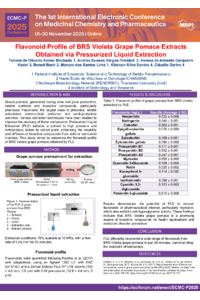
Grape pomace, generated during wine and juice production, retains nutrients and bioactive compounds, particularly phenolics. Flavonoids, the largest class of phenolics, exhibit antioxidant, antimicrobial, antitumor, and cardioprotective activities. Various extraction techniques have been studied to improve the recovery of these compounds. Pressurized Liquid Extraction (PLE) subjects a solvent to high pressure and temperature, below its critical point, enhancing the solubility and diffusion of bioactive compounds from solid or semi-solid matrices. This study aimed to determine the flavonoid profile of BRS Violeta grape pomace obtained by PLE. Pomace from juice production was dehydrated, milled (20-28 mesh), and extracted using 70% acetone at 10 MPa, a flow rate of 5 mL/min, for 30 minutes. The extracts were analyzed by HPLC-DAD for flavonoid identification and quantification. A total of 16 flavonoids were identified, with hesperidin (0.724 ± 0.006 mg/g), myricetin (0.655 ± 0.005 mg/g), naringenin (0.640 ± 0.001 mg/g), petunidin-3-glucoside (0.615 ± 0.009 mg/g), and procyanidin B2 (0.552 ± 0.001 mg/g) being the most abundant. Of nine anthocyanins analyzed, only two were detected, probably due to their extraction into the juice during processing. Results demonstrate the potential of PLE to recover flavonoids of pharmaceutical interest, particularly myricetin, which also exhibits anti-hyperglycemic activity. These findings indicate that BRS Violeta grape pomace is a promising source of bioactive compounds for health applications and metabolic disorder prevention. Despite the variety’s widespread use in juice production, its pomace phenolic composition remains poorly studied, and this work contributes to filling this knowledge gap.
Keywords
grape byproduct
phytochemical characterization
bioactive compounds
Poster
Poster IECMC.pdf
Chemical composition and biotechnological potential of lichens from desert and coastal oases in Chile
THE COMBINATION BETWEEN A STANDARDIZED EXTRACT OF BRAZILIAN RED PROPOLIS WITH PRAZIQUANTEL AGAINST Schistosoma mansoni IN VITRO