Event submissions
EventsThe 1st International Electronic Conference on Medicinal Chemistry and Pharmaceutics
Published
This submission belongs to the session S5. Natural Products and Biopharmaceuticals of the event The 1st International Electronic Conference on Medicinal Chemistry and Pharmaceutics
Published date
29 Oct, 2025
Academic Editor
'%3e%3cpath%20d='M12.6657%2010.9104C12.4185%2010.325%2012.0599%209.79327%2011.6097%209.34482C11.1609%208.89508%2010.6293%208.5365%2010.0442%208.28888C10.0389%208.28626%2010.0337%208.28495%2010.0285%208.28233C10.8446%207.69279%2011.3752%206.73249%2011.3752%205.64904C11.3752%203.8542%209.92103%202.39999%208.1262%202.39999C6.33136%202.39999%204.87715%203.8542%204.87715%205.64904C4.87715%206.73249%205.40774%207.69279%206.22393%208.28364C6.21869%208.28626%206.21345%208.28757%206.20821%208.29019C5.62129%208.5378%205.09463%208.89284%204.64265%209.34613C4.1929%209.79493%203.83432%2010.3266%203.58671%2010.9117C3.34345%2011.4845%203.21226%2012.0987%203.20023%2012.7209C3.19988%2012.7349%203.20233%2012.7488%203.20744%2012.7619C3.21255%2012.7749%203.22022%2012.7867%203.22998%2012.7968C3.23975%2012.8068%203.25142%2012.8147%203.26431%2012.8202C3.2772%2012.8256%203.29105%2012.8284%203.30504%2012.8284H4.09109C4.14874%2012.8284%204.19459%2012.7825%204.1959%2012.7262C4.2221%2011.7148%204.62823%2010.7676%205.34617%2010.0497C6.08899%209.30683%207.0755%208.89808%208.1262%208.89808C9.17689%208.89808%2010.1634%209.30683%2010.9062%2010.0497C11.6242%2010.7676%2012.0303%2011.7148%2012.0565%2012.7262C12.0578%2012.7838%2012.1037%2012.8284%2012.1613%2012.8284H12.9474C12.9613%2012.8284%2012.9752%2012.8256%2012.9881%2012.8202C13.001%2012.8147%2013.0126%2012.8068%2013.0224%2012.7968C13.0322%2012.7867%2013.0398%2012.7749%2013.0449%2012.7619C13.0501%2012.7488%2013.0525%2012.7349%2013.0522%2012.7209C13.0391%2012.0947%2012.9094%2011.4855%2012.6657%2010.9104ZM8.1262%207.9024C7.52486%207.9024%206.9589%207.6679%206.53312%207.24211C6.10733%206.81633%205.87283%206.25037%205.87283%205.64904C5.87283%205.0477%206.10733%204.48174%206.53312%204.05596C6.9589%203.63018%207.52486%203.39567%208.1262%203.39567C8.72753%203.39567%209.29349%203.63018%209.71927%204.05596C10.1451%204.48174%2010.3796%205.0477%2010.3796%205.64904C10.3796%206.25037%2010.1451%206.81633%209.71927%207.24211C9.29349%207.6679%208.72753%207.9024%208.1262%207.9024Z'%20fill='%235D1EE1'/%3e%3c/g%3e%3c/svg%3e) Antonio Vassallo
Antonio VassalloCitation
Maria Veisllari, Georgia Kythreoti, Veroniki Vidali, Cinnamaldehyde Analogues as antibacterial agents: A Study of Structure-Activity Relationship, in Proceedings of The 1st International Electronic Conference on Medicinal Chemistry and Pharmaceutics, 1 November–30 November 2025, MDPI: Basel, Switzerland
Share
Email
Facebook
Twitter
LinkedIn
Cinnamaldehyde Analogues as antibacterial agents: A Study of Structure-Activity Relationship
'%3e%3cpath%20d='M12.6647%2010.9104C12.4176%2010.325%2012.0589%209.7933%2011.6088%209.34485C11.16%208.89511%2010.6283%208.53653%2010.0432%208.28891C10.038%208.28629%2010.0327%208.28498%2010.0275%208.28236C10.8437%207.69282%2011.3743%206.73252%2011.3743%205.64907C11.3743%203.85423%209.92005%202.40002%208.12522%202.40002C6.33038%202.40002%204.87618%203.85423%204.87618%205.64907C4.87618%206.73252%205.40677%207.69282%206.22296%208.28367C6.21772%208.28629%206.21248%208.2876%206.20724%208.29022C5.62031%208.53783%205.09365%208.89287%204.64167%209.34616C4.19192%209.79496%203.83334%2010.3266%203.58573%2010.9117C3.34247%2011.4846%203.21128%2012.0987%203.19925%2012.721C3.1989%2012.735%203.20135%2012.7489%203.20646%2012.7619C3.21157%2012.7749%203.21924%2012.7868%203.22901%2012.7968C3.23877%2012.8068%203.25045%2012.8148%203.26334%2012.8202C3.27623%2012.8256%203.29007%2012.8284%203.30406%2012.8284H4.09012C4.14776%2012.8284%204.19362%2012.7825%204.19493%2012.7262C4.22113%2011.7148%204.62726%2010.7676%205.34519%2010.0497C6.08802%209.30686%207.07452%208.89811%208.12522%208.89811C9.17592%208.89811%2010.1624%209.30686%2010.9052%2010.0497C11.6232%2010.7676%2012.0293%2011.7148%2012.0555%2012.7262C12.0568%2012.7839%2012.1027%2012.8284%2012.1603%2012.8284H12.9464C12.9604%2012.8284%2012.9742%2012.8256%2012.9871%2012.8202C13%2012.8148%2013.0117%2012.8068%2013.0214%2012.7968C13.0312%2012.7868%2013.0389%2012.7749%2013.044%2012.7619C13.0491%2012.7489%2013.0515%2012.735%2013.0512%2012.721C13.0381%2012.0947%2012.9084%2011.4856%2012.6647%2010.9104ZM8.12522%207.90243C7.52388%207.90243%206.95792%207.66793%206.53214%207.24215C6.10636%206.81636%205.87185%206.2504%205.87185%205.64907C5.87185%205.04773%206.10636%204.48177%206.53214%204.05599C6.95792%203.63021%207.52388%203.3957%208.12522%203.3957C8.72655%203.3957%209.29252%203.63021%209.7183%204.05599C10.1441%204.48177%2010.3786%205.04773%2010.3786%205.64907C10.3786%206.2504%2010.1441%206.81636%209.7183%207.24215C9.29252%207.66793%208.72655%207.90243%208.12522%207.90243Z'%20fill='%235D1EE1'/%3e%3c/g%3e%3c/svg%3e)
Maria Veisllari 1
Georgia Kythreoti 1
Veroniki Vidali 2
1. Department of Science and Mathematics, The American College of Greece, 6 Gravias Street, 15342 Athens, Greece
2. Natural Products Synthesis and Bioorganic Chemistry Laboratory, Institute of Nanoscience & Nanotechnology,
National Centre of Scientific Research "Demokritos", Terma Patr. Grigoriou & Neapoleos 27, Ag. Paraskevi, 15341,
Greece
Abstract
The rise of antimicrobial resistance (AMR) to the plethora of current antibiotics constitutes a major threat to public health, urging for the discovery of novel antibiotics through natural products. This study explores the potential of ten cinnamaldehyde analogues as novel antibacterial agents against model organisms, namely Escherichia coli, Staphylococcus aureus, and Pseudomonas aeruginosa. Antibacterial activity and structure-activity relationships (SARs) were assessed using high-throughput screening (HTS) and minimum inhibitory concentration (MIC) assays, with ampicillin included as a standard control compound. Synergy was evaluated through checkerboard assays with ampicillin and neomycin. Hydroxylated cinnamaldehyde analogues, namely 1.2 and 1.3, exhibited enhanced bioactivity against Escherichia coli when compared to the parent compound (cinnamaldehyde). Most ketone derivatives resulted in minimal or reduced potency with the exception of 2.3 (MIC at 5mM with a 17.26% growth). Compounds 1.1, 1.2, 1.3 aldehydes exhibited an MIC (5 mM, 2.5 mM, 0.016 mM respectively) and adequate microbial growth inhibition (2.33-9.49%) for Staphylococcus aureus. Interestingly, ketones 2.3, 2.4 resulted in MICs at 5 mM with ~ 15% microbial growth. As for Pseudomonas aeruginosa, a similar trend of ketone inactivity was observed with none of them achieving more than 55.8% inhibition. The aldehyde group here presented better efficacy. Specifically, compounds 1.1, 1.2 with MIC = 5 mM and MIC = 2.5 mM respectively. Notably, compound 1.1 was able to achieve complete inhibition at the concentration of 5 mM. The importance of keeping the aldehyde core while strategically adding hydroxyl groups and bromine for antimicrobial efficacy was highlighted through SAR analysis. Synergistic effect trials with ampicillin and neomycin revealed mainly indifferent interactions, with cases of additive and synergistic effects related to potency alone.
Keywords
cinnamaldehyde analogues
antibacterial agents
antimicrobial resistance
structure–activity relationship
minimum inhibitory concentration
Escherichia coli
Staphylococcus aureus
Pseudomonas aeruginosa
synergy assays
Poster
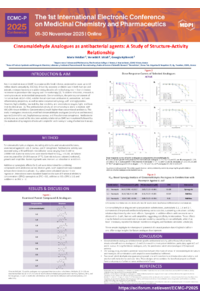
Veisllari_ECMC Poster 2025.pdf
Wild Mushrooms as Neuroprotective Reservoirs: Polyamine-Enriched Antioxidant and Anti-Acetylcholinesterase Activities
Antibacterial, antiobesity, and toxicity effects of cherry stem ethanolic extract