Event submissions
EventsThe 1st International Electronic Conference on Medicinal Chemistry and Pharmaceutics
Published
This submission belongs to the session S6. Novel and Sustainable approaches in Medicinal Chemistry of the event The 1st International Electronic Conference on Medicinal Chemistry and Pharmaceutics
Published date
29 Oct, 2025
Academic Editor
'%3e%3cpath%20d='M12.6657%2010.9104C12.4185%2010.325%2012.0599%209.79327%2011.6097%209.34482C11.1609%208.89508%2010.6293%208.5365%2010.0442%208.28888C10.0389%208.28626%2010.0337%208.28495%2010.0285%208.28233C10.8446%207.69279%2011.3752%206.73249%2011.3752%205.64904C11.3752%203.8542%209.92103%202.39999%208.1262%202.39999C6.33136%202.39999%204.87715%203.8542%204.87715%205.64904C4.87715%206.73249%205.40774%207.69279%206.22393%208.28364C6.21869%208.28626%206.21345%208.28757%206.20821%208.29019C5.62129%208.5378%205.09463%208.89284%204.64265%209.34613C4.1929%209.79493%203.83432%2010.3266%203.58671%2010.9117C3.34345%2011.4845%203.21226%2012.0987%203.20023%2012.7209C3.19988%2012.7349%203.20233%2012.7488%203.20744%2012.7619C3.21255%2012.7749%203.22022%2012.7867%203.22998%2012.7968C3.23975%2012.8068%203.25142%2012.8147%203.26431%2012.8202C3.2772%2012.8256%203.29105%2012.8284%203.30504%2012.8284H4.09109C4.14874%2012.8284%204.19459%2012.7825%204.1959%2012.7262C4.2221%2011.7148%204.62823%2010.7676%205.34617%2010.0497C6.08899%209.30683%207.0755%208.89808%208.1262%208.89808C9.17689%208.89808%2010.1634%209.30683%2010.9062%2010.0497C11.6242%2010.7676%2012.0303%2011.7148%2012.0565%2012.7262C12.0578%2012.7838%2012.1037%2012.8284%2012.1613%2012.8284H12.9474C12.9613%2012.8284%2012.9752%2012.8256%2012.9881%2012.8202C13.001%2012.8147%2013.0126%2012.8068%2013.0224%2012.7968C13.0322%2012.7867%2013.0398%2012.7749%2013.0449%2012.7619C13.0501%2012.7488%2013.0525%2012.7349%2013.0522%2012.7209C13.0391%2012.0947%2012.9094%2011.4855%2012.6657%2010.9104ZM8.1262%207.9024C7.52486%207.9024%206.9589%207.6679%206.53312%207.24211C6.10733%206.81633%205.87283%206.25037%205.87283%205.64904C5.87283%205.0477%206.10733%204.48174%206.53312%204.05596C6.9589%203.63018%207.52486%203.39567%208.1262%203.39567C8.72753%203.39567%209.29349%203.63018%209.71927%204.05596C10.1451%204.48174%2010.3796%205.0477%2010.3796%205.64904C10.3796%206.25037%2010.1451%206.81633%209.71927%207.24211C9.29349%207.6679%208.72753%207.9024%208.1262%207.9024Z'%20fill='%235D1EE1'/%3e%3c/g%3e%3c/svg%3e) Paweł Kafarski
Paweł KafarskiCitation
Dmitry Kashirskikh, Igor Sobenin, Exogenous Neuraminidase as a Tool to Model LDL Desialylation and Accelerated Atherosclerosis in ApoE-KO Mice, in Proceedings of The 1st International Electronic Conference on Medicinal Chemistry and Pharmaceutics, 1 November–30 November 2025, MDPI: Basel, Switzerland
Share
Email
Facebook
Twitter
LinkedIn
Exogenous Neuraminidase as a Tool to Model LDL Desialylation and Accelerated Atherosclerosis in ApoE-KO Mice
'%3e%3cpath%20d='M12.6647%2010.9104C12.4176%2010.325%2012.0589%209.7933%2011.6088%209.34485C11.16%208.89511%2010.6283%208.53653%2010.0432%208.28891C10.038%208.28629%2010.0327%208.28498%2010.0275%208.28236C10.8437%207.69282%2011.3743%206.73252%2011.3743%205.64907C11.3743%203.85423%209.92005%202.40002%208.12522%202.40002C6.33038%202.40002%204.87618%203.85423%204.87618%205.64907C4.87618%206.73252%205.40677%207.69282%206.22296%208.28367C6.21772%208.28629%206.21248%208.2876%206.20724%208.29022C5.62031%208.53783%205.09365%208.89287%204.64167%209.34616C4.19192%209.79496%203.83334%2010.3266%203.58573%2010.9117C3.34247%2011.4846%203.21128%2012.0987%203.19925%2012.721C3.1989%2012.735%203.20135%2012.7489%203.20646%2012.7619C3.21157%2012.7749%203.21924%2012.7868%203.22901%2012.7968C3.23877%2012.8068%203.25045%2012.8148%203.26334%2012.8202C3.27623%2012.8256%203.29007%2012.8284%203.30406%2012.8284H4.09012C4.14776%2012.8284%204.19362%2012.7825%204.19493%2012.7262C4.22113%2011.7148%204.62726%2010.7676%205.34519%2010.0497C6.08802%209.30686%207.07452%208.89811%208.12522%208.89811C9.17592%208.89811%2010.1624%209.30686%2010.9052%2010.0497C11.6232%2010.7676%2012.0293%2011.7148%2012.0555%2012.7262C12.0568%2012.7839%2012.1027%2012.8284%2012.1603%2012.8284H12.9464C12.9604%2012.8284%2012.9742%2012.8256%2012.9871%2012.8202C13%2012.8148%2013.0117%2012.8068%2013.0214%2012.7968C13.0312%2012.7868%2013.0389%2012.7749%2013.044%2012.7619C13.0491%2012.7489%2013.0515%2012.735%2013.0512%2012.721C13.0381%2012.0947%2012.9084%2011.4856%2012.6647%2010.9104ZM8.12522%207.90243C7.52388%207.90243%206.95792%207.66793%206.53214%207.24215C6.10636%206.81636%205.87185%206.2504%205.87185%205.64907C5.87185%205.04773%206.10636%204.48177%206.53214%204.05599C6.95792%203.63021%207.52388%203.3957%208.12522%203.3957C8.72655%203.3957%209.29252%203.63021%209.7183%204.05599C10.1441%204.48177%2010.3786%205.04773%2010.3786%205.64907C10.3786%206.2504%2010.1441%206.81636%209.7183%207.24215C9.29252%207.66793%208.72655%207.90243%208.12522%207.90243Z'%20fill='%235D1EE1'/%3e%3c/g%3e%3c/svg%3e)
Dmitry Kashirskikh 1
Igor Sobenin 1,2
1. Institute of General Pathology and Pathophysiology, Moscow 125315, Russia
2. Chazov National Medical Research Center of Cardiology, Ministry of Health of the Russian Federation, Moscow 121552, Russia
Abstract
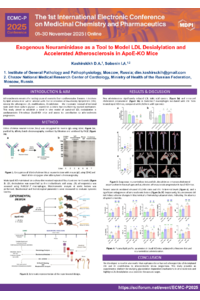
Introduction: Atherosclerosis remains the leading cause of mortality from cardiovascular diseases. It is driven by lipid accumulation within arterial walls due to retention of low-density lipoproteins (LDL). Among the atherogenic LDL modifications, desialylation — the enzymatic removal of terminal sialic acids from surface glycans — represents a critical but insufficiently studied mechanism. This study aimed to establish a novel in vivo model of sustained LDL desialylation in apolipoprotein E-knockout (ApoE-KO) mice and assess its contribution to atherosclerosis progression.
Methods: Vibrio cholerae neuraminidase (Neu) was conjugated to murine IgG using EDAC, purified by affinity batch chromatography, sterilized by filtration and validated by PAGE. Male ApoE-KO maintained on a chow diet received repeated Neu injections for 6 weeks. LDL desialylation was quantified by the thiobarbituric acid assay. LDL atherogenicity was assessed using RAW264.7 macrophages. Morphometric analysis of aortic lesions was performed. Biochemical and hematological parameters were measured to evaluate systemic toxicity.
Results: Neu administration significantly reduced LDL sialic acid content and enhanced cholesterol accumulation in RAW264.7 macrophages incubated with LDL from treated ApoE-KO mice, compared with LDL from wild-type mice. Treated animals exhibited elevated LDL/HDL ratio and LDL cholesterol levels, and a significant enlargement of atherosclerotic lesions. Importantly, Neu treatment did not induce adverse changes in biochemical or hematological parameters, indicating the absence of systemic toxicity.
Conclusions: We developed a novel in vivo model that replicates the enhanced atherogenicity of desialylated LDL and its contribution to atherosclerotic lesion progression. This study provides an experimental platform for studying glycosylation-dependent mechanisms in atherosclerosis and highlight LDL desialylation as a potential therapeutic target.
Keywords
Atherosclerosis
neuraminidase
desialylation
modified LDL
Poster
Exogenous Neuraminidase as a Tool to Model LDL Desialylation and Accelerated Atherosclerosis in ApoE-KO Mice.pdf
Comparative Study of the Antioxidant and Antidiabetic Activities of the Methanol and Hexane Oil Extract of Bitter Melon (Momordica charantia)
Thermodynamic Framework for Quantifying Drug Precipitation and Solubility in Cyclodextrin-Based Systems